

5.10 Wind Wave Generation in a Current
237
.4.
z=O
Wave
L
L
/.
/
/_
I
I
/_
I
I
I
V(z)
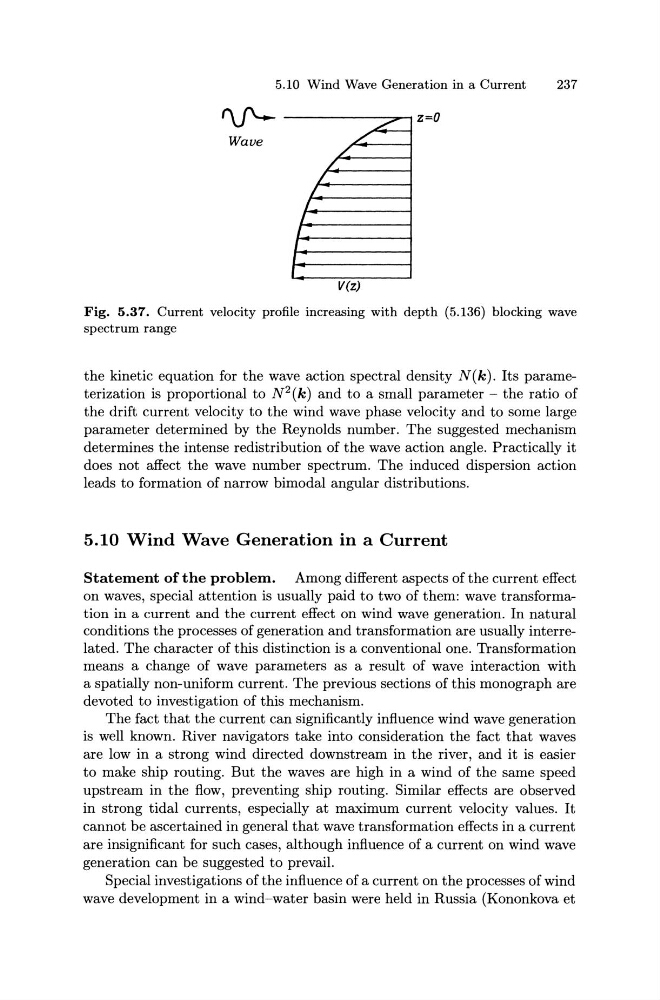
Fig. 5.37. Current velocity profile increasing with depth (5.136) blocking wave
spectrum range
the kinetic equation for the wave action spectral density N(k). Its parameterization is proportional to N 2 (k) and to a small parameter- the ratio of
the drift current velocity to the wind wave phase velocity and to some large
parameter determined by the Reynolds number. The suggested mechanism
determines the intense redistribution of the wave action angle. Practically it
does not affect the wave number spectrum. The induced dispersion action
leads to formation of narrow bimodal angular distributions.
5.10 Wind Wave Generation in a Current
Statement of the problem. Among different aspects of the current effect
on waves, special attention is usually paid to two of them: wave transformation in a current and the current effect on wind wave generation. In natural
conditions the processes of generation and transformation are usually interrelated. The character of this distinction is a conventional one. Transformation
means a change of wave parameters as a result of wave interaction with
a spatially non-uniform current. The previous sections of this monograph are
devoted to investigation of this mechanism.
The fact that the current can significantly influence wind wave generation
is well known. River navigators take into consideration the fact that waves
are low in a strong wind directed downstream in the river, and it is easier
to make ship routing. But the waves are high in a wind of the same speed
upstream in the flow, preventing ship routing. Similar effects are observed
in strong tidal currents, especially at maximum current velocity values. It
cannot be ascertained in general that wave transformation effects in a current
are insignificant for such cases, although influence of a current on wind wave
generation can be suggested to prevail.
Special investigations of the influence of a current on the processes of wind
wave development in a wind-water basin were held in Russia (Kononkova et
237
.4.
z=O
Wave
L
L
/.
/
/_
I
I
/_
I
I
I
V(z)
Fig. 5.37. Current velocity profile increasing with depth (5.136) blocking wave
spectrum range
the kinetic equation for the wave action spectral density N(k). Its parameterization is proportional to N 2 (k) and to a small parameter- the ratio of
the drift current velocity to the wind wave phase velocity and to some large
parameter determined by the Reynolds number. The suggested mechanism
determines the intense redistribution of the wave action angle. Practically it
does not affect the wave number spectrum. The induced dispersion action
leads to formation of narrow bimodal angular distributions.
5.10 Wind Wave Generation in a Current
Statement of the problem. Among different aspects of the current effect
on waves, special attention is usually paid to two of them: wave transformation in a current and the current effect on wind wave generation. In natural
conditions the processes of generation and transformation are usually interrelated. The character of this distinction is a conventional one. Transformation
means a change of wave parameters as a result of wave interaction with
a spatially non-uniform current. The previous sections of this monograph are
devoted to investigation of this mechanism.
The fact that the current can significantly influence wind wave generation
is well known. River navigators take into consideration the fact that waves
are low in a strong wind directed downstream in the river, and it is easier
to make ship routing. But the waves are high in a wind of the same speed
upstream in the flow, preventing ship routing. Similar effects are observed
in strong tidal currents, especially at maximum current velocity values. It
cannot be ascertained in general that wave transformation effects in a current
are insignificant for such cases, although influence of a current on wind wave
generation can be suggested to prevail.
Special investigations of the influence of a current on the processes of wind
wave development in a wind-water basin were held in Russia (Kononkova et