

5.9 Vertical Non-Uniform Current Effect
235
too large wave heights. As shown in Sect. 5.5, the singularity arising in the
classical solution for waves propagating in the increasing countercurrent is
eliminated around the caustic and the calculation results are in sufficiently
good agreement with full-scale observations. At the same time the vertical
non-uniformity of the flow seems to change significantly the solution.
As an example, the wave propagation in a countercurrent with its increasing value dependent not only on the horizontal coordinate x, but also on the
vertical z coordinate: V = {-V(x, z), 0} will be considered. The wave packet
is prevented from arriving at the point where the wave group velocity is equal
to the current speed and opposite to its direction. In this case wave blocking
takes place. The waves start propagating in the reverse direction. The current
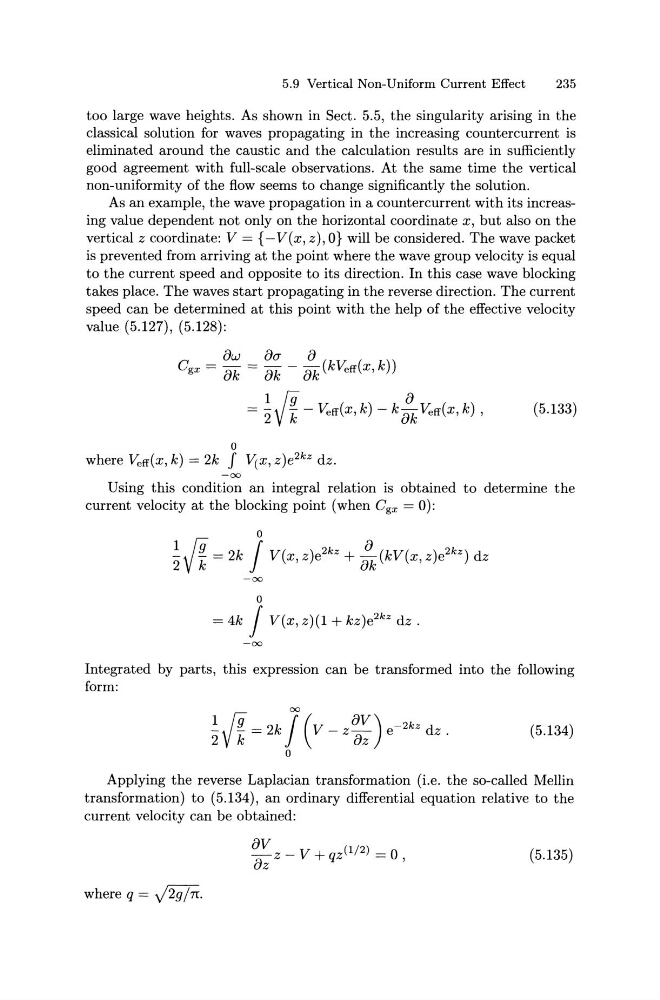
speed can be determined at this point with the help of the effective velocity
value (5.127), (5.128):
aw
aa
a
Cgx = ak = ak - ak (kV.,ff(X, k))
1 (9
a
= "2V k- V.,ff(x, k)- k ak V.,ff(x, k),
(5.133)
0
where V.,ff(x, k) = 2k J V(x, z)e 2 kz dz.
-oo
Using this condition an integral relation is obtained to determine the
current velocity at the blocking point (when Cgx = 0):
0
~~ = 2k J V(x, z)e 2 kz +! (kV(x, z)e 2 kz) dz
-oo
0
= 4k J V(x, z)(l + kz)e 2 kz dz .
-oo
Integrated by parts, this expression can be transformed into the following
form:
(5.134)
Applying the reverse Laplacian transformation (i.e. the so-called Mellin
transformation) to (5.134), an ordinary differential equation relative to the
current velocity can be obtained:
av az z - v + qz(ll 2 ) = 0 '
(5.135)
where q = vfiiTir.
235
too large wave heights. As shown in Sect. 5.5, the singularity arising in the
classical solution for waves propagating in the increasing countercurrent is
eliminated around the caustic and the calculation results are in sufficiently
good agreement with full-scale observations. At the same time the vertical
non-uniformity of the flow seems to change significantly the solution.
As an example, the wave propagation in a countercurrent with its increasing value dependent not only on the horizontal coordinate x, but also on the
vertical z coordinate: V = {-V(x, z), 0} will be considered. The wave packet
is prevented from arriving at the point where the wave group velocity is equal
to the current speed and opposite to its direction. In this case wave blocking
takes place. The waves start propagating in the reverse direction. The current
speed can be determined at this point with the help of the effective velocity
value (5.127), (5.128):
aw
aa
a
Cgx = ak = ak - ak (kV.,ff(X, k))
1 (9
a
= "2V k- V.,ff(x, k)- k ak V.,ff(x, k),
(5.133)
0
where V.,ff(x, k) = 2k J V(x, z)e 2 kz dz.
-oo
Using this condition an integral relation is obtained to determine the
current velocity at the blocking point (when Cgx = 0):
0
~~ = 2k J V(x, z)e 2 kz +! (kV(x, z)e 2 kz) dz
-oo
0
= 4k J V(x, z)(l + kz)e 2 kz dz .
-oo
Integrated by parts, this expression can be transformed into the following
form:
(5.134)
Applying the reverse Laplacian transformation (i.e. the so-called Mellin
transformation) to (5.134), an ordinary differential equation relative to the
current velocity can be obtained:
av az z - v + qz(ll 2 ) = 0 '
(5.135)
where q = vfiiTir.