

5.9 Vertical Non-Uniform Current Effect
227
z=
z
Vs
0
I
I
I
_/
_/
J
I
I
J
I
I
_/
I
VB
j_
/
z=-H
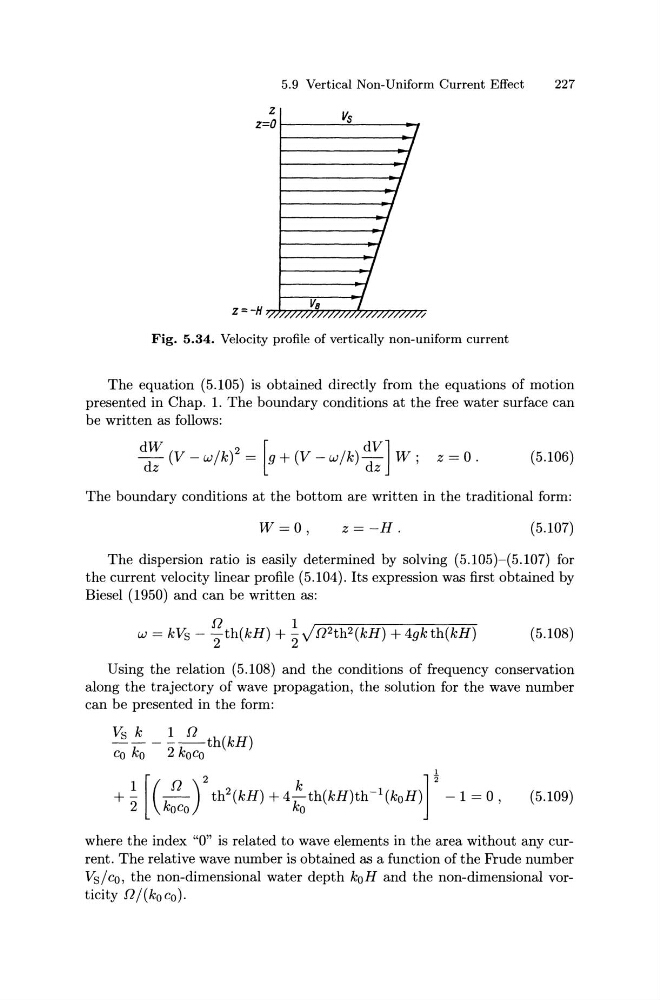
Fig. 5.34. Velocity profile of vertically non-uniform current
The equation (5.105) is obtained directly from the equations of motion
presented in Chap. 1. The boundary conditions at the free water surface can
be written as follows:
dW
2
[
dV]
dz (V- wjk) = g + (V- wjk)d;"" W; z = 0 0
(5.106)
The boundary conditions at the bottom are written in the traditional form:
W=O,
z=-H.
(5.107)
The dispersion ratio is easily determined by solving (5.105)-(5.107) for
the current velocity linear profile (5.104). Its expression was first obtained by
Biesel (1950) and can be written as:
n
1
w = kVs- 2 th(kH) + 2 Jn 2 th 2 (kH) + 4gkth(kH)
(5.108)
Using the relation (5.108) and the conditions of frequency conservation
along the trajectory of wave propagation, the solution for the wave number
can be presented in the form:
Vs k
1 n
- - - --th(kH)
eo ko 2 koeo
1 [( n )
2
k
] !
+ 2 koco th 2 (kH) + 4 ko th(kH)th- 1 (koH) - 1 = 0, (5.109)
where the index "0" is related to wave elements in the area without any current. The relative wave number is obtained as a function of the Frude number
Vs/Co, the non-dimensional water depth k0 H and the non-dimensional vorticity fl/(koeo).
227
z=
z
Vs
0
I
I
I
_/
_/
J
I
I
J
I
I
_/
I
VB
j_
/
z=-H
Fig. 5.34. Velocity profile of vertically non-uniform current
The equation (5.105) is obtained directly from the equations of motion
presented in Chap. 1. The boundary conditions at the free water surface can
be written as follows:
dW
2
[
dV]
dz (V- wjk) = g + (V- wjk)d;"" W; z = 0 0
(5.106)
The boundary conditions at the bottom are written in the traditional form:
W=O,
z=-H.
(5.107)
The dispersion ratio is easily determined by solving (5.105)-(5.107) for
the current velocity linear profile (5.104). Its expression was first obtained by
Biesel (1950) and can be written as:
n
1
w = kVs- 2 th(kH) + 2 Jn 2 th 2 (kH) + 4gkth(kH)
(5.108)
Using the relation (5.108) and the conditions of frequency conservation
along the trajectory of wave propagation, the solution for the wave number
can be presented in the form:
Vs k
1 n
- - - --th(kH)
eo ko 2 koeo
1 [( n )
2
k
] !
+ 2 koco th 2 (kH) + 4 ko th(kH)th- 1 (koH) - 1 = 0, (5.109)
where the index "0" is related to wave elements in the area without any current. The relative wave number is obtained as a function of the Frude number
Vs/Co, the non-dimensional water depth k0 H and the non-dimensional vorticity fl/(koeo).