

5.6 Wave Diffraction Around a Caustic
193
metrical optics approximation. Actually, the field is different from zero there
and arises from diffraction. The field exponentially decreases in the shadow
zone with distance from the caustics in most ordinary cases. A complex generalization of geometrical optics (Voganov & Kantsenbaum, 1982; Kravtsov
& Orlov, 1980) or other methods (Kravtsov, 1968; Ludwig, 1966) can be used
for calculation of the field.
As mentioned above, the wave amplitude in the geometrical optics approximation becomes infinite due to ray convergence in the vicinity of the caustic.
However, the Helmholts equation (5.45) and some other basic equations of
wave theory do not permit infinite field values. That is why the amplitude
singularity in the caustics indicates an inapplicability of the geometrical solution in the caustics themselves and in the area around them. Nevertheless,
reasonable estimates of the field in caustics can also be obtained by using
geometrical optics, when the area of the inapplicability of geometrical optics
is identified in advance and the notions of conservation of wave action density flow are applied. This approach, proposed by Kravtsov & Orlov (1980)
and in Non-linear Waves (1981), is used for the case with energy flow being
preserved. The action density rather than the energy is preserved for waves
in a non-uniform current. This approach also permits generalizations for the
wave action conservation case.
The width of the ray tube formed by two rays at some distance from the
caustic is assumed to be equal to Al(O) (see Fig. 5.17). This value is equal to
Al* near the caustic. It is the length of the perpendicular reconstructed from
the point of the first caustic ray contacting the second ray. The value Al* is
equal to the caustic zone width. Let the values a< 0 ), C~o), a< 0 ) be the amplitude, group velocity and frequency at a distance from the caustic respectively,
and let a*, c;, a* be the values near it. Assuming that the amplitude a is
changed insignificantly in the caustic zone, the conservation of the action
density flow can be written as:
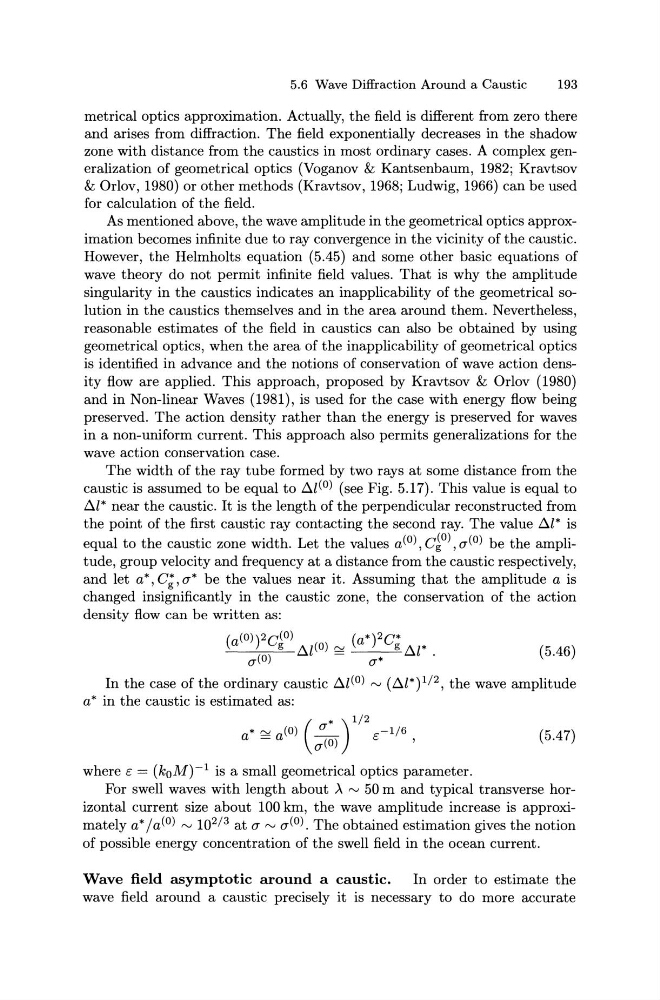
( a(0))2c(O)
(a*)2C*
...:...._---'c:=---"-g-Al(O) ~
gAl*
a< 0 )
a*
(5.46)
In the case of the ordinary caustic Al(o) "' (Al*) 1 1 2 , the wave amplitude
a* in the caustic is estimated as:
a* !::>! a
(
* ) 1/2
-
a(D)
'
(5.47)
where c = (k0M)- 1 is a small geometrical optics parameter.
For swell waves with length about >. "' 50 m and typical transverse horizontal current size about 100 km, the wave amplitude increase is approximately a*/ a< 0 ) "' 10 2 1 3 at a "' a< 0 ). The obtained estimation gives the notion
of possible energy concentration of the swell field in the ocean current.
Wave field asymptotic around a caustic.
In order to estimate the
wave field around a caustic precisely it is necessary to do more accurate
193
metrical optics approximation. Actually, the field is different from zero there
and arises from diffraction. The field exponentially decreases in the shadow
zone with distance from the caustics in most ordinary cases. A complex generalization of geometrical optics (Voganov & Kantsenbaum, 1982; Kravtsov
& Orlov, 1980) or other methods (Kravtsov, 1968; Ludwig, 1966) can be used
for calculation of the field.
As mentioned above, the wave amplitude in the geometrical optics approximation becomes infinite due to ray convergence in the vicinity of the caustic.
However, the Helmholts equation (5.45) and some other basic equations of
wave theory do not permit infinite field values. That is why the amplitude
singularity in the caustics indicates an inapplicability of the geometrical solution in the caustics themselves and in the area around them. Nevertheless,
reasonable estimates of the field in caustics can also be obtained by using
geometrical optics, when the area of the inapplicability of geometrical optics
is identified in advance and the notions of conservation of wave action density flow are applied. This approach, proposed by Kravtsov & Orlov (1980)
and in Non-linear Waves (1981), is used for the case with energy flow being
preserved. The action density rather than the energy is preserved for waves
in a non-uniform current. This approach also permits generalizations for the
wave action conservation case.
The width of the ray tube formed by two rays at some distance from the
caustic is assumed to be equal to Al(O) (see Fig. 5.17). This value is equal to
Al* near the caustic. It is the length of the perpendicular reconstructed from
the point of the first caustic ray contacting the second ray. The value Al* is
equal to the caustic zone width. Let the values a< 0 ), C~o), a< 0 ) be the amplitude, group velocity and frequency at a distance from the caustic respectively,
and let a*, c;, a* be the values near it. Assuming that the amplitude a is
changed insignificantly in the caustic zone, the conservation of the action
density flow can be written as:
( a(0))2c(O)
(a*)2C*
...:...._---'c:=---"-g-Al(O) ~
gAl*
a< 0 )
a*
(5.46)
In the case of the ordinary caustic Al(o) "' (Al*) 1 1 2 , the wave amplitude
a* in the caustic is estimated as:
a* !::>! a
(
* ) 1/2
-
a(D)
'
(5.47)
where c = (k0M)- 1 is a small geometrical optics parameter.
For swell waves with length about >. "' 50 m and typical transverse horizontal current size about 100 km, the wave amplitude increase is approximately a*/ a< 0 ) "' 10 2 1 3 at a "' a< 0 ). The obtained estimation gives the notion
of possible energy concentration of the swell field in the ocean current.
Wave field asymptotic around a caustic.
In order to estimate the
wave field around a caustic precisely it is necessary to do more accurate