

5.6 Wave Diffraction Around a Caustic
191
is in agreement with the solution for the monochromatic wave (5.37) at the
blocking point.
There exists a viewpoint (Phillips, 1980) that a monochromatic wave is
broken earlier before reaching the blocking point. However, this does not seem
to be quite correct. It depends on the steepness whether the wave is broken
or not. The steepness may be not so large for breaking before or during the
blocking. As is shown, reverse waves can also be broken, in the case of their
rolling downstream to the point with a sufficiently small current velocity. On
the one hand, large wave amplitudes and steepness require implementation of
a non-linear theory. On the other hand, it is necessary to apply more accurate
estimation methods even for a small wave steepness around the turning point
(or the wave blocking point), since the unreasonably large values for such
waves are also given with the help of the monochromatic wave solution (5.37).
These methods, describing the wave field, are based on the assumption
of locally plane waves. However, this assumption is not always true. There
are some situations in which changes to the small wave field, compared with
the wavelength, are accumulated. This can result in a significant difference
of the wave field on some segment from the local flat field. Such wave field
changes take place near the caustic. The caustic is the boundary between
the area with a complex wave pattern as a result of the interference of two
wave groups and the neighbouring area without any waves. The caustics are
certain local peculiarities of many different wave configurations in a fluid.
Definite attention is also paid in the scientific literature to wave fields of
a different nature in the caustic areas. The classification of different types
of caustics is given, for example, in the monograph by Kravtsov & Orlov
(1980) with a large reference list or in the well-known monograph by Arnold
The Theory of Catastrophes (1989). As for papers dealing with gravity waves
in water, the publications of Dobrokhotov and Zhevandrov (1988a,b) should
be pointed out. They are devoted to the use of asymptotic expansions and
the Maslov canonical operator. However, no proper attention is paid to the
problem of wave fields in a non-uniform current.
Following the historical succession of studying the problem of waves in
the caustic area, the Helmholtz equation describing light propagation should
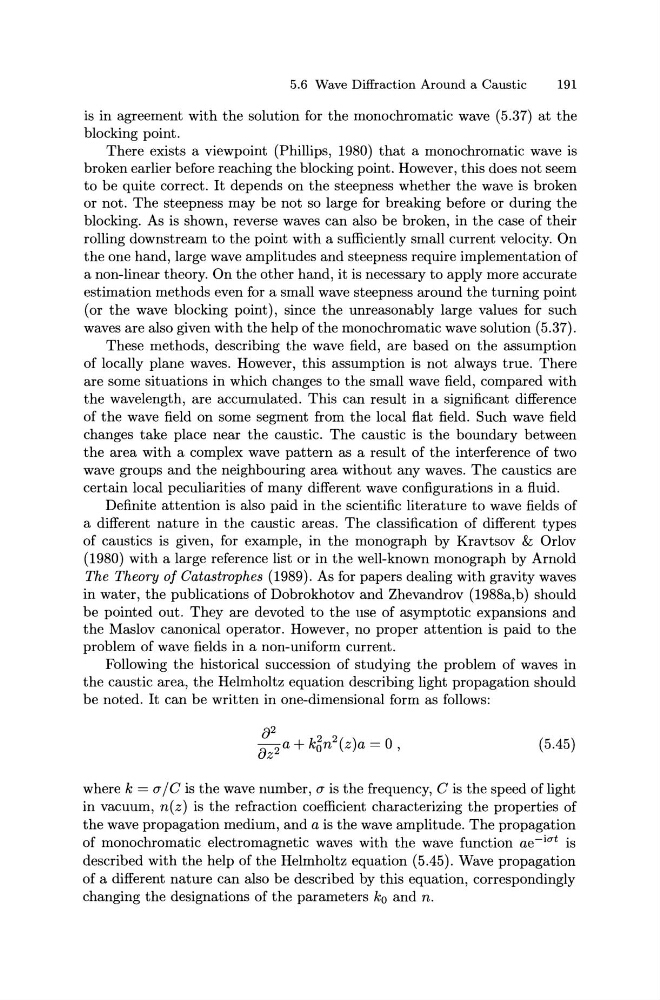
be noted. It can be written in one-dimensional form as follows:
(5.45)
where k = a/Cis the wave number, a is the frequency, Cis the speed of light
in vacuum, n(z) is the refraction coefficient characterizing the properties of
the wave propagation medium, and a is the wave amplitude. The propagation
of monochromatic electromagnetic waves with the wave function ae-iut is
described with the help of the Helmholtz equation (5.45). Wave propagation
of a different nature can also be described by this equation, correspondingly
changing the designations of the parameters k0 and n.
191
is in agreement with the solution for the monochromatic wave (5.37) at the
blocking point.
There exists a viewpoint (Phillips, 1980) that a monochromatic wave is
broken earlier before reaching the blocking point. However, this does not seem
to be quite correct. It depends on the steepness whether the wave is broken
or not. The steepness may be not so large for breaking before or during the
blocking. As is shown, reverse waves can also be broken, in the case of their
rolling downstream to the point with a sufficiently small current velocity. On
the one hand, large wave amplitudes and steepness require implementation of
a non-linear theory. On the other hand, it is necessary to apply more accurate
estimation methods even for a small wave steepness around the turning point
(or the wave blocking point), since the unreasonably large values for such
waves are also given with the help of the monochromatic wave solution (5.37).
These methods, describing the wave field, are based on the assumption
of locally plane waves. However, this assumption is not always true. There
are some situations in which changes to the small wave field, compared with
the wavelength, are accumulated. This can result in a significant difference
of the wave field on some segment from the local flat field. Such wave field
changes take place near the caustic. The caustic is the boundary between
the area with a complex wave pattern as a result of the interference of two
wave groups and the neighbouring area without any waves. The caustics are
certain local peculiarities of many different wave configurations in a fluid.
Definite attention is also paid in the scientific literature to wave fields of
a different nature in the caustic areas. The classification of different types
of caustics is given, for example, in the monograph by Kravtsov & Orlov
(1980) with a large reference list or in the well-known monograph by Arnold
The Theory of Catastrophes (1989). As for papers dealing with gravity waves
in water, the publications of Dobrokhotov and Zhevandrov (1988a,b) should
be pointed out. They are devoted to the use of asymptotic expansions and
the Maslov canonical operator. However, no proper attention is paid to the
problem of wave fields in a non-uniform current.
Following the historical succession of studying the problem of waves in
the caustic area, the Helmholtz equation describing light propagation should
be noted. It can be written in one-dimensional form as follows:
(5.45)
where k = a/Cis the wave number, a is the frequency, Cis the speed of light
in vacuum, n(z) is the refraction coefficient characterizing the properties of
the wave propagation medium, and a is the wave amplitude. The propagation
of monochromatic electromagnetic waves with the wave function ae-iut is
described with the help of the Helmholtz equation (5.45). Wave propagation
of a different nature can also be described by this equation, correspondingly
changing the designations of the parameters k0 and n.