

188
5 Wave Evolution in Non-uniform Currents in Deep Water
At first the wavelength is decreased to some value with increasing current
velocity. Thus, the minimum value of the relative wavelength )t./ )..0 is equal
to 0.42 for n = 5. This is achieved at the point v = 0.12, and it is increased
monotonically after that. It should be remembered that for a monochromatic
wave (see Fig. 5.14), only the wavelength decrease takes place in a countercurrent. The monotonic increase obtained in our calculations is due to the
spectral wave character. A specific filtration takes place in a countercurrent,
resulting in elimination of short waves and penetration of only long waves to
the larger current velocity areas.
As for the wave period, its value is slightly decreased at small v and then
begins to increase. Thus, the period is estimated as T /ro = 1.8 for n = 5, at
v = 0.35. At the same time it should be remembered that the period is not
changed for monochromatic waves.
Hence, the transformation of mean wave elements in a current is principally changed by the spectral wave structure. With the spectrum being
narrowed, i.e. the parameter n being increased, the change of mean wave
elements is more similar to the classic solution for monochromatic waves
(5.37) and (5.38). For natural waves, characterized by values of the parameter n = 4-8, the change of mean wave elements is principally different from
monochromatic wave elements.
The wave height is smoothly decreased in the fair current ( v < 0),
while the period remains constant and the wavelength is increased. There is
a smaller influence of the fair current on the change of mean wave elements,
compared to the countercurrent. In this case the spectral wave structure is
not so important as in a countercurrent.
The full-scale observational data obtained by the Scripps Institute of
Oceanography (USA), as well as by Zhevnovatiy (1971) in 1968-1969 in the
White Sea onboard ships of the USSR Hydrometeorological Service are shown
in Fig. 5.15. While comparing the observations and calculation results, the
value of the parameter v is expressed through the initial mean wave elements
and the current velocity (5.41):
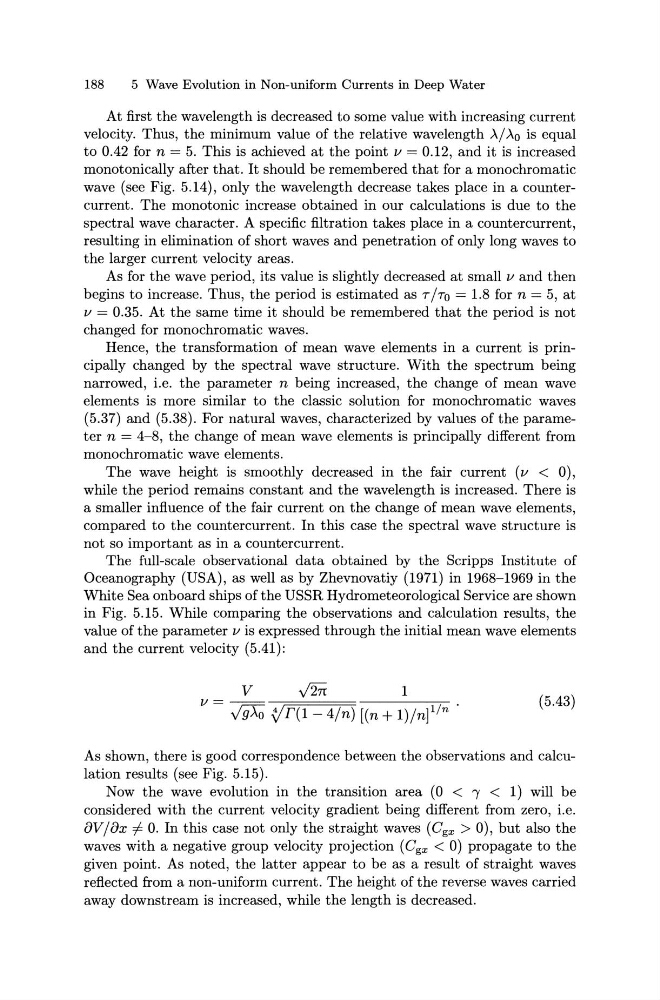
v
v%t
1
v = -.;gy:Q-g A-o ---=-y;r=r:7:( 1=-=4::=;/ n==<=) [ ( n + 1) / n ]1 In
(5.43)
As shown, there is good correspondence between the observations and calculation results (see Fig. 5.15).
Now the wave evolution in the transition area (0 < 'Y < 1) will be
considered with the current velocity gradient being different from zero, i.e.
8V/8x =f 0. In this case not only the straight waves (Cgx > 0), but also the
waves with a negative group velocity projection (Cgx < 0) propagate to the
given point. As noted, the latter appear to be as a result of straight waves
reflected from a non-uniform current. The height of the reverse waves carried
away downstream is increased, while the length is decreased.
5 Wave Evolution in Non-uniform Currents in Deep Water
At first the wavelength is decreased to some value with increasing current
velocity. Thus, the minimum value of the relative wavelength )t./ )..0 is equal
to 0.42 for n = 5. This is achieved at the point v = 0.12, and it is increased
monotonically after that. It should be remembered that for a monochromatic
wave (see Fig. 5.14), only the wavelength decrease takes place in a countercurrent. The monotonic increase obtained in our calculations is due to the
spectral wave character. A specific filtration takes place in a countercurrent,
resulting in elimination of short waves and penetration of only long waves to
the larger current velocity areas.
As for the wave period, its value is slightly decreased at small v and then
begins to increase. Thus, the period is estimated as T /ro = 1.8 for n = 5, at
v = 0.35. At the same time it should be remembered that the period is not
changed for monochromatic waves.
Hence, the transformation of mean wave elements in a current is principally changed by the spectral wave structure. With the spectrum being
narrowed, i.e. the parameter n being increased, the change of mean wave
elements is more similar to the classic solution for monochromatic waves
(5.37) and (5.38). For natural waves, characterized by values of the parameter n = 4-8, the change of mean wave elements is principally different from
monochromatic wave elements.
The wave height is smoothly decreased in the fair current ( v < 0),
while the period remains constant and the wavelength is increased. There is
a smaller influence of the fair current on the change of mean wave elements,
compared to the countercurrent. In this case the spectral wave structure is
not so important as in a countercurrent.
The full-scale observational data obtained by the Scripps Institute of
Oceanography (USA), as well as by Zhevnovatiy (1971) in 1968-1969 in the
White Sea onboard ships of the USSR Hydrometeorological Service are shown
in Fig. 5.15. While comparing the observations and calculation results, the
value of the parameter v is expressed through the initial mean wave elements
and the current velocity (5.41):
v
v%t
1
v = -.;gy:Q-g A-o ---=-y;r=r:7:( 1=-=4::=;/ n==<=) [ ( n + 1) / n ]1 In
(5.43)
As shown, there is good correspondence between the observations and calculation results (see Fig. 5.15).
Now the wave evolution in the transition area (0 < 'Y < 1) will be
considered with the current velocity gradient being different from zero, i.e.
8V/8x =f 0. In this case not only the straight waves (Cgx > 0), but also the
waves with a negative group velocity projection (Cgx < 0) propagate to the
given point. As noted, the latter appear to be as a result of straight waves
reflected from a non-uniform current. The height of the reverse waves carried
away downstream is increased, while the length is decreased.