

186
5 Wave Evolution in Non-uniform Currents in Deep Water
and increases monotonically in the same direction up to some maximum
value Vmax· It follows from (5.2) that the frequency w and the wave vector
component kx are preserved along the ray. According to Sect. 5.4, the solution
of the spectral energy density S, depending on the frequency 0' and the angle
{3 = arctan(ky/kx), can be found in the form (5.32).
The mean statistical elements of waves, depending on the current velocity V, can be easily obtained with the help of the solution (5.32). In particular,
it is sufficient to integrate the spectral value S(k,{3) within the corresponding
range of the argument variations to estimate the statistical moments mpq:
00 7[
mpq = j j S(k,{3)kP+q cosP(f3) dk d{3.
(5.39)
0 -7[
In order to integrate (5.39), the spectrum F(fj, {3) = 8(0', {3, V) (dO' j dfj)
will be used. This is a function of the non-dimensional variable fj and it
depends on the parameters v, /, n.
The change of mean wave components in a current will be estimated in the
absence of reverse waves, using the spectrum (5.32). Such a situation is observed, firstly, in a fair current and, secondly, in a countercurrent, within the
area, where the current velocity is no longer changed (I= 1) (see Fig. 5.9a).
The evolution of the wave parameter in the countercurrent transitional segment (0 < 1 < 1) is to be considered after that.
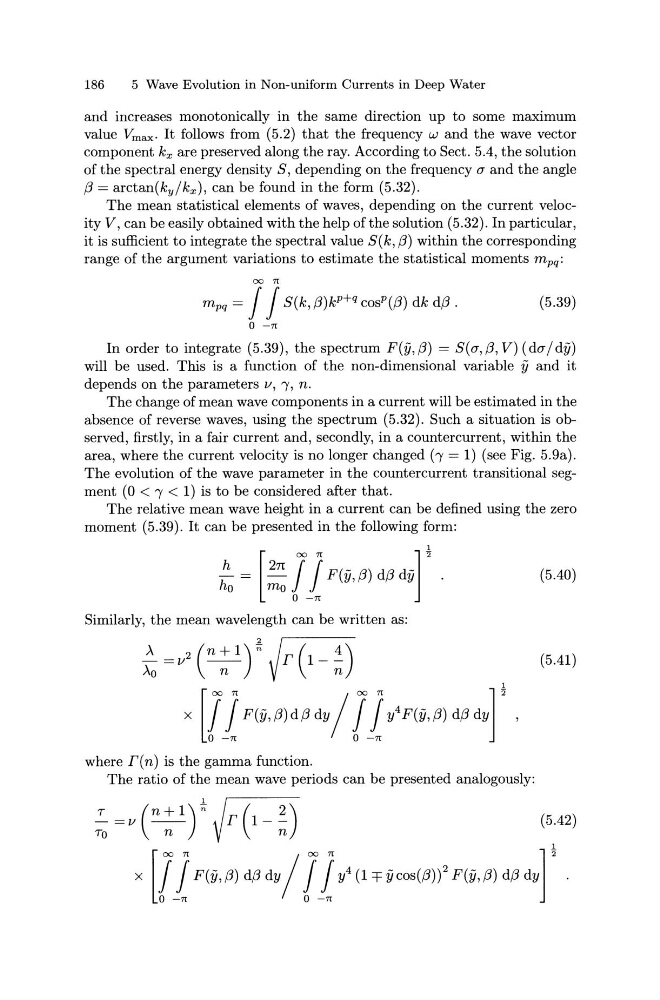
The relative mean wave height in a current can be defined using the zero
moment (5.39). It can be presented in the following form:
1
~ ~ [ ~: 11
F(Y, fJ) dfl dy r (5.40)
Similarly, the mean wavelength can be written as:
(5.41)
1
X [ll F(Y,fJ)dfldy Ill y 4 F(Y,fJ) dfldyl' ,
where r(n) is the gamma function.
The ratio of the mean wave periods can be presented analogously:
(5.42)
1
X [ll F(Y, fl) dfl dy Ill Y
4
(1 'f ijco,(fl))' F(Y, fl) dfl dy r .
5 Wave Evolution in Non-uniform Currents in Deep Water
and increases monotonically in the same direction up to some maximum
value Vmax· It follows from (5.2) that the frequency w and the wave vector
component kx are preserved along the ray. According to Sect. 5.4, the solution
of the spectral energy density S, depending on the frequency 0' and the angle
{3 = arctan(ky/kx), can be found in the form (5.32).
The mean statistical elements of waves, depending on the current velocity V, can be easily obtained with the help of the solution (5.32). In particular,
it is sufficient to integrate the spectral value S(k,{3) within the corresponding
range of the argument variations to estimate the statistical moments mpq:
00 7[
mpq = j j S(k,{3)kP+q cosP(f3) dk d{3.
(5.39)
0 -7[
In order to integrate (5.39), the spectrum F(fj, {3) = 8(0', {3, V) (dO' j dfj)
will be used. This is a function of the non-dimensional variable fj and it
depends on the parameters v, /, n.
The change of mean wave components in a current will be estimated in the
absence of reverse waves, using the spectrum (5.32). Such a situation is observed, firstly, in a fair current and, secondly, in a countercurrent, within the
area, where the current velocity is no longer changed (I= 1) (see Fig. 5.9a).
The evolution of the wave parameter in the countercurrent transitional segment (0 < 1 < 1) is to be considered after that.
The relative mean wave height in a current can be defined using the zero
moment (5.39). It can be presented in the following form:
1
~ ~ [ ~: 11
F(Y, fJ) dfl dy r (5.40)
Similarly, the mean wavelength can be written as:
(5.41)
1
X [ll F(Y,fJ)dfldy Ill y 4 F(Y,fJ) dfldyl' ,
where r(n) is the gamma function.
The ratio of the mean wave periods can be presented analogously:
(5.42)
1
X [ll F(Y, fl) dfl dy Ill Y
4
(1 'f ijco,(fl))' F(Y, fl) dfl dy r .