

5.4 Estimation of Non-Linear Wave Interaction in the Rip Spectrum
175
Sr
to'
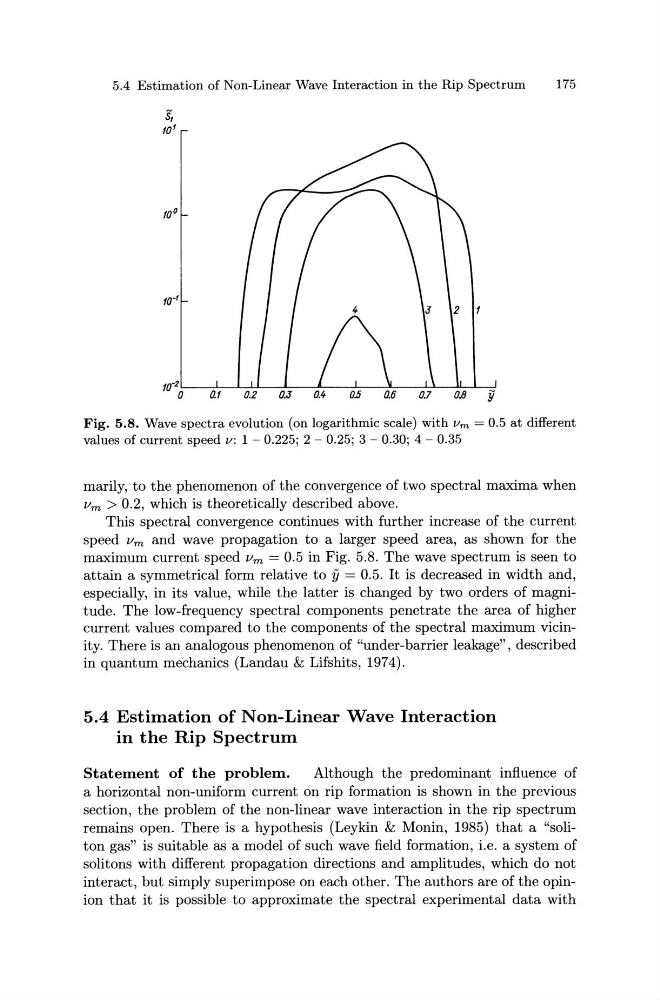
Fig. 5.8. Wave spectra evolution (on logarithmic scale) with Vm = 0.5 at different
values of current speed v: 1 - 0.225; 2 - 0.25; 3 - 0.30; 4 - 0.35
marily, to the phenomenon of the convergence of two spectral maxima when
Vm > 0.2, which is theoretically described above.
This spectral convergence continues with further increase of the current
speed Vm and wave propagation to a larger speed area, as shown for the
maximum current speed Vm = 0.5 in Fig. 5.8. The wave spectrum is seen to
attain a symmetrical form relative to f) = 0.5. It is decreased in width and,
especially, in its value, while the latter is changed by two orders of magnitude. The low-frequency spectral components penetrate the area of higher
current values compared to the components of the spectral maximum vicinity. There is an analogous phenomenon of "under-barrier leakage", described
in quantum mechanics (Landau & Lifshits, 1974).
5.4 Estimation of Non-Linear Wave Interaction
in the Rip Spectrum
Statement of the problem.
Although the predominant influence of
a horizontal non-uniform current on rip formation is shown in the previous
section, the problem of the non-linear wave interaction in the rip spectrum
remains open. There is a hypothesis (Leykin & Monin, 1985) that a "soliton gas" is suitable as a model of such wave field formation, i.e. a system of
solitons with different propagation directions and amplitudes, which do not
interact, but simply superimpose on each other. The authors are of the opinion that it is possible to approximate the spectral experimental data with
175
Sr
to'
Fig. 5.8. Wave spectra evolution (on logarithmic scale) with Vm = 0.5 at different
values of current speed v: 1 - 0.225; 2 - 0.25; 3 - 0.30; 4 - 0.35
marily, to the phenomenon of the convergence of two spectral maxima when
Vm > 0.2, which is theoretically described above.
This spectral convergence continues with further increase of the current
speed Vm and wave propagation to a larger speed area, as shown for the
maximum current speed Vm = 0.5 in Fig. 5.8. The wave spectrum is seen to
attain a symmetrical form relative to f) = 0.5. It is decreased in width and,
especially, in its value, while the latter is changed by two orders of magnitude. The low-frequency spectral components penetrate the area of higher
current values compared to the components of the spectral maximum vicinity. There is an analogous phenomenon of "under-barrier leakage", described
in quantum mechanics (Landau & Lifshits, 1974).
5.4 Estimation of Non-Linear Wave Interaction
in the Rip Spectrum
Statement of the problem.
Although the predominant influence of
a horizontal non-uniform current on rip formation is shown in the previous
section, the problem of the non-linear wave interaction in the rip spectrum
remains open. There is a hypothesis (Leykin & Monin, 1985) that a "soliton gas" is suitable as a model of such wave field formation, i.e. a system of
solitons with different propagation directions and amplitudes, which do not
interact, but simply superimpose on each other. The authors are of the opinion that it is possible to approximate the spectral experimental data with