

5.3 Spectral Model of Rips
167
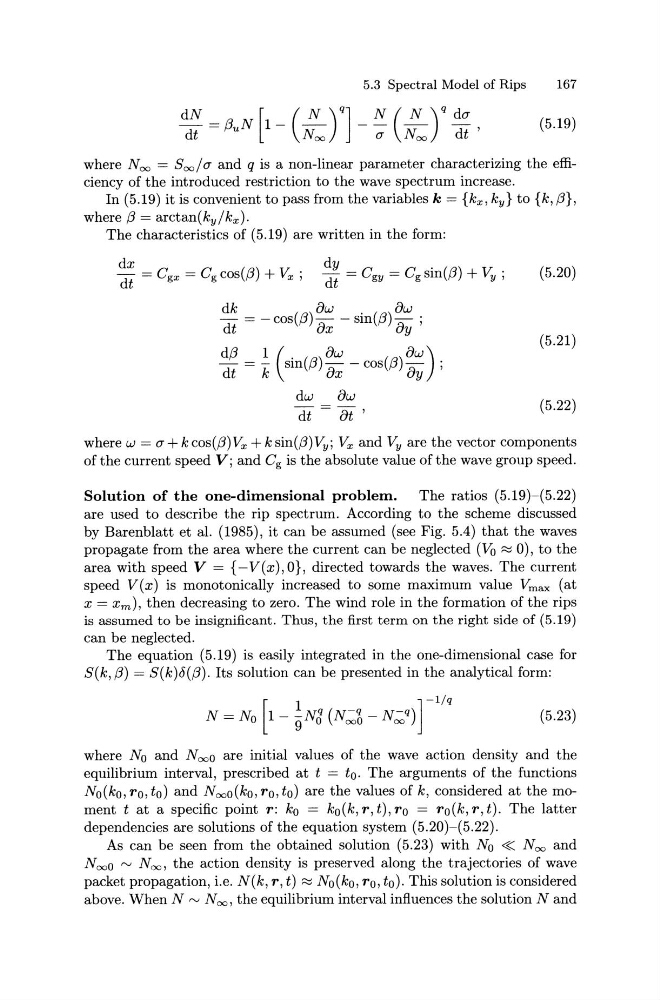
dN = f3uN [1- (__!!_)q]- N (__!!_)q dO"'
(5.19)
dt
N00
0" N00
dt
where N 00 = S00 /0" and q is a non-linear parameter characterizing the efficiency of the introduced restriction to the wave spectrum increase.
In (5.19) it is convenient to pass from the variables k = {kx, ky} to {k, /3},
where f3 = arctan(ky/kx)·
The characteristics of (5.19) are written in the form:
dx
dt = Cgx = Cg cos(/3) + Vx ;
dy
.
dt = Cgy = Cg sm(/3) + Vy ;
(5.20)
dk
ow . ow
-
= -cos(/3)-- sm(/3)-;
dt
ax
ay
d/3 = ~ (sin(/3) ow - cos(/3) ow) ;
dt
k
ax
ay
(5.21)
dw
ow
dt
at '
(5.22)
where w = O" + k cos(/3) Vx + k sin(/3) Vy; Vx and Vy are the vector components
of the current speed V; and Cg is the absolute value of the wave group speed.
Solution of the one-dimensional problem.
The ratios (5.19)-(5.22)
are used to describe the rip spectrum. According to the scheme discussed
by Barenblatt et al. (1985), it can be assumed (see Fig. 5.4) that the waves
propagate from the area where the current can be neglected (V0 ~ 0), to the
area with speed V = {-V ( x), 0}, directed towards the waves. The current
speed V(x) is monotonically increased to some maximum value Vmax (at
x = Xm), then decreasing to zero. The wind role in the formation of the rips
is assumed to be insignificant. Thus, the first term on the right side of (5.19)
can be neglected.
The equation (5.19) is easily integrated in the one-dimensional case for
S(k,/3) = S(k)r5({3). Its solution can be presented in the analytical form:
(5.23)
where No and N000 are initial values of the wave action density and the
equilibrium interval, prescribed at t = t0 . The arguments of the functions
N0 (k0 , ro, to) and N 00 o(ko, ro, to) are the values of k, considered at the moment t at a specific point r: ko = ko(k, r, t), ro = ro(k, r, t). The latter
dependencies are solutions of the equation system (5.20)-(5.22).
As can be seen from the obtained solution (5.23) with No « N 00 and
N 000 rv N OCJ, the action density is preserved along the trajectories of wave
packet propagation, i.e. N ( k, r, t) ~ N 0 ( k0 , r 0 , t0 ). This solution is considered
above. When N"' Ncx:n the equilibrium interval influences the solution Nand
167
dN = f3uN [1- (__!!_)q]- N (__!!_)q dO"'
(5.19)
dt
N00
0" N00
dt
where N 00 = S00 /0" and q is a non-linear parameter characterizing the efficiency of the introduced restriction to the wave spectrum increase.
In (5.19) it is convenient to pass from the variables k = {kx, ky} to {k, /3},
where f3 = arctan(ky/kx)·
The characteristics of (5.19) are written in the form:
dx
dt = Cgx = Cg cos(/3) + Vx ;
dy
.
dt = Cgy = Cg sm(/3) + Vy ;
(5.20)
dk
ow . ow
-
= -cos(/3)-- sm(/3)-;
dt
ax
ay
d/3 = ~ (sin(/3) ow - cos(/3) ow) ;
dt
k
ax
ay
(5.21)
dw
ow
dt
at '
(5.22)
where w = O" + k cos(/3) Vx + k sin(/3) Vy; Vx and Vy are the vector components
of the current speed V; and Cg is the absolute value of the wave group speed.
Solution of the one-dimensional problem.
The ratios (5.19)-(5.22)
are used to describe the rip spectrum. According to the scheme discussed
by Barenblatt et al. (1985), it can be assumed (see Fig. 5.4) that the waves
propagate from the area where the current can be neglected (V0 ~ 0), to the
area with speed V = {-V ( x), 0}, directed towards the waves. The current
speed V(x) is monotonically increased to some maximum value Vmax (at
x = Xm), then decreasing to zero. The wind role in the formation of the rips
is assumed to be insignificant. Thus, the first term on the right side of (5.19)
can be neglected.
The equation (5.19) is easily integrated in the one-dimensional case for
S(k,/3) = S(k)r5({3). Its solution can be presented in the analytical form:
(5.23)
where No and N000 are initial values of the wave action density and the
equilibrium interval, prescribed at t = t0 . The arguments of the functions
N0 (k0 , ro, to) and N 00 o(ko, ro, to) are the values of k, considered at the moment t at a specific point r: ko = ko(k, r, t), ro = ro(k, r, t). The latter
dependencies are solutions of the equation system (5.20)-(5.22).
As can be seen from the obtained solution (5.23) with No « N 00 and
N 000 rv N OCJ, the action density is preserved along the trajectories of wave
packet propagation, i.e. N ( k, r, t) ~ N 0 ( k0 , r 0 , t0 ). This solution is considered
above. When N"' Ncx:n the equilibrium interval influences the solution Nand