

5 Wave Evolution in Non-uniform Currents
in Deep Water
5.1 Formulation of the Problem
in the Local Coordinate System
The general formulation of the wind wave mathematical modelling problem
in the ocean under the action of different factors forming the wind spectrum
is presented in Chap. 1. The effects associated with wave spectrum transformation in a horizontal non-uniform current are investigated in this chapter.
Fundamental theoretical results for the problem were obtained by Longuet-Higgins and Stewart (1960, 1961, 1962, 1964). According to their investigations, waves and horizontal non-uniform currents can interact. As a result,
wave energy can be received or transferred to the current. With the help of
their theory a number of wave dynamic problems can be explained, although
the field of application of the theory is limited. Thus, the wave energy is
increased when the wave propagation is opposite to the flow, whose velocity
is increased along its direction. The drawback of this theory is that the wave
amplitude is estimated as having infinitely large values at the point where
the wave group velocity is equal in value and opposite in direction to the
current velocity. In fact, the results obtained by Longuet-Higgins and Stewart become invalid in the vicinity of this special point (caustic). The spectral
approach used in this chapter eliminates such features near the caustics and
provides an adequate description of wave behaviour in a non-uniform current.
As noted above, the influence of the current and bottom on waves is local. It is reasonable to consider the problem in the local coordinate system,
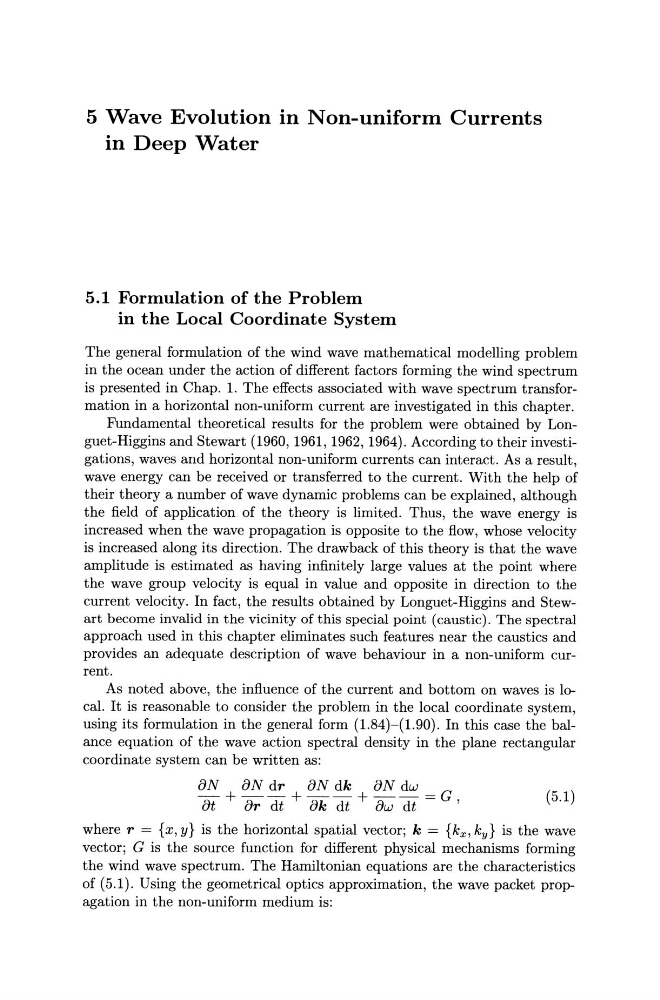
using its formulation in the general form (1.84)~(1.90). In this case the balance equation of the wave action spectral density in the plane rectangular
coordinate system can be written as:
(5.1)
where r = { x, y} is the horizontal spatial vector; k = { kx, ky} is the wave
vector; G is the source function for different physical mechanisms forming
the wind wave spectrum. The Hamiltonian equations are the characteristics
of (5.1). Using the geometrical optics approximation, the wave packet propagation in the non-uniform medium is:
in Deep Water
5.1 Formulation of the Problem
in the Local Coordinate System
The general formulation of the wind wave mathematical modelling problem
in the ocean under the action of different factors forming the wind spectrum
is presented in Chap. 1. The effects associated with wave spectrum transformation in a horizontal non-uniform current are investigated in this chapter.
Fundamental theoretical results for the problem were obtained by Longuet-Higgins and Stewart (1960, 1961, 1962, 1964). According to their investigations, waves and horizontal non-uniform currents can interact. As a result,
wave energy can be received or transferred to the current. With the help of
their theory a number of wave dynamic problems can be explained, although
the field of application of the theory is limited. Thus, the wave energy is
increased when the wave propagation is opposite to the flow, whose velocity
is increased along its direction. The drawback of this theory is that the wave
amplitude is estimated as having infinitely large values at the point where
the wave group velocity is equal in value and opposite in direction to the
current velocity. In fact, the results obtained by Longuet-Higgins and Stewart become invalid in the vicinity of this special point (caustic). The spectral
approach used in this chapter eliminates such features near the caustics and
provides an adequate description of wave behaviour in a non-uniform current.
As noted above, the influence of the current and bottom on waves is local. It is reasonable to consider the problem in the local coordinate system,
using its formulation in the general form (1.84)~(1.90). In this case the balance equation of the wave action spectral density in the plane rectangular
coordinate system can be written as:
(5.1)
where r = { x, y} is the horizontal spatial vector; k = { kx, ky} is the wave
vector; G is the source function for different physical mechanisms forming
the wind wave spectrum. The Hamiltonian equations are the characteristics
of (5.1). Using the geometrical optics approximation, the wave packet propagation in the non-uniform medium is: