

144
4 Physical Mechanisms Forming the Wave Spectrum in Deep Water
The presence of local variant fluctuations within the quasi-stationary
state time intervals (r3 ) follows from the spatial-temporal wave field nonuniformity. It can be described by a kinetic equation for the wind wave spectrum evolution (Zaslavskii & Krasitskii, 1993). But in that paper the nonlinear energy transfer is not taken into consideration due to energy conservation. The wave dispersion fluctuations are determined by the wind variations
connected with "micro-meteorological gusts". The dispersion fluctuations of
the sea surface are shown to be quasi-periodic, due to changes of the local
wave spectrum and, in particular, to its peakness.
Wave generation by wind and wave dissipation are not considered here.
The effect of wind wave parameter fluctuation on non-linear spectrum evolution is investigated by introducing a periodically changing term to the energy
balance equation. The variations of the spectrum form including its peakness
cause a local variation of the non-linear energy transfer in the wave spectrum. Thus it makes sense to estimate the influence of these variations at
large temporal scales (T4-T5), taking into account the cubic proportion between the non-linear energy transfer and the spectrum value.
Problem formulation. In order to obtain quantitative estimates of the
physical processes related to quasi-oscillations, it is necessary to define
their parameters. A number of unsolved problems remain, namely the dependence of the oscillation period on the parameters of the spectrum itself, its peakness, wave stage development, etc. Using the results of Zaslavskii & Krasitskii (1993), the elementary approximation of spectral density
in the quasi-stationary state interval with quasi-oscillations can be presented
as an approximation of the JONSWAP spectrum (Hasselman et al., 1973)
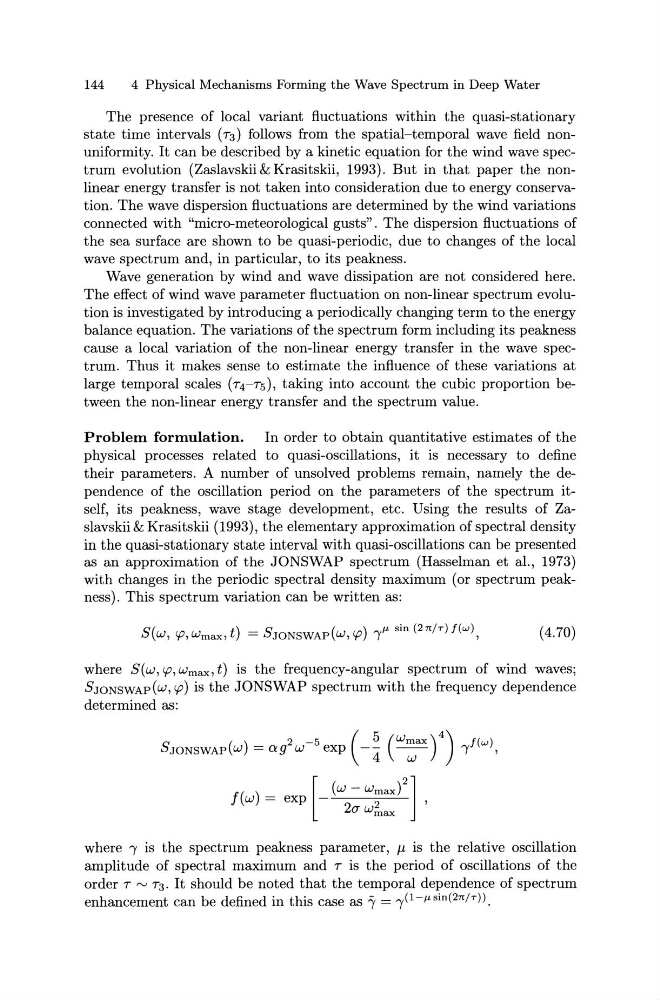
with changes in the periodic spectral density maximum (or spectrum peakness). This spectrum variation can be written as:
S(w, r.p,Wmax, t) = SJONSWAP(w, r.p) /p, sin (2n/r)f(w)'
(4.70)
where S(w, r.p, Wma.x, t) is the frequency-angular spectrum of wind waves;
SJONSWAP(w, r.p) is the JONSWAP spectrum with the frequency dependence
determined as:
where 1 is the spectrum peakness parameter, J.L is the relative oscillation
amplitude of spectral maximum and T is the period of oscillations of the
order T,....., r 3 • It should be noted that the temporal dependence of spectrum
enhancement can be defined in this case as i = /(l-p,sin( 2 n/-r)).
4 Physical Mechanisms Forming the Wave Spectrum in Deep Water
The presence of local variant fluctuations within the quasi-stationary
state time intervals (r3 ) follows from the spatial-temporal wave field nonuniformity. It can be described by a kinetic equation for the wind wave spectrum evolution (Zaslavskii & Krasitskii, 1993). But in that paper the nonlinear energy transfer is not taken into consideration due to energy conservation. The wave dispersion fluctuations are determined by the wind variations
connected with "micro-meteorological gusts". The dispersion fluctuations of
the sea surface are shown to be quasi-periodic, due to changes of the local
wave spectrum and, in particular, to its peakness.
Wave generation by wind and wave dissipation are not considered here.
The effect of wind wave parameter fluctuation on non-linear spectrum evolution is investigated by introducing a periodically changing term to the energy
balance equation. The variations of the spectrum form including its peakness
cause a local variation of the non-linear energy transfer in the wave spectrum. Thus it makes sense to estimate the influence of these variations at
large temporal scales (T4-T5), taking into account the cubic proportion between the non-linear energy transfer and the spectrum value.
Problem formulation. In order to obtain quantitative estimates of the
physical processes related to quasi-oscillations, it is necessary to define
their parameters. A number of unsolved problems remain, namely the dependence of the oscillation period on the parameters of the spectrum itself, its peakness, wave stage development, etc. Using the results of Zaslavskii & Krasitskii (1993), the elementary approximation of spectral density
in the quasi-stationary state interval with quasi-oscillations can be presented
as an approximation of the JONSWAP spectrum (Hasselman et al., 1973)
with changes in the periodic spectral density maximum (or spectrum peakness). This spectrum variation can be written as:
S(w, r.p,Wmax, t) = SJONSWAP(w, r.p) /p, sin (2n/r)f(w)'
(4.70)
where S(w, r.p, Wma.x, t) is the frequency-angular spectrum of wind waves;
SJONSWAP(w, r.p) is the JONSWAP spectrum with the frequency dependence
determined as:
where 1 is the spectrum peakness parameter, J.L is the relative oscillation
amplitude of spectral maximum and T is the period of oscillations of the
order T,....., r 3 • It should be noted that the temporal dependence of spectrum
enhancement can be defined in this case as i = /(l-p,sin( 2 n/-r)).