

140
4 Physical Mechanisms Forming the Wave Spectrum in Deep Water
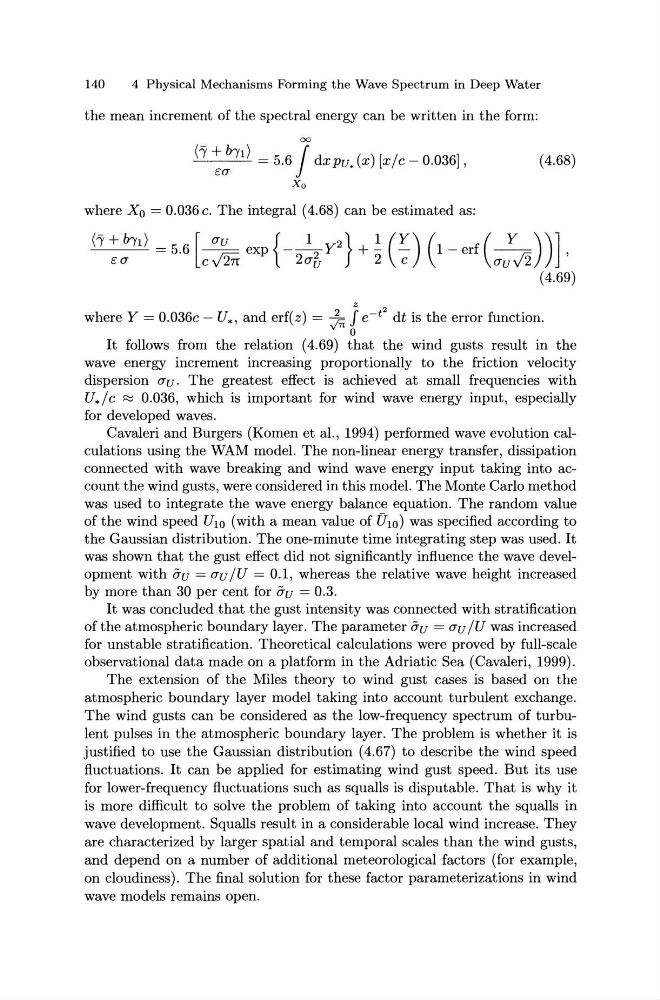
the mean increment of the spectral energy can be written in the form:
00
..:....:(' Y_+_lry__:_::.:_ 1 ) = 5.6 j dxpu. (x) [xjc- 0.036],
E:a
Xo
where X 0 = 0.036c. The integral (4.68) can be estimated as:
(4.68)
E:a
= 5.6 [___!!!!__ exp { - -
1 y 2 } +! (y) (1- erf (~))],
cv'27t
2a~
2 c
auv"i
(4.69)
z
where y = 0.036c- u*, and erf(z) = Jn J e-t
2
dt is the error function.
0
It follows from the relation (4.69) that the wind gusts result in the
wave energy increment increasing proportionally to the friction velocity
dispersion au. The greatest effect is achieved at small frequencies with
U*jc ~ 0.036, which is important for wind wave energy input, especially
for developed waves.
Cavaleri and Burgers (Kamen et al., 1994) performed wave evolution calculations using the WAM model. The non-linear energy transfer, dissipation
connected with wave breaking and wind wave energy input taking into account the wind gusts, were considered in this model. The Monte Carlo method
was used to integrate the wave energy balance equation. The random value
of the wind speed U10 (with a mean value of Uw) was specified according to
the Gaussian distribution. The one-minute time integrating step was used. It
was shown that the gust effect did not significantly influence the wave development with iiu = au /U = 0.1, whereas the relative wave height increased
by more than 30 per cent for au = 0.3.
It was concluded that the gust intensity was connected with stratification
of the atmospheric boundary layer. The parameter au = au /U was increased
for unstable stratification. Theoretical calculations were proved by full-scale
observational data made on a platform in the Adriatic Sea (Cavaleri, 1999).
The extension of the Miles theory to wind gust cases is based on the
atmospheric boundary layer model taking into account turbulent exchange.
The wind gusts can be considered as the low-frequency spectrum of turbulent pulses in the atmospheric boundary layer. The problem is whether it is
justified to use the Gaussian distribution ( 4.67) to describe the wind speed
fluctuations. It can be applied for estimating wind gust speed. But its use
for lower-frequency fluctuations such as squalls is disputable. That is why it
is more difficult to solve the problem of taking into account the squalls in
wave development. Squalls result in a considerable local wind increase. They
are characterized by larger spatial and temporal scales than the wind gusts,
and depend on a number of additional meteorological factors (for example,
on cloudiness). The final solution for these factor parameterizations in wind
wave models remains open.
4 Physical Mechanisms Forming the Wave Spectrum in Deep Water
the mean increment of the spectral energy can be written in the form:
00
..:....:(' Y_+_lry__:_::.:_ 1 ) = 5.6 j dxpu. (x) [xjc- 0.036],
E:a
Xo
where X 0 = 0.036c. The integral (4.68) can be estimated as:
(4.68)
E:a
= 5.6 [___!!!!__ exp { - -
1 y 2 } +! (y) (1- erf (~))],
cv'27t
2a~
2 c
auv"i
(4.69)
z
where y = 0.036c- u*, and erf(z) = Jn J e-t
2
dt is the error function.
0
It follows from the relation (4.69) that the wind gusts result in the
wave energy increment increasing proportionally to the friction velocity
dispersion au. The greatest effect is achieved at small frequencies with
U*jc ~ 0.036, which is important for wind wave energy input, especially
for developed waves.
Cavaleri and Burgers (Kamen et al., 1994) performed wave evolution calculations using the WAM model. The non-linear energy transfer, dissipation
connected with wave breaking and wind wave energy input taking into account the wind gusts, were considered in this model. The Monte Carlo method
was used to integrate the wave energy balance equation. The random value
of the wind speed U10 (with a mean value of Uw) was specified according to
the Gaussian distribution. The one-minute time integrating step was used. It
was shown that the gust effect did not significantly influence the wave development with iiu = au /U = 0.1, whereas the relative wave height increased
by more than 30 per cent for au = 0.3.
It was concluded that the gust intensity was connected with stratification
of the atmospheric boundary layer. The parameter au = au /U was increased
for unstable stratification. Theoretical calculations were proved by full-scale
observational data made on a platform in the Adriatic Sea (Cavaleri, 1999).
The extension of the Miles theory to wind gust cases is based on the
atmospheric boundary layer model taking into account turbulent exchange.
The wind gusts can be considered as the low-frequency spectrum of turbulent pulses in the atmospheric boundary layer. The problem is whether it is
justified to use the Gaussian distribution ( 4.67) to describe the wind speed
fluctuations. It can be applied for estimating wind gust speed. But its use
for lower-frequency fluctuations such as squalls is disputable. That is why it
is more difficult to solve the problem of taking into account the squalls in
wave development. Squalls result in a considerable local wind increase. They
are characterized by larger spatial and temporal scales than the wind gusts,
and depend on a number of additional meteorological factors (for example,
on cloudiness). The final solution for these factor parameterizations in wind
wave models remains open.