

136
4 Physical Mechanisms Forming the Wave Spectrum in Deep Water
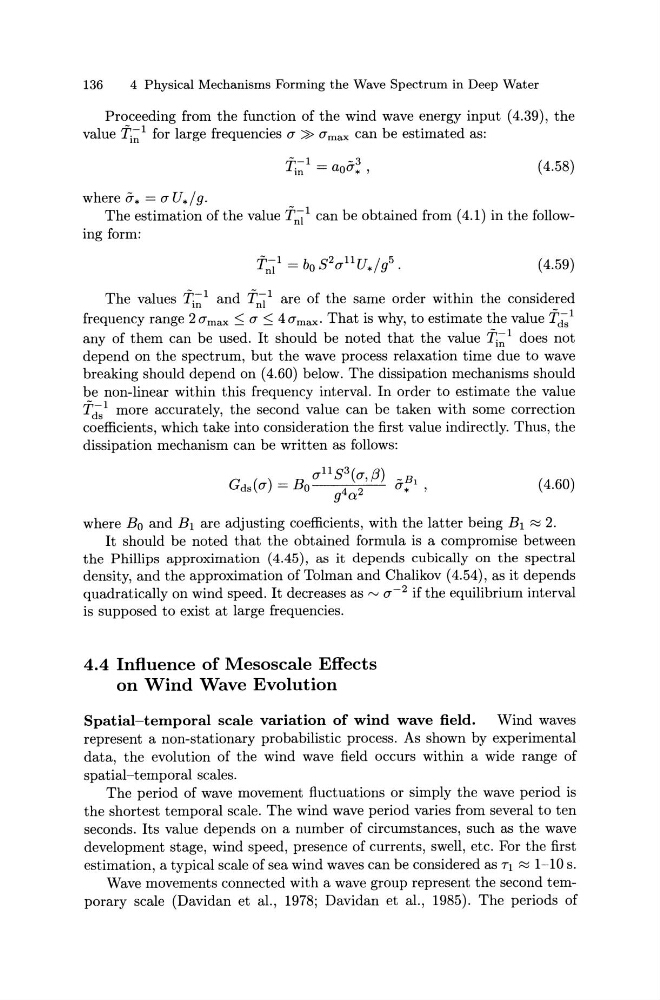
Proceeding from the function of the wind wave energy input (4.39), the
value ~~ 1 for large frequencies a» amax can be estimated as:
T --1
-3
in =aoa*'
( 4.58)
where a*= a U*jg.
The estimation of the value Tci 1 can be obtained from (4.1) in the following form:
(4.59)
The values ~~ 1 and Tn] 1 are of the same order within the considered
frequency range 2amax ~a~ 4amax· That is why, to estimate the value Td~ 1
any of them can be used. It should be noted that the value ~~ 1 does not
depend on the spectrum, but the wave process relaxation time due to wave
breaking should depend on ( 4.60) below. The dissipation mechanisms should
be non-linear within this frequency interval. In order to estimate the value
Td~ 1 more accurately, the second value can be taken with some correction
coefficients, which take into consideration the first value indirectly. Thus, the
dissipation mechanism can be written as follows:
-
al1S3(a, ,8) -B,
Gds(a)- Eo
4 2
a* ,
g a
( 4.60)
where Eo and E 1 are adjusting coefficients, with the latter being E 1 ~ 2.
It should be noted that the obtained formula is a compromise between
the Phillips approximation (4.45), as it depends cubically on the spectral
density, and the approximation of Tolman and Chalikov (4.54), as it depends
quadratically on wind speed. It decreases as ""' a- 2 if the equilibrium interval
is supposed to exist at large frequencies.
4.4 Influence of Mesoscale Effects
on Wind Wave Evolution
Spatial-temporal scale variation of wind wave field.
Wind waves
represent a non-stationary probabilistic process. As shown by experimental
data, the evolution of the wind wave field occurs within a wide range of
spatial-temporal scales.
The period of wave movement fluctuations or simply the wave period is
the shortest temporal scale. The wind wave period varies from several to ten
seconds. Its value depends on a number of circumstances, such as the wave
development stage, wind speed, presence of currents, swell, etc. For the first
estimation, a typical scale of sea wind waves can be considered as T1 ~ 1-10 s.
Wave movements connected with a wave group represent the second temporary scale (Davidan et al., 1978; Davidan et al., 1985). The periods of
4 Physical Mechanisms Forming the Wave Spectrum in Deep Water
Proceeding from the function of the wind wave energy input (4.39), the
value ~~ 1 for large frequencies a» amax can be estimated as:
T --1
-3
in =aoa*'
( 4.58)
where a*= a U*jg.
The estimation of the value Tci 1 can be obtained from (4.1) in the following form:
(4.59)
The values ~~ 1 and Tn] 1 are of the same order within the considered
frequency range 2amax ~a~ 4amax· That is why, to estimate the value Td~ 1
any of them can be used. It should be noted that the value ~~ 1 does not
depend on the spectrum, but the wave process relaxation time due to wave
breaking should depend on ( 4.60) below. The dissipation mechanisms should
be non-linear within this frequency interval. In order to estimate the value
Td~ 1 more accurately, the second value can be taken with some correction
coefficients, which take into consideration the first value indirectly. Thus, the
dissipation mechanism can be written as follows:
-
al1S3(a, ,8) -B,
Gds(a)- Eo
4 2
a* ,
g a
( 4.60)
where Eo and E 1 are adjusting coefficients, with the latter being E 1 ~ 2.
It should be noted that the obtained formula is a compromise between
the Phillips approximation (4.45), as it depends cubically on the spectral
density, and the approximation of Tolman and Chalikov (4.54), as it depends
quadratically on wind speed. It decreases as ""' a- 2 if the equilibrium interval
is supposed to exist at large frequencies.
4.4 Influence of Mesoscale Effects
on Wind Wave Evolution
Spatial-temporal scale variation of wind wave field.
Wind waves
represent a non-stationary probabilistic process. As shown by experimental
data, the evolution of the wind wave field occurs within a wide range of
spatial-temporal scales.
The period of wave movement fluctuations or simply the wave period is
the shortest temporal scale. The wind wave period varies from several to ten
seconds. Its value depends on a number of circumstances, such as the wave
development stage, wind speed, presence of currents, swell, etc. For the first
estimation, a typical scale of sea wind waves can be considered as T1 ~ 1-10 s.
Wave movements connected with a wave group represent the second temporary scale (Davidan et al., 1978; Davidan et al., 1985). The periods of