

OCEAN MODELS
Evolution of a tracer by the diffusion equation
0
'..
_ -
<.
_ - -
-1 00
-
a
a,
0 -300- T after 120 days
-500;
0.2
0.4
0.6
0.8
1
Temperature
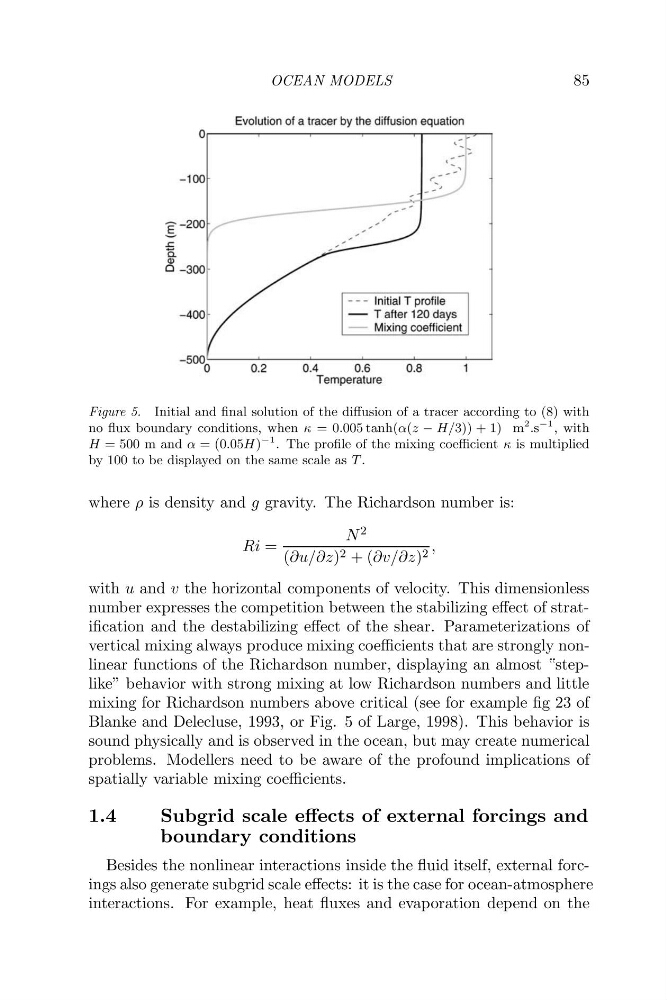
Figure 5. Initial and final solution of the diffusion of a tracer according t o (8) with
no flux boundary conditions, when n = 0.005 tanh(a(z - H/3)) + 1) m2.sP1, with
H = 500 m and a = ( 0 . 0 5 ~ ) - l . The profile of the mixing coefficient n is multiplied
by 100 to be displayed on the same scale as T.
where p is density and g gravity. The Richardson number is:
with u and v the horizontal components of velocity. This dimensionless
number expresses the competition between the stabilizing effect of stratification and the destabilizing effect of the shear. Parameterizations of
vertical mixing always produce mixing coefficients that are strongly nonlinear functions of the Richardson number, displaying an almost "steplike" behavior with strong mixing at low Richardson numbers and little
mixing for Richardson numbers above critical (see for example fig 23 of
Blanke and Delecluse, 1993, or Fig. 5 of Large, 1998). This behavior is
sound physically and is observed in the ocean, but may create numerical
problems. Modellers need to be aware of the profound implications of
spatially variable mixing coefficients.
1.4
Subgrid scale effects of external forcings and
boundary conditions
Besides the nonlinear interactions inside the fluid itself, external forcings also generate subgrid scale effects: it is the case for ocean-atmosphere
interactions. For example, heat fluxes and evaporation depend on the
Evolution of a tracer by the diffusion equation
0
'..
_ -
<.
_ - -
-1 00
-
a
a,
0 -300- T after 120 days
-500;
0.2
0.4
0.6
0.8
1
Temperature
Figure 5. Initial and final solution of the diffusion of a tracer according t o (8) with
no flux boundary conditions, when n = 0.005 tanh(a(z - H/3)) + 1) m2.sP1, with
H = 500 m and a = ( 0 . 0 5 ~ ) - l . The profile of the mixing coefficient n is multiplied
by 100 to be displayed on the same scale as T.
where p is density and g gravity. The Richardson number is:
with u and v the horizontal components of velocity. This dimensionless
number expresses the competition between the stabilizing effect of stratification and the destabilizing effect of the shear. Parameterizations of
vertical mixing always produce mixing coefficients that are strongly nonlinear functions of the Richardson number, displaying an almost "steplike" behavior with strong mixing at low Richardson numbers and little
mixing for Richardson numbers above critical (see for example fig 23 of
Blanke and Delecluse, 1993, or Fig. 5 of Large, 1998). This behavior is
sound physically and is observed in the ocean, but may create numerical
problems. Modellers need to be aware of the profound implications of
spatially variable mixing coefficients.
1.4
Subgrid scale effects of external forcings and
boundary conditions
Besides the nonlinear interactions inside the fluid itself, external forcings also generate subgrid scale effects: it is the case for ocean-atmosphere
interactions. For example, heat fluxes and evaporation depend on the