

564
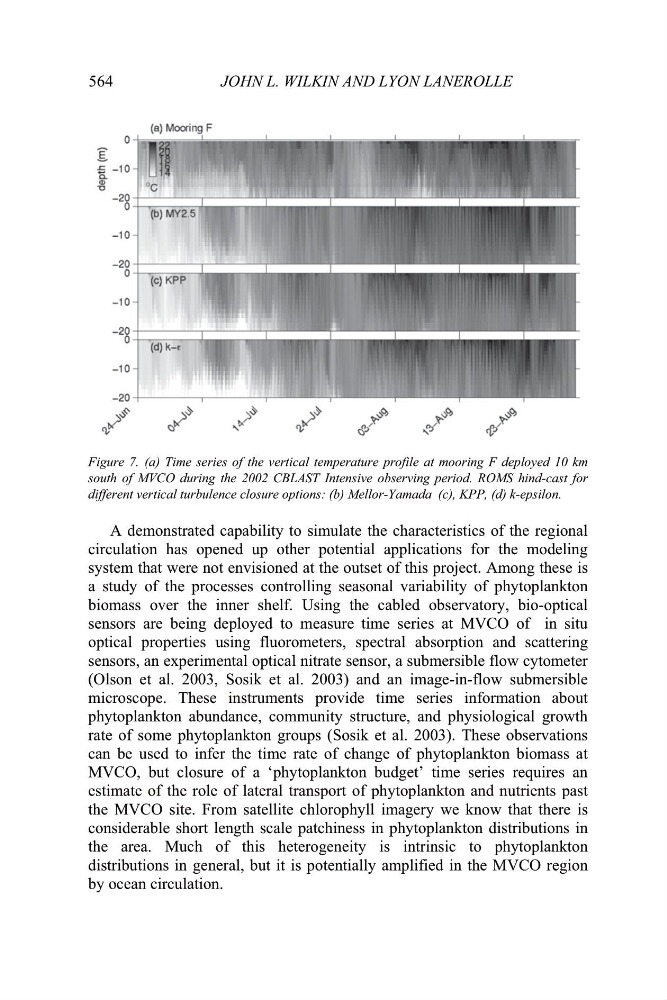
Figure 7. (a) Time series of the vertical temperature profile at mooring F deployed 10 km
south of MVCO during the 2002 CBLAST Intensive observing period. ROMS hind-cast for
A demonstrated capability to simulate the characteristics of the regional
circulation has opened up other potential applications for the modeling
system that were not envisioned at the outset of this project. Among these is
a study of the processes controlling seasonal variability of phytoplankton
biomass over the inner shelf. Using the cabled observatory, bio-optical
sensors are being deployed to measure time series at MVCO of in situ
optical properties using fluorometers, spectral absorption and scattering
sensors, an experimental optical nitrate sensor, a submersible flow cytometer
(Olson et al. 2003, Sosik et al. 2003) and an image-in-flow submersible
microscope. These instruments provide time series information about
phytoplankton abundance, community structure, and physiological growth
rate of some phytoplankton groups (Sosik et al. 2003). These observations
can be used to infer the time rate of change of phytoplankton biomass at
MVCO, but closure of a ‘phytoplankton budget’ time series requires an
estimate of the role of lateral transport of phytoplankton and nutrients past
the MVCO site. From satellite chlorophyll imagery we know that there is
considerable short length scale patchiness in phytoplankton distributions in
the area. Much of this heterogeneity is intrinsic to phytoplankton
distributions in general, but it is potentially amplified in the MVCO region
by ocean circulation.
JOHN L. WILKIN AND LYON LANEROLLE
different vertical turbulence closure options: (b) Mellor-Yamada (c), KPP, (d) k-epsilon.