

SOME OCEAN MODEL FUNDAMENTALS
45
purpose, recall that with z,, single signed, the vertical thickness of a grid
cell is
dz = z,, ds.
(65)
Bringing these results together, and taking the limit as the volume of
the cell in (x, y, s) space goes to zero (i.e., dx dy ds -t 0) leads to
Notably, the horizontal gradient operator V, is computed on surfaces of
constant s, and so it is distinct generally from the horizontal gradient V,
taken on surfaces of constant z. Instead of taking the limit as dx dy ds -t
0, it convenient for discretization purposes to take the limit as the time
independent horizontal area dxdy goes to zero, thus maintaining the
time dependent thickness dz = z,, ds inside the derivative operators. In
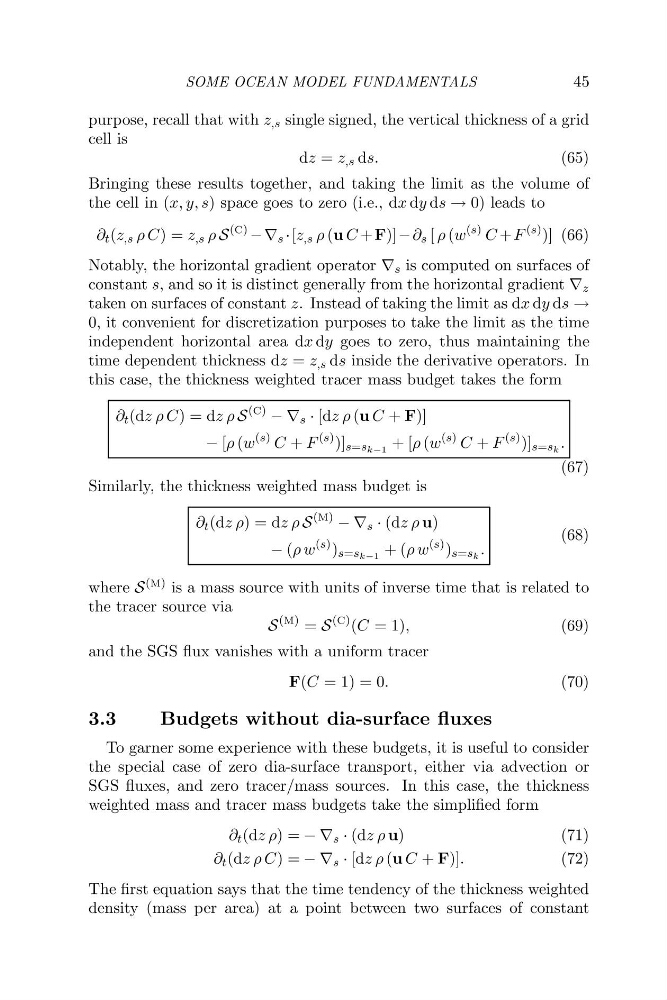
this case, the thickness weighted tracer mass budget takes the form
Similarly, the thickness weighted mass budget is
where s ( ~ )
is a mass source with units of inverse time that is related to
at(dzp) = d z p ~ ( ~ )
- V, (dzpu)
s)
- (P .w( )
,
= ,
,
,
+ (p w(~)),=,, .
the tracer source via
s ( M ) = s ( C ) (C = I),
(68)
and the SGS flux vanishes with a uniform tracer
3.3
Budgets without dia-surface fluxes
To garner some experience with these budgets, it is useful to consider
the special case of zero diamu-face transport, either via advection or
SGS fluxes, and zero tracerlmass sources. In this case, the thickness
weighted mass and tracer mass budgets take the simplified form
at (dz p) = - V, . (dz p u)
(71)
&(dzpC) = - V, [ d z p ( u C + F ) ] .
(72)
The first equation says that the time tendency of the thickness weighted
density (mass per area) at a point between two surfaces of constant
45
purpose, recall that with z,, single signed, the vertical thickness of a grid
cell is
dz = z,, ds.
(65)
Bringing these results together, and taking the limit as the volume of
the cell in (x, y, s) space goes to zero (i.e., dx dy ds -t 0) leads to
Notably, the horizontal gradient operator V, is computed on surfaces of
constant s, and so it is distinct generally from the horizontal gradient V,
taken on surfaces of constant z. Instead of taking the limit as dx dy ds -t
0, it convenient for discretization purposes to take the limit as the time
independent horizontal area dxdy goes to zero, thus maintaining the
time dependent thickness dz = z,, ds inside the derivative operators. In
this case, the thickness weighted tracer mass budget takes the form
Similarly, the thickness weighted mass budget is
where s ( ~ )
is a mass source with units of inverse time that is related to
at(dzp) = d z p ~ ( ~ )
- V, (dzpu)
s)
- (P .w( )
,
= ,
,
,
+ (p w(~)),=,, .
the tracer source via
s ( M ) = s ( C ) (C = I),
(68)
and the SGS flux vanishes with a uniform tracer
3.3
Budgets without dia-surface fluxes
To garner some experience with these budgets, it is useful to consider
the special case of zero diamu-face transport, either via advection or
SGS fluxes, and zero tracerlmass sources. In this case, the thickness
weighted mass and tracer mass budgets take the simplified form
at (dz p) = - V, . (dz p u)
(71)
&(dzpC) = - V, [ d z p ( u C + F ) ] .
(72)
The first equation says that the time tendency of the thickness weighted
density (mass per area) at a point between two surfaces of constant