

42
STEPHEN GRIFFIES
where as = z,, a,. The last form motivates some to consider w(') as a
vertical velocity component that measures the rate at which fluid parcels
penetrate the surface of constant generalized coordinate (see Appendix
A to McDougall, 1995). One should be mindful, however, to distinguish
w(') from the generally different vertical velocity component w = dzldt,
which measures the water flux crossing constant geopotential surfaces.
We close with a few points of clarification for the case where no fluid
parcels cross the generalized surface. Such occurs, in particular, in the
case of adiabatic flows with s = p an isopycnal coordinate. In this case,
the material time derivative (56) only has a horizontal twedimensional
advective component u . V,. This result should not be interpreted to
mean that the velocity of a fluid parcel is strictly horizontal. Indeed, it
generally is not, as the previous derivation should make clear. Rather,
it means that the transport of fluid properties occurs along surfaces
of constant s, and such transport is measured by the convergence of
horizontal advective fluxes as measured along surfaces of constant s.
We revisit this point in Section 3.2 when discussing tracer transport
(see in particular Figure 7).
3.
Mass and tracer budgets
The purpose of this section is to extend the kinematics discussed in
the previous section to the case of mass and tracer budgets for finite
domains within the ocean fluid. In the formulation of ocean models,
these domains are thought of as discrete model grid cells.
3.1
General formulation
Assume that mass and tracer are altered within a finite region by
transport across boundaries of the region and by sources within the
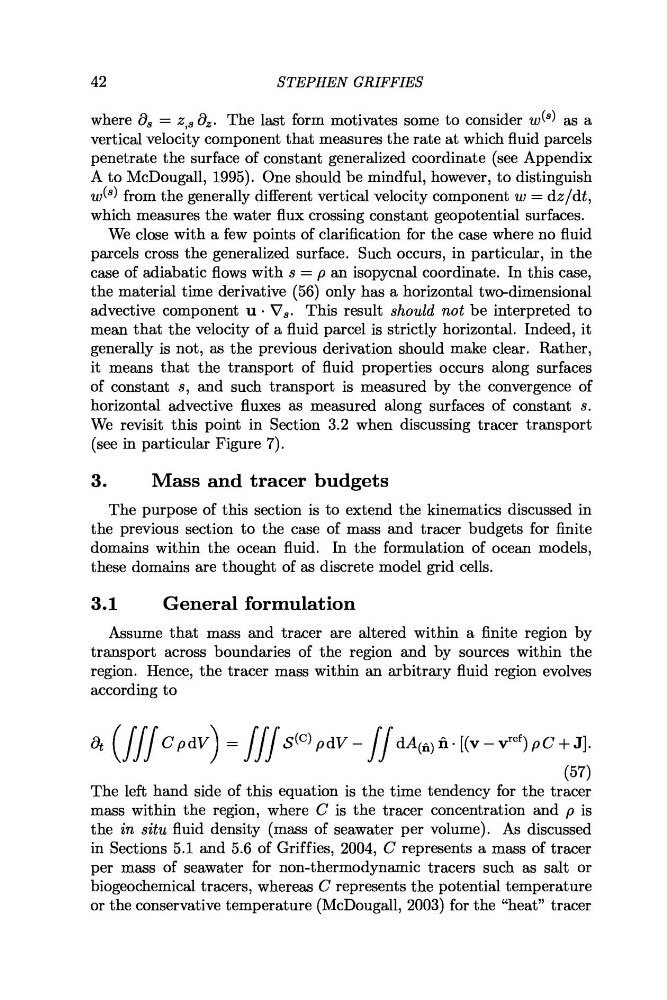
region. Hence, the tracer mass within an arbitrary fluid region evolves
according to
(57)
The left hand side of this equation is the time tendency for the tracer
mass within the region, where C is the tracer concentration and p is
the in situ fluid density (mass of seawater per volume). As discussed
in Sections 5.1 and 5.6 of Griffies, 2004, C represents a mass of tracer
per mass of seawater for non-thermodynamic tracers such as salt or
biogeochemical tracers, whereas C represents the potential temperature
or the conservative temperature (McDougall, 2003) for the "heat" tracer
STEPHEN GRIFFIES
where as = z,, a,. The last form motivates some to consider w(') as a
vertical velocity component that measures the rate at which fluid parcels
penetrate the surface of constant generalized coordinate (see Appendix
A to McDougall, 1995). One should be mindful, however, to distinguish
w(') from the generally different vertical velocity component w = dzldt,
which measures the water flux crossing constant geopotential surfaces.
We close with a few points of clarification for the case where no fluid
parcels cross the generalized surface. Such occurs, in particular, in the
case of adiabatic flows with s = p an isopycnal coordinate. In this case,
the material time derivative (56) only has a horizontal twedimensional
advective component u . V,. This result should not be interpreted to
mean that the velocity of a fluid parcel is strictly horizontal. Indeed, it
generally is not, as the previous derivation should make clear. Rather,
it means that the transport of fluid properties occurs along surfaces
of constant s, and such transport is measured by the convergence of
horizontal advective fluxes as measured along surfaces of constant s.
We revisit this point in Section 3.2 when discussing tracer transport
(see in particular Figure 7).
3.
Mass and tracer budgets
The purpose of this section is to extend the kinematics discussed in
the previous section to the case of mass and tracer budgets for finite
domains within the ocean fluid. In the formulation of ocean models,
these domains are thought of as discrete model grid cells.
3.1
General formulation
Assume that mass and tracer are altered within a finite region by
transport across boundaries of the region and by sources within the
region. Hence, the tracer mass within an arbitrary fluid region evolves
according to
(57)
The left hand side of this equation is the time tendency for the tracer
mass within the region, where C is the tracer concentration and p is
the in situ fluid density (mass of seawater per volume). As discussed
in Sections 5.1 and 5.6 of Griffies, 2004, C represents a mass of tracer
per mass of seawater for non-thermodynamic tracers such as salt or
biogeochemical tracers, whereas C represents the potential temperature
or the conservative temperature (McDougall, 2003) for the "heat" tracer