

472
JOHN HARDING AND JAMES RIGNEY
operational oceanographic applications, primarily numerical ocean
prediction. The MSRC is one of the most capable HPC environments in the
world and, given its bi-annual hardware refresh rate, regularly ranks in the
top 10 computer centers globally. This facility serves a nationwide user
community of over 4,000 scientists and engineers and currently includes a
cumulative 30 teraop computing resource combined with petabyte
hierarchical storage and multi-gigabit local/wide area network.
4.
NAVOCEANO oceanography and GODAE
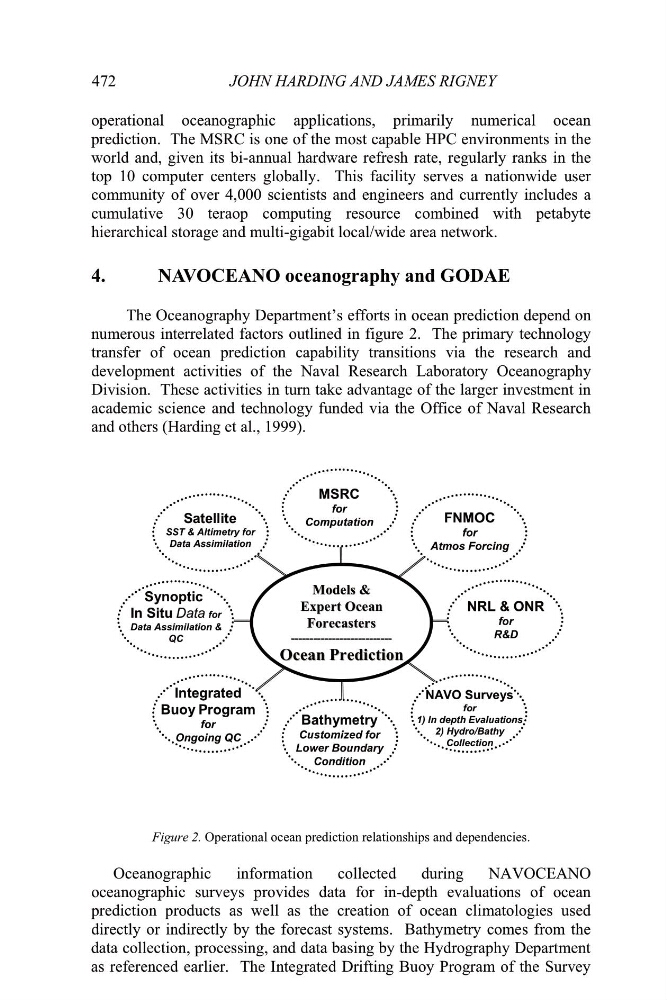
The Oceanography Department’s efforts in ocean prediction depend on
numerous interrelated factors outlined in figure 2. The primary technology
transfer of ocean prediction capability transitions via the research and
development activities of the Naval Research Laboratory Oceanography
Division. These activities in turn take advantage of the larger investment in
academic science and technology funded via the Office of Naval Research
and others (Harding et al., 1999).
NRL & ONR
for
R&D
Models &
Models &
Expert Ocean
Expert Ocean
Forecasters
Forecasters
--------------------------Ocean Prediction
Ocean Prediction
MSRC
for
Computation
FNMOC
for
Atmos Forcing
Integrated
Buoy Program
for
Ongoing QC
Satellite
SST & Altimetry for
Data Assimilation
NAVO Surveys
for
1) In depth Evaluations
2) Hydro/Bathy
Collection
Synoptic
In Situ Data for
Data Assimilation &
QC
Bathymetry
Customized for
Lower Boundary
Condition
Figure 2. Operational ocean prediction relationships and dependencies.
Oceanographic
information
collected
during
NAVOCEANO
oceanographic surveys provides data for in-depth evaluations of ocean
prediction products as well as the creation of ocean climatologies used
directly or indirectly by the forecast systems. Bathymetry comes from the
data collection, processing, and data basing by the Hydrography Department
as referenced earlier. The Integrated Drifting Buoy Program of the Survey
JOHN HARDING AND JAMES RIGNEY
operational oceanographic applications, primarily numerical ocean
prediction. The MSRC is one of the most capable HPC environments in the
world and, given its bi-annual hardware refresh rate, regularly ranks in the
top 10 computer centers globally. This facility serves a nationwide user
community of over 4,000 scientists and engineers and currently includes a
cumulative 30 teraop computing resource combined with petabyte
hierarchical storage and multi-gigabit local/wide area network.
4.
NAVOCEANO oceanography and GODAE
The Oceanography Department’s efforts in ocean prediction depend on
numerous interrelated factors outlined in figure 2. The primary technology
transfer of ocean prediction capability transitions via the research and
development activities of the Naval Research Laboratory Oceanography
Division. These activities in turn take advantage of the larger investment in
academic science and technology funded via the Office of Naval Research
and others (Harding et al., 1999).
NRL & ONR
for
R&D
Models &
Models &
Expert Ocean
Expert Ocean
Forecasters
Forecasters
--------------------------Ocean Prediction
Ocean Prediction
MSRC
for
Computation
FNMOC
for
Atmos Forcing
Integrated
Buoy Program
for
Ongoing QC
Satellite
SST & Altimetry for
Data Assimilation
NAVO Surveys
for
1) In depth Evaluations
2) Hydro/Bathy
Collection
Synoptic
In Situ Data for
Data Assimilation &
QC
Bathymetry
Customized for
Lower Boundary
Condition
Figure 2. Operational ocean prediction relationships and dependencies.
Oceanographic
information
collected
during
NAVOCEANO
oceanographic surveys provides data for in-depth evaluations of ocean
prediction products as well as the creation of ocean climatologies used
directly or indirectly by the forecast systems. Bathymetry comes from the
data collection, processing, and data basing by the Hydrography Department
as referenced earlier. The Integrated Drifting Buoy Program of the Survey