

SOME OCEAN MODEL FUNDAMENTALS
33
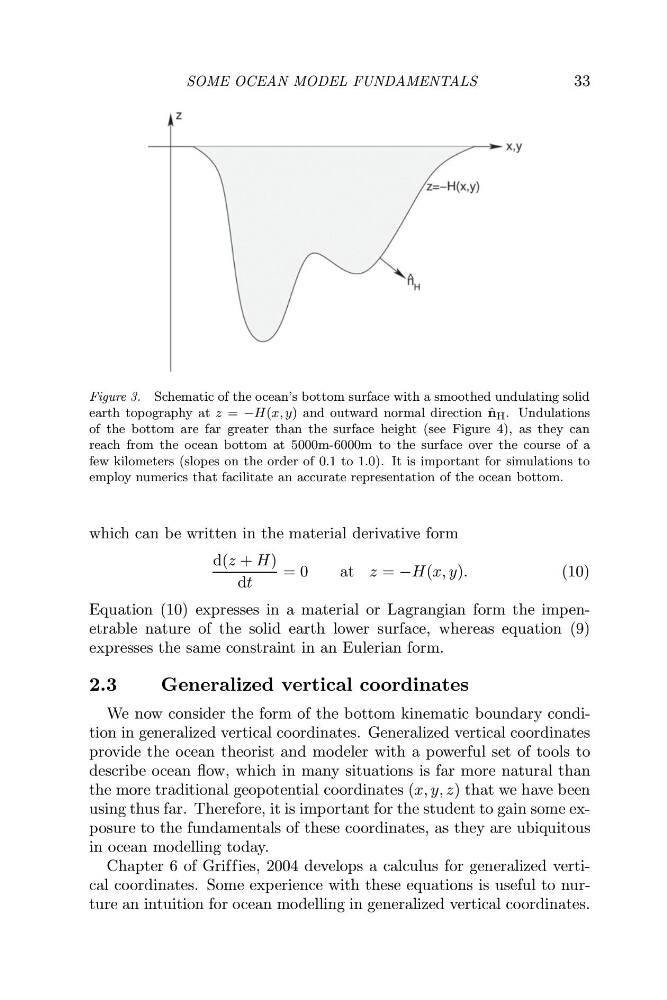
Figure 3. Schematic of the ocean’s bottom surface with a smoothed undulating solid
earth topography at z = −H(x, y) and outward normal direction ˆ
n H . Undulations
of the bottom are far greater than the surface height (see Figure 4), as they can
reach from the ocean bottom at 5000m-6000m to the surface over the course of a
few kilometers (slopes on the order of 0.1 to 1.0). It is important for simulations to
employ numerics that facilitate an accurate representation of the ocean bottom.
which can be written in the material derivative form
d(z + H)
dt
= 0
at z = −H(x, y).
(10)
Equation (10) expresses in a material or Lagrangian form the impenetrable nature of the solid earth lower surface, whereas equation (9)
expresses the same constraint in an Eulerian form.
2.3
Generalized vertical coordinates
We now consider the form of the bottom kinematic boundary condition in generalized vertical coordinates. Generalized vertical coordinates
provide the ocean theorist and modeler with a powerful set of tools to
describe ocean flow, which in many situations is far more natural than
the more traditional geopotential coordinates (x, y, z) that we have been
using thus far. Therefore, it is important for the student to gain some exposure to the fundamentals of these coordinates, as they are ubiquitous
in ocean modelling today.
Chapter 6 of Griffies, 2004 develops a calculus for generalized vertical coordinates. Some experience with these equations is useful to nurture an intuition for ocean modelling in generalized vertical coordinates.
33
Figure 3. Schematic of the ocean’s bottom surface with a smoothed undulating solid
earth topography at z = −H(x, y) and outward normal direction ˆ
n H . Undulations
of the bottom are far greater than the surface height (see Figure 4), as they can
reach from the ocean bottom at 5000m-6000m to the surface over the course of a
few kilometers (slopes on the order of 0.1 to 1.0). It is important for simulations to
employ numerics that facilitate an accurate representation of the ocean bottom.
which can be written in the material derivative form
d(z + H)
dt
= 0
at z = −H(x, y).
(10)
Equation (10) expresses in a material or Lagrangian form the impenetrable nature of the solid earth lower surface, whereas equation (9)
expresses the same constraint in an Eulerian form.
2.3
Generalized vertical coordinates
We now consider the form of the bottom kinematic boundary condition in generalized vertical coordinates. Generalized vertical coordinates
provide the ocean theorist and modeler with a powerful set of tools to
describe ocean flow, which in many situations is far more natural than
the more traditional geopotential coordinates (x, y, z) that we have been
using thus far. Therefore, it is important for the student to gain some exposure to the fundamentals of these coordinates, as they are ubiquitous
in ocean modelling today.
Chapter 6 of Griffies, 2004 develops a calculus for generalized vertical coordinates. Some experience with these equations is useful to nurture an intuition for ocean modelling in generalized vertical coordinates.