

32
STEPHEN GRIFFIES
parcels that conserve their volume are known as Boussinesq parcels,
whereas mass conserving parcels are non-Boussinesq. Non-Boussinesq
parcels are generally considered in atmospheric dynamics, since the atmosphere is far more compressible than the ocean. However, most new
ocean models are removing the Boussinesq approximation since straightforward means are known to solve the more general non-Boussinesq evolution using pressure-based coordinates.
2.2
Solid earth kinematic boundary condition
To begin our discussion of fluid flow through a surface, we start with
the simplest surface: the time independent solid earth boundary. As
mentioned earlier, one typically assumes in ocean modelling that there
is no fluid crossing the solid earth lower boundary. In this case, a nonormal flow condition is imposed at the solid earth boundary at the
depth
z = -H(x, y).
(6)
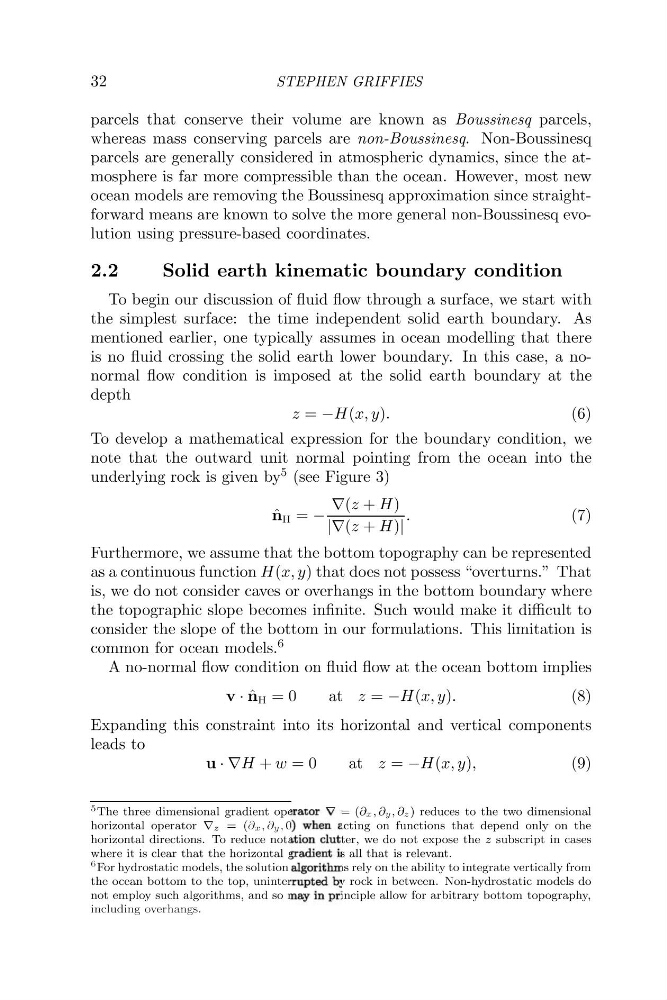
To develop a mathematical expression for the boundary condition, we
note that the outward unit normal pointing from the ocean into the
underlying rock is given by5 (see Figure 3)
Furthermore, we assume that the bottom topography can be represented
as a continuous function H(x, y) that does not possess "overturns." That
is, we do not consider caves or overhangs in the bottom boundary where
the topographic slope becomes infinite. Such would make it difficult to
consider the slope of the bottom in our formulations. This limitation is
common for ocean model^.^
A no-normal flow condition on fluid flow at the ocean bottom implies
Expanding this constraint into its horizontal and vertical components
leads to
u . VH + w = o at z = -H(x, y),
(9)
5The three dimensional gradient operator V = (a,, a,, a,) reduces to the two dimensional
horizontal operator V, = (a,, ay, 0) when acting on functions that depend only on the
horizontal directions. To reduce notation clutter, we do not expose the z subscript in cases
where it is clear that the horizontal gradient is all that is relevant.
6 ~ o r
hydrostatic models, the solution algorithms rely on the ability to integrate vertically from
the ocean bottom to the top, uninterrupted by rock in between. Non-hydrostatic models do
not employ such algorithms, and so may in principle allow for arbitrary bottom topography,
including overhangs.
STEPHEN GRIFFIES
parcels that conserve their volume are known as Boussinesq parcels,
whereas mass conserving parcels are non-Boussinesq. Non-Boussinesq
parcels are generally considered in atmospheric dynamics, since the atmosphere is far more compressible than the ocean. However, most new
ocean models are removing the Boussinesq approximation since straightforward means are known to solve the more general non-Boussinesq evolution using pressure-based coordinates.
2.2
Solid earth kinematic boundary condition
To begin our discussion of fluid flow through a surface, we start with
the simplest surface: the time independent solid earth boundary. As
mentioned earlier, one typically assumes in ocean modelling that there
is no fluid crossing the solid earth lower boundary. In this case, a nonormal flow condition is imposed at the solid earth boundary at the
depth
z = -H(x, y).
(6)
To develop a mathematical expression for the boundary condition, we
note that the outward unit normal pointing from the ocean into the
underlying rock is given by5 (see Figure 3)
Furthermore, we assume that the bottom topography can be represented
as a continuous function H(x, y) that does not possess "overturns." That
is, we do not consider caves or overhangs in the bottom boundary where
the topographic slope becomes infinite. Such would make it difficult to
consider the slope of the bottom in our formulations. This limitation is
common for ocean model^.^
A no-normal flow condition on fluid flow at the ocean bottom implies
Expanding this constraint into its horizontal and vertical components
leads to
u . VH + w = o at z = -H(x, y),
(9)
5The three dimensional gradient operator V = (a,, a,, a,) reduces to the two dimensional
horizontal operator V, = (a,, ay, 0) when acting on functions that depend only on the
horizontal directions. To reduce notation clutter, we do not expose the z subscript in cases
where it is clear that the horizontal gradient is all that is relevant.
6 ~ o r
hydrostatic models, the solution algorithms rely on the ability to integrate vertically from
the ocean bottom to the top, uninterrupted by rock in between. Non-hydrostatic models do
not employ such algorithms, and so may in principle allow for arbitrary bottom topography,
including overhangs.