

391
appreciate the impact for its own application. This loop also permits to
analyse more precisely the model performances and diagnoses the model
ability to represent physical processes. As examples of such analysis, the
Figure 3 illustrates the quality jump realised at the time of the transition
from middle (PSY1v1) to high (PSY2v1) resolution model.
3.3
Internal metrics and intercomparison plans
This third loop entered recently ocean operational centres assessment
activity thanks to the effort undergone in the GMES/EC MERSEA Strand 1
project and the GODAE experiment at international level.
An open collaboration with FOAM (UK), MFS (Italy), TOPAZ
(Norway) and HYCOM-Miami (US) teams enabled to define standard
“metrics” adopted for the North Atlantic and Mediterranean Seas and to be
extended to the global ocean (see the chapter by L. Crosnier in this volume
and http://www.mersea.eu.org/html/strand1/intercomparison.html#metrics).
This is now a core component of the assessment activity of the MERCATOR
OCEAN centre. Systematic intercomparison has already allowed clear
improvements in the different systems.
3.4
Scientific and user feedback
The fourth loop considers the feedback of the user community, with a
clear focus on the scientific community using MERCATOR outputs in its
own research activity. The MERCATOR Science Working Team is
composed of around 100 researchers, directly associated to this scientific
assessment activity and improvements of MERCATOR algorithms.
Coupling with ecosystem models, with coastal models, statistical analysis,
etc., any research initiative conducted with MERCATOR outputs conveys
direct opportunities to assess quality of the MERCATOR system.
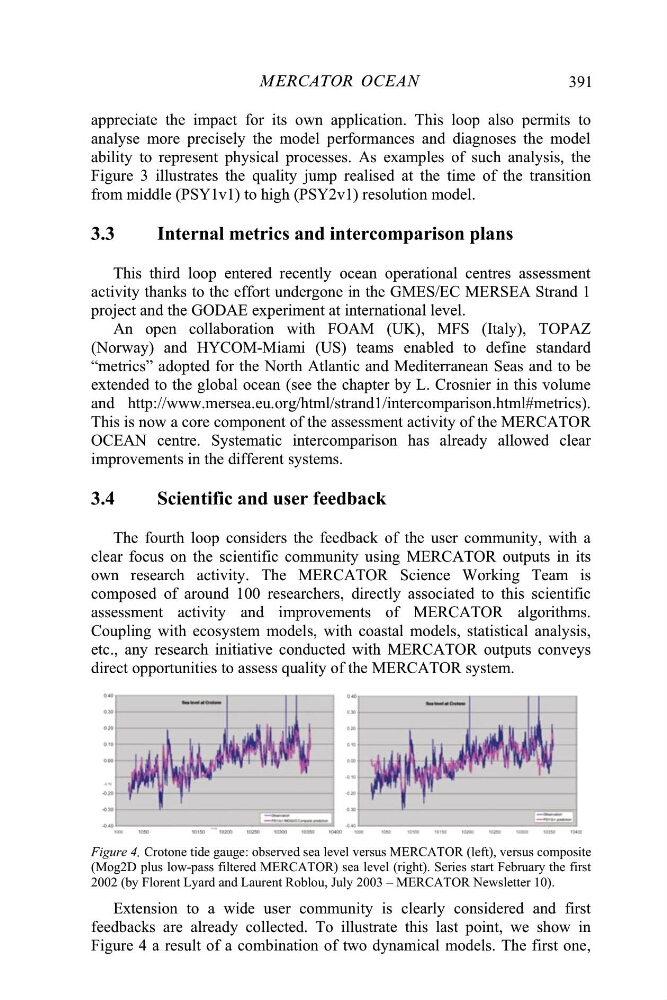
Figure 4 Crotone tide gauge: observed sea level versus MERCATOR (left), versus composite
(Mog2D plus low-pass filtered MERCATOR) sea level (right). Series start February the first
2002 (by Florent Lyard and Laurent Roblou, July 2003 – MERCATOR Newsletter 10).
Extension to a wide user community is clearly considered and first
feedbacks are already collected. To illustrate this last point, we show in
Figure 4 a result of a combination of two dynamical models. The first one,
.
MERCATOR OCEAN
appreciate the impact for its own application. This loop also permits to
analyse more precisely the model performances and diagnoses the model
ability to represent physical processes. As examples of such analysis, the
Figure 3 illustrates the quality jump realised at the time of the transition
from middle (PSY1v1) to high (PSY2v1) resolution model.
3.3
Internal metrics and intercomparison plans
This third loop entered recently ocean operational centres assessment
activity thanks to the effort undergone in the GMES/EC MERSEA Strand 1
project and the GODAE experiment at international level.
An open collaboration with FOAM (UK), MFS (Italy), TOPAZ
(Norway) and HYCOM-Miami (US) teams enabled to define standard
“metrics” adopted for the North Atlantic and Mediterranean Seas and to be
extended to the global ocean (see the chapter by L. Crosnier in this volume
and http://www.mersea.eu.org/html/strand1/intercomparison.html#metrics).
This is now a core component of the assessment activity of the MERCATOR
OCEAN centre. Systematic intercomparison has already allowed clear
improvements in the different systems.
3.4
Scientific and user feedback
The fourth loop considers the feedback of the user community, with a
clear focus on the scientific community using MERCATOR outputs in its
own research activity. The MERCATOR Science Working Team is
composed of around 100 researchers, directly associated to this scientific
assessment activity and improvements of MERCATOR algorithms.
Coupling with ecosystem models, with coastal models, statistical analysis,
etc., any research initiative conducted with MERCATOR outputs conveys
direct opportunities to assess quality of the MERCATOR system.
Figure 4 Crotone tide gauge: observed sea level versus MERCATOR (left), versus composite
(Mog2D plus low-pass filtered MERCATOR) sea level (right). Series start February the first
2002 (by Florent Lyard and Laurent Roblou, July 2003 – MERCATOR Newsletter 10).
Extension to a wide user community is clearly considered and first
feedbacks are already collected. To illustrate this last point, we show in
Figure 4 a result of a combination of two dynamical models. The first one,
.
MERCATOR OCEAN