

ICHIRO FUKUMORI
336
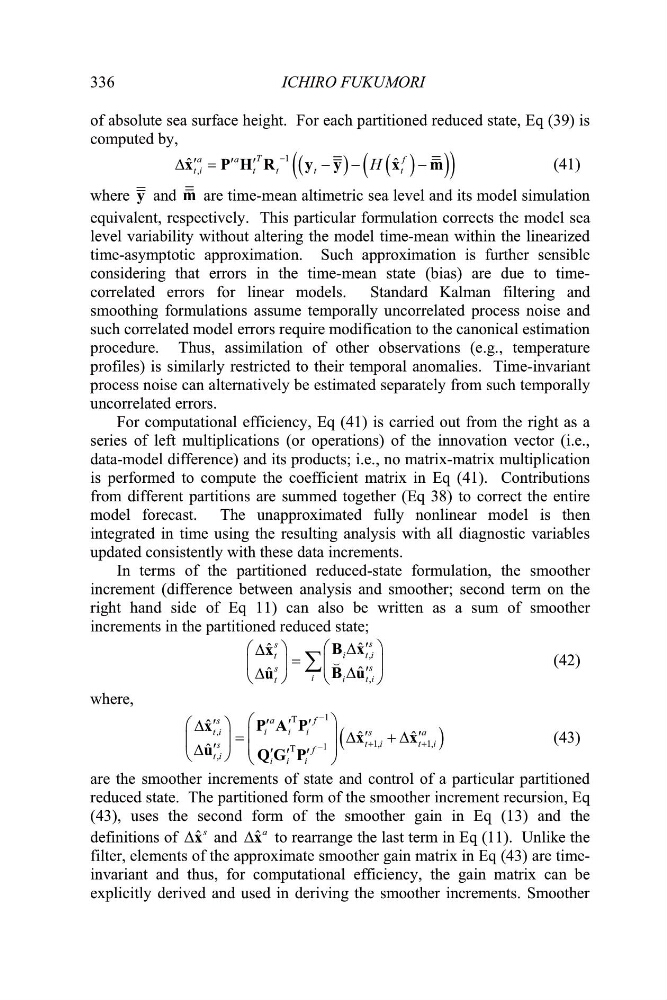
of absolute sea surface height. For each partitioned reduced state, Eq (39) is
computed by,
1
,
ˆ
ˆ
T
a
a
f
t i
t
t
t
t
H
c
c c
'
x
P H R
y y
x
m
(41)
where y and m are time-mean altimetric sea level and
y
cations (or operations) of the innovation vector (i.e.,
data
ther; second term on the
righ
its model simulation
equivalent, respectively. This particular formulation corrects the model sea
level variabilit without altering the model time-mean within the linearized
time-asymptotic approximation. Such approximation is further sensible
considering that errors in the time-mean state (bias) are due to timecorrelated errors for linear models. Standard Kalman filtering and
smoothing formulations assume temporally uncorrelated process noise and
such correlated model errors require modification to the canonical estimation
procedure. Thus, assimilation of other observations (e.g., temperature
profiles) is similarly restricted to their temporal anomalies. Time-invariant
process noise can alternatively be estimated separately from such temporally
uncorrelated errors.
For computational efficiency, Eq (41) is carried out from the right as a
series of left multipli
-model difference) and its products; i.e., no matrix-matrix multiplication
is performed to compute the coefficient matrix in Eq (41). Contributions
from different partitions are summed together (Eq 38) to correct the entire
model forecast. The unapproximated fully nonlinear model is then
integrated in time using the resulting analysis with all diagnostic variables
updated consistently with these data increments.
In terms of the partitioned reduced-state formulation, the smoother
increment (difference between analysis and smoo
t hand side of Eq 11) can also be written as a sum of smoother
increments in the partitioned reduced state;
,
ˆ
ˆ
ˆ
ˆ
,
s
s
i
ti
t
s
s
c
§
·
'
§
·
'
¨
¨
¸
c
'
'
©
¹
¦
B x
x
B u
u
i
i
ti
t
¸
©
¹
(42)
here,
'
(43)
re the smoother increments of state and control of a
reduced state. The partitioned form of the smoother increment recursion, Eq
w
1
T
,
1,
1,
1
T
,
ˆ
ˆ
ˆ
ˆ
a
f
s
i
i
i
t i
s
a
t i
t i
s
f
t i
i i
i
§
·
c c c
c
§
·
'
¨
¸
c
c
'
¨
¸ ¨
¸
c
'
c c c
©
¹ ©
¹
P A P
x
x
x
u
Q G P
a
particular partitioned
(43), uses the second form of the smoother gain in Eq (13) and the
definitions of ˆ
s
'x and ˆ
a
'x to rearrange the last term in Eq (11). Unlike the
filter, elements of the approximate smoother gain matrix in Eq (43) are timeinvariant and thus, for computational efficiency, the gain matrix can be
explicitly derived and used in deriving the smoother increments. Smoother
336
of absolute sea surface height. For each partitioned reduced state, Eq (39) is
computed by,
1
,
ˆ
ˆ
T
a
a
f
t i
t
t
t
t
H
c
c c
'
x
P H R
y y
x
m
(41)
where y and m are time-mean altimetric sea level and
y
cations (or operations) of the innovation vector (i.e.,
data
ther; second term on the
righ
its model simulation
equivalent, respectively. This particular formulation corrects the model sea
level variabilit without altering the model time-mean within the linearized
time-asymptotic approximation. Such approximation is further sensible
considering that errors in the time-mean state (bias) are due to timecorrelated errors for linear models. Standard Kalman filtering and
smoothing formulations assume temporally uncorrelated process noise and
such correlated model errors require modification to the canonical estimation
procedure. Thus, assimilation of other observations (e.g., temperature
profiles) is similarly restricted to their temporal anomalies. Time-invariant
process noise can alternatively be estimated separately from such temporally
uncorrelated errors.
For computational efficiency, Eq (41) is carried out from the right as a
series of left multipli
-model difference) and its products; i.e., no matrix-matrix multiplication
is performed to compute the coefficient matrix in Eq (41). Contributions
from different partitions are summed together (Eq 38) to correct the entire
model forecast. The unapproximated fully nonlinear model is then
integrated in time using the resulting analysis with all diagnostic variables
updated consistently with these data increments.
In terms of the partitioned reduced-state formulation, the smoother
increment (difference between analysis and smoo
t hand side of Eq 11) can also be written as a sum of smoother
increments in the partitioned reduced state;
,
ˆ
ˆ
ˆ
ˆ
,
s
s
i
ti
t
s
s
c
§
·
'
§
·
'
¨
¨
¸
c
'
'
©
¹
¦
B x
x
B u
u
i
i
ti
t
¸
©
¹
(42)
here,
'
(43)
re the smoother increments of state and control of a
reduced state. The partitioned form of the smoother increment recursion, Eq
w
1
T
,
1,
1,
1
T
,
ˆ
ˆ
ˆ
ˆ
a
f
s
i
i
i
t i
s
a
t i
t i
s
f
t i
i i
i
§
·
c c c
c
§
·
'
¨
¸
c
c
'
¨
¸ ¨
¸
c
'
c c c
©
¹ ©
¹
P A P
x
x
x
u
Q G P
a
particular partitioned
(43), uses the second form of the smoother gain in Eq (13) and the
definitions of ˆ
s
'x and ˆ
a
'x to rearrange the last term in Eq (11). Unlike the
filter, elements of the approximate smoother gain matrix in Eq (43) are timeinvariant and thus, for computational efficiency, the gain matrix can be
explicitly derived and used in deriving the smoother increments. Smoother