

ICHIRO FUKUMORI
328
y done?
W
assim
large computational requirements
5. Examples of implementing assimilation; how is
assimilation actuall
hile the theory of data assimilation is well understood, implementing
ilation is often nontrivial owing to its
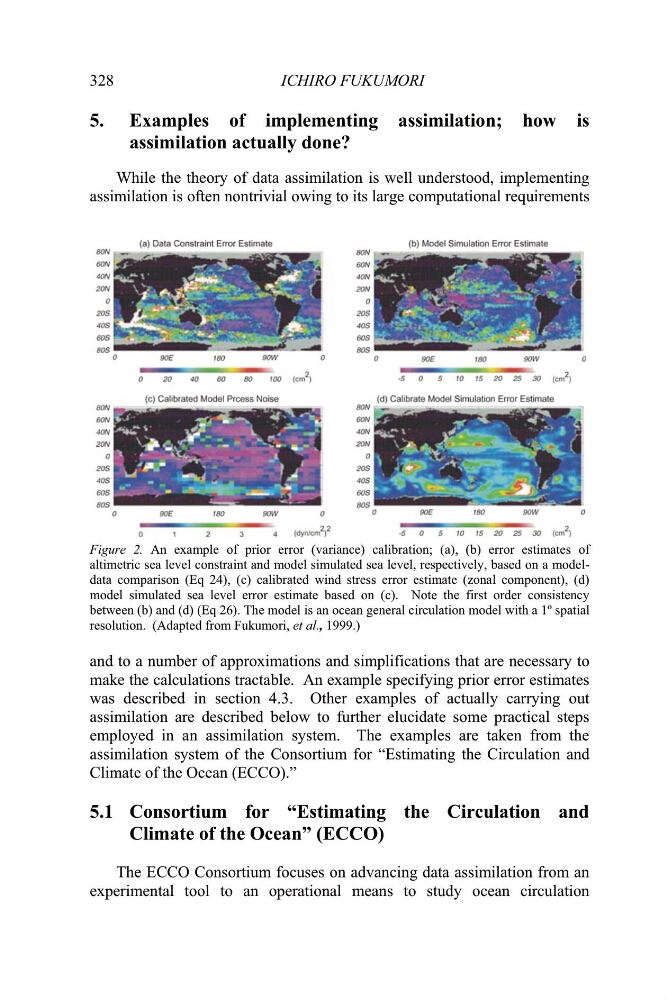
Figure 2. An example of prior error (variance) calibration; (a), (b) error estimates of
altimetric sea level constraint and model simulated sea level, respectively, based on a modeldata comparison (Eq 24), (c) calibrated wind stress error estimate (zonal component), (d)
e specifying prior error estimates
was described in section 4.3. Other examples of actually carrying out
(ECCO)
experi
to study ocean circulation
model simulated sea level error estimate based on (c). Note the first order consistency
between (b) and (d) (Eq 26). The model is an ocean general circulation model with a 1º spatial
resolution. (Adapted from Fukumori, et al., 1999.)
and to a number of approximations and simplifications that are necessary to
make the calculations tractable. An exampl
assimilation are described below to further elucidate some practical steps
employed in an assimilation system. The examples are taken from the
assimilation system of the Consortium for “Estimating the Circulation and
Climate of the Ocean (ECCO).”
5.1 Consortium for “Estimating the Circulation and
Climate of the Ocean”
The ECCO Consortium focuses on advancing data assimilation from an
mental tool to an operational means
328
y done?
W
assim
large computational requirements
5. Examples of implementing assimilation; how is
assimilation actuall
hile the theory of data assimilation is well understood, implementing
ilation is often nontrivial owing to its
Figure 2. An example of prior error (variance) calibration; (a), (b) error estimates of
altimetric sea level constraint and model simulated sea level, respectively, based on a modeldata comparison (Eq 24), (c) calibrated wind stress error estimate (zonal component), (d)
e specifying prior error estimates
was described in section 4.3. Other examples of actually carrying out
(ECCO)
experi
to study ocean circulation
model simulated sea level error estimate based on (c). Note the first order consistency
between (b) and (d) (Eq 26). The model is an ocean general circulation model with a 1º spatial
resolution. (Adapted from Fukumori, et al., 1999.)
and to a number of approximations and simplifications that are necessary to
make the calculations tractable. An exampl
assimilation are described below to further elucidate some practical steps
employed in an assimilation system. The examples are taken from the
assimilation system of the Consortium for “Estimating the Circulation and
Climate of the Ocean (ECCO).”
5.1 Consortium for “Estimating the Circulation and
Climate of the Ocean”
The ECCO Consortium focuses on advancing data assimilation from an
mental tool to an operational means