

ICHIRO FUKUMORI
326
0
1
ˆ
,
t
t
A
x
x u t
(19)
function describing the evolution of the model
stat
e
volution can be thought of similarly as,
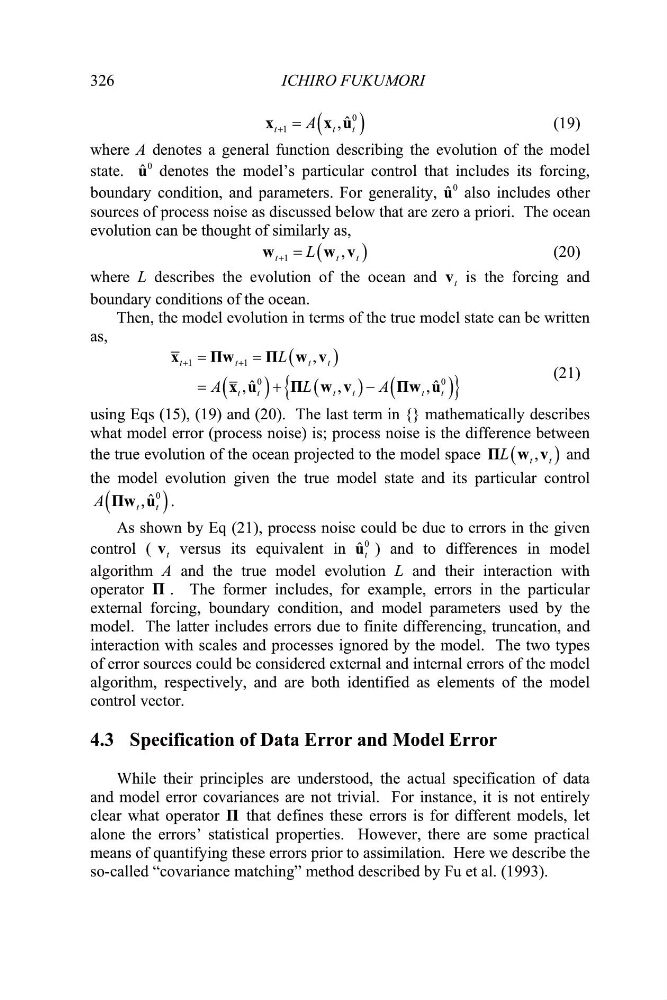
where A denotes a general
e. ˆ
u denotes the model’s particular control that includes its forcing,
boundary condition, and parameters. For generality,
0
ˆ
u also includes other
ources of process noise as discuss d belo
0
s
w that are zero a priori. The ocean
e
1
,
t
t
t
L
w
w v
(20)
where L describes the evolution of the ocean and t
v is the forcing and
boundary conditions of the ocean.
Then, the model evolution in terms of the true model state can be written
as,
^
1
1
0
0
ˆ
ˆ
,
,
,
t
t
t
t
t
t
A
L
A
x u
Ȇ w v
Ȇw u
(21)
`
,
t
t
t
t
L
x
Ȇw
Ȇ w v
usin
model error (process noise) is; process noise is the difference between
the true evolution of the ocean projected to the model space
g Eqs (15), (19) and (20). The last term in {} mathematically describes
what
,
t
t
L
Ȇ w v and
e model evolution given the true model state and i
th
ts particular control
0
ˆ
,
t
t
A Ȇw u .
As shown by Eq (21), process noise could be due to errors in the given
control ( t
v versus its equivalent in
0
ˆ t
u ) and to differe
odel
algorithm A and the true model evolution L and their interaction with
operator Ȇ . The former includes, for example, errors in the particular
nces in m
external forcing, boundary condition, and model parameters used by the
mod
,
covariances are not trivial. For instance, it is not entirely
lear what operator
that defines these errors is for different models, let
practical
e
o-c
el. The latter includes errors due to finite differencing, truncation, and
interaction with scales and processes ignored by the model. The two types
of error sources could be considered external and internal errors of the model
algorithm respectively, and are both identified as elements of the model
control vector.
4.3 Specification of Data Error and Model Error
While their principles are understood, the actual specification of data
and model error
Ȇ
c
alone the errors’ statistical properties. However, there are some
eans of quantifying these errors prior to assimilation. Here we describe th
m
s alled “covariance matching” method described by Fu et al. (1993).
326
0
1
ˆ
,
t
t
A
x
x u t
(19)
function describing the evolution of the model
stat
e
volution can be thought of similarly as,
where A denotes a general
e. ˆ
u denotes the model’s particular control that includes its forcing,
boundary condition, and parameters. For generality,
0
ˆ
u also includes other
ources of process noise as discuss d belo
0
s
w that are zero a priori. The ocean
e
1
,
t
t
t
L
w
w v
(20)
where L describes the evolution of the ocean and t
v is the forcing and
boundary conditions of the ocean.
Then, the model evolution in terms of the true model state can be written
as,
^
1
1
0
0
ˆ
ˆ
,
,
,
t
t
t
t
t
t
A
L
A
x u
Ȇ w v
Ȇw u
(21)
`
,
t
t
t
t
L
x
Ȇw
Ȇ w v
usin
model error (process noise) is; process noise is the difference between
the true evolution of the ocean projected to the model space
g Eqs (15), (19) and (20). The last term in {} mathematically describes
what
,
t
t
L
Ȇ w v and
e model evolution given the true model state and i
th
ts particular control
0
ˆ
,
t
t
A Ȇw u .
As shown by Eq (21), process noise could be due to errors in the given
control ( t
v versus its equivalent in
0
ˆ t
u ) and to differe
odel
algorithm A and the true model evolution L and their interaction with
operator Ȇ . The former includes, for example, errors in the particular
nces in m
external forcing, boundary condition, and model parameters used by the
mod
,
covariances are not trivial. For instance, it is not entirely
lear what operator
that defines these errors is for different models, let
practical
e
o-c
el. The latter includes errors due to finite differencing, truncation, and
interaction with scales and processes ignored by the model. The two types
of error sources could be considered external and internal errors of the model
algorithm respectively, and are both identified as elements of the model
control vector.
4.3 Specification of Data Error and Model Error
While their principles are understood, the actual specification of data
and model error
Ȇ
c
alone the errors’ statistical properties. However, there are some
eans of quantifying these errors prior to assimilation. Here we describe th
m
s alled “covariance matching” method described by Fu et al. (1993).