

287
for instance, can be considered as a time-invariant observation system
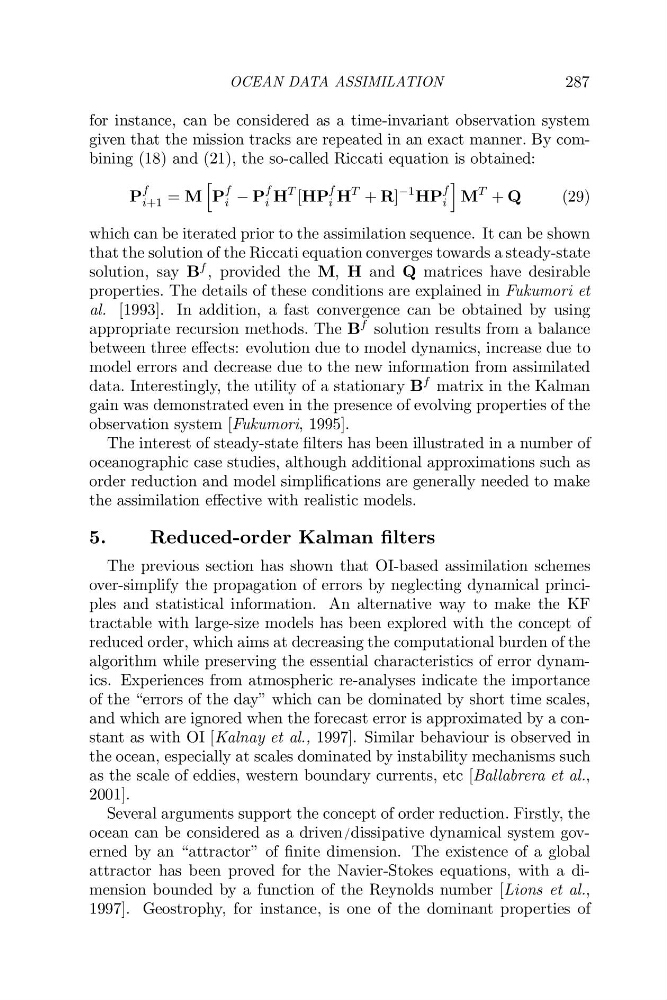
given that the mission tracks are repeated in an exact manner. By combining (18) and (21), the so-called Riccati equation is obtained:
P
f
i+1 = M
k
P
f
i P
f
i H
T
[HP
f
i H
T
+ R]
31 HP
f
i
l
M
T
+ Q
(29)
which can be iterated prior to the assimilation sequence. It can be shown
that the solution of the Riccati equation converges towards a steady-state
solution, say B f , provided the M, H and Q matrices have desirable
properties. The details of these conditions are explained in Fukumori et
al. [1993]. In addition, a fast convergence can be obtained by using
appropriate recursion methods. The B
f solution results from a balance
between three eects: evolution due to model dynamics, increase due to
model errors and decrease due to the new information from assimilated
data. Interestingly, the utility of a stationary B
f matrix in the Kalman
gain was demonstrated even in the presence of evolving properties of the
observation system [Fukumori, 1995].
The interest of steady-state filters has been illustrated in a number of
oceanographic case studies, although additional approximations such as
order reduction and model simplifications are generally needed to make
the assimilation eective with realistic models.
5.
Reduced-order Kalman filters
The previous section has shown that OI-based assimilation schemes
over-simplify the propagation of errors by neglecting dynamical principles and statistical information. An alternative way to make the KF
tractable with large-size models has been explored with the concept of
reduced order, which aims at decreasing the computational burden of the
algorithm while preserving the essential characteristics of error dynamics. Experiences from atmospheric re-analyses indicate the importance
of the “errors of the day” which can be dominated by short time scales,
and which are ignored when the forecast error is approximated by a constant as with OI [Kalnay et al., 1997]. Similar behaviour is observed in
the ocean, especially at scales dominated by instability mechanisms such
as the scale of eddies, western boundary currents, etc [Ballabrera et al.,
2001].
Several arguments support the concept of order reduction. Firstly, the
ocean can be considered as a driven/dissipative dynamical system governed by an “attractor” of finite dimension. The existence of a global
attractor has been proved for the Navier-Stokes equations, with a dimension bounded by a function of the Reynolds number [Lions et al.,
1997]. Geostrophy, for instance, is one of the dominant properties of
OCEAN DATA ASSIMILATION
for instance, can be considered as a time-invariant observation system
given that the mission tracks are repeated in an exact manner. By combining (18) and (21), the so-called Riccati equation is obtained:
P
f
i+1 = M
k
P
f
i P
f
i H
T
[HP
f
i H
T
+ R]
31 HP
f
i
l
M
T
+ Q
(29)
which can be iterated prior to the assimilation sequence. It can be shown
that the solution of the Riccati equation converges towards a steady-state
solution, say B f , provided the M, H and Q matrices have desirable
properties. The details of these conditions are explained in Fukumori et
al. [1993]. In addition, a fast convergence can be obtained by using
appropriate recursion methods. The B
f solution results from a balance
between three eects: evolution due to model dynamics, increase due to
model errors and decrease due to the new information from assimilated
data. Interestingly, the utility of a stationary B
f matrix in the Kalman
gain was demonstrated even in the presence of evolving properties of the
observation system [Fukumori, 1995].
The interest of steady-state filters has been illustrated in a number of
oceanographic case studies, although additional approximations such as
order reduction and model simplifications are generally needed to make
the assimilation eective with realistic models.
5.
Reduced-order Kalman filters
The previous section has shown that OI-based assimilation schemes
over-simplify the propagation of errors by neglecting dynamical principles and statistical information. An alternative way to make the KF
tractable with large-size models has been explored with the concept of
reduced order, which aims at decreasing the computational burden of the
algorithm while preserving the essential characteristics of error dynamics. Experiences from atmospheric re-analyses indicate the importance
of the “errors of the day” which can be dominated by short time scales,
and which are ignored when the forecast error is approximated by a constant as with OI [Kalnay et al., 1997]. Similar behaviour is observed in
the ocean, especially at scales dominated by instability mechanisms such
as the scale of eddies, western boundary currents, etc [Ballabrera et al.,
2001].
Several arguments support the concept of order reduction. Firstly, the
ocean can be considered as a driven/dissipative dynamical system governed by an “attractor” of finite dimension. The existence of a global
attractor has been proved for the Navier-Stokes equations, with a dimension bounded by a function of the Reynolds number [Lions et al.,
1997]. Geostrophy, for instance, is one of the dominant properties of
OCEAN DATA ASSIMILATION