

286
PIERRE BRASSEUR
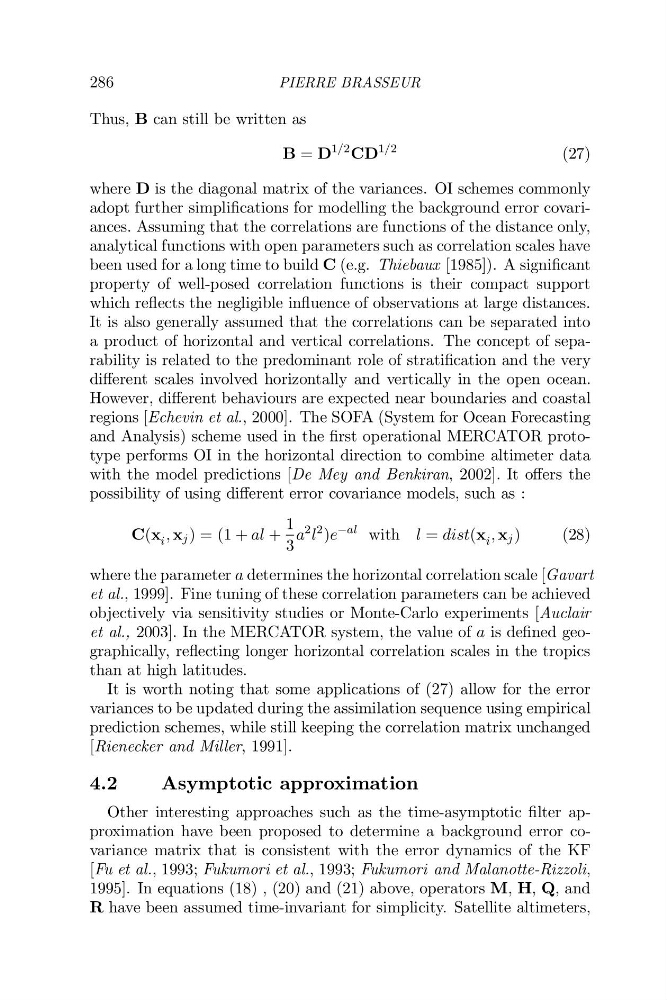
Thus, B can still be written as
B = D
1/2 CD
1/2
(27)
where D is the diagonal matrix of the variances. OI schemes commonly
adopt further simplifications for modelling the background error covariances. Assuming that the correlations are functions of the distance only,
analytical functions with open parameters such as correlation scales have
been used for a long time to build C (e.g. Thiebaux [1985]). A significant
property of well-posed correlation functions is their compact support
which reflects the negligible influence of observations at large distances.
It is also generally assumed that the correlations can be separated into
a product of horizontal and vertical correlations. The concept of separability is related to the predominant role of stratification and the very
dierent scales involved horizontally and vertically in the open ocean.
However, dierent behaviours are expected near boundaries and coastal
regions [Echevin et al., 2000]. The SOFA (System for Ocean Forecasting
and Analysis) scheme used in the first operational MERCATOR prototype performs OI in the horizontal direction to combine altimeter data
with the model predictions [De Mey and Benkiran, 2002]. It oers the
possibility of using dierent error covariance models, such as :
C(x i , x j ) = (1 + al +
1
3
a
2 l
2
)e
3al with l = dist(x i , x j )
(28)
where the parameter a determines the horizontal correlation scale [Gavart
et al., 1999]. Fine tuning of these correlation parameters can be achieved
objectively via sensitivity studies or Monte-Carlo experiments [Auclair
et al., 2003]. In the MERCATOR system, the value of a is defined geographically, reflecting longer horizontal correlation scales in the tropics
than at high latitudes.
It is worth noting that some applications of (27) allow for the error
variances to be updated during the assimilation sequence using empirical
prediction schemes, while still keeping the correlation matrix unchanged
[Rienecker and Miller, 1991].
4.2
Asymptotic approximation
Other interesting approaches such as the time-asymptotic filter approximation have been proposed to determine a background error covariance matrix that is consistent with the error dynamics of the KF
[Fu et al., 1993; Fukumori et al., 1993; Fukumori and Malanotte-Rizzoli,
1995]. In equations (18) , (20) and (21) above, operators M, H, Q, and
R have been assumed time-invariant for simplicity. Satellite altimeters,
PIERRE BRASSEUR
Thus, B can still be written as
B = D
1/2 CD
1/2
(27)
where D is the diagonal matrix of the variances. OI schemes commonly
adopt further simplifications for modelling the background error covariances. Assuming that the correlations are functions of the distance only,
analytical functions with open parameters such as correlation scales have
been used for a long time to build C (e.g. Thiebaux [1985]). A significant
property of well-posed correlation functions is their compact support
which reflects the negligible influence of observations at large distances.
It is also generally assumed that the correlations can be separated into
a product of horizontal and vertical correlations. The concept of separability is related to the predominant role of stratification and the very
dierent scales involved horizontally and vertically in the open ocean.
However, dierent behaviours are expected near boundaries and coastal
regions [Echevin et al., 2000]. The SOFA (System for Ocean Forecasting
and Analysis) scheme used in the first operational MERCATOR prototype performs OI in the horizontal direction to combine altimeter data
with the model predictions [De Mey and Benkiran, 2002]. It oers the
possibility of using dierent error covariance models, such as :
C(x i , x j ) = (1 + al +
1
3
a
2 l
2
)e
3al with l = dist(x i , x j )
(28)
where the parameter a determines the horizontal correlation scale [Gavart
et al., 1999]. Fine tuning of these correlation parameters can be achieved
objectively via sensitivity studies or Monte-Carlo experiments [Auclair
et al., 2003]. In the MERCATOR system, the value of a is defined geographically, reflecting longer horizontal correlation scales in the tropics
than at high latitudes.
It is worth noting that some applications of (27) allow for the error
variances to be updated during the assimilation sequence using empirical
prediction schemes, while still keeping the correlation matrix unchanged
[Rienecker and Miller, 1991].
4.2
Asymptotic approximation
Other interesting approaches such as the time-asymptotic filter approximation have been proposed to determine a background error covariance matrix that is consistent with the error dynamics of the KF
[Fu et al., 1993; Fukumori et al., 1993; Fukumori and Malanotte-Rizzoli,
1995]. In equations (18) , (20) and (21) above, operators M, H, Q, and
R have been assumed time-invariant for simplicity. Satellite altimeters,