

279
This allows us to write the gain also as
K i+1 = P
a
i+1 H
T R
31 ,
(22)
provided that R is invertible. Equation (21) shows that the uncertainty
in the forecast is reduced during the analysis according to the amount
of additional information assimilated in the system.
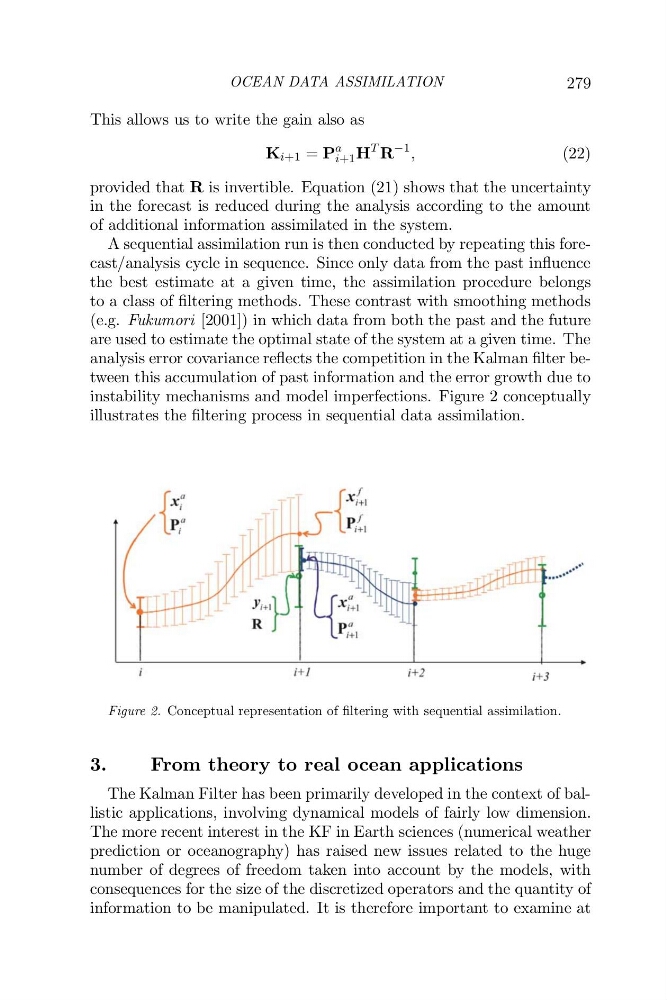
A sequential assimilation run is then conducted by repeating this forecast/analysis cycle in sequence. Since only data from the past influence
the best estimate at a given time, the assimilation procedure belongs
to a class of filtering methods. These contrast with smoothing methods
(e.g. Fukumori [2001]) in which data from both the past and the future
are used to estimate the optimal state of the system at a given time. The
analysis error covariance reflects the competition in the Kalman filter between this accumulation of past information and the error growth due to
instability mechanisms and model imperfections. Figure 2 conceptually
illustrates the filtering process in sequential data assimilation.
Figure 2. Conceptual representation of filtering with sequential assimilation.
3.
From theory to real ocean applications
The Kalman Filter has been primarily developed in the context of ballistic applications, involving dynamical models of fairly low dimension.
The more recent interest in the KF in Earth sciences (numerical weather
prediction or oceanography) has raised new issues related to the huge
number of degrees of freedom taken into account by the models, with
consequences for the size of the discretized operators and the quantity of
information to be manipulated. It is therefore important to examine at
OCEAN DATA ASSIMILATION
This allows us to write the gain also as
K i+1 = P
a
i+1 H
T R
31 ,
(22)
provided that R is invertible. Equation (21) shows that the uncertainty
in the forecast is reduced during the analysis according to the amount
of additional information assimilated in the system.
A sequential assimilation run is then conducted by repeating this forecast/analysis cycle in sequence. Since only data from the past influence
the best estimate at a given time, the assimilation procedure belongs
to a class of filtering methods. These contrast with smoothing methods
(e.g. Fukumori [2001]) in which data from both the past and the future
are used to estimate the optimal state of the system at a given time. The
analysis error covariance reflects the competition in the Kalman filter between this accumulation of past information and the error growth due to
instability mechanisms and model imperfections. Figure 2 conceptually
illustrates the filtering process in sequential data assimilation.
Figure 2. Conceptual representation of filtering with sequential assimilation.
3.
From theory to real ocean applications
The Kalman Filter has been primarily developed in the context of ballistic applications, involving dynamical models of fairly low dimension.
The more recent interest in the KF in Earth sciences (numerical weather
prediction or oceanography) has raised new issues related to the huge
number of degrees of freedom taken into account by the models, with
consequences for the size of the discretized operators and the quantity of
information to be manipulated. It is therefore important to examine at
OCEAN DATA ASSIMILATION