

SURFACE FLUXES
247
Fetch
Data
Standard
(km)
hours Mean deviation Minimum Maximum
10 - 20
200
1.14
.18
.75
2.03
20 - 100
54
1.10
.22
.73
1.87
100 - 200
85
1.13
.24
.64
1.76
unlimited
291
1.14
.21
.62
1.75
all
590
1.13
.21
.62
2.03
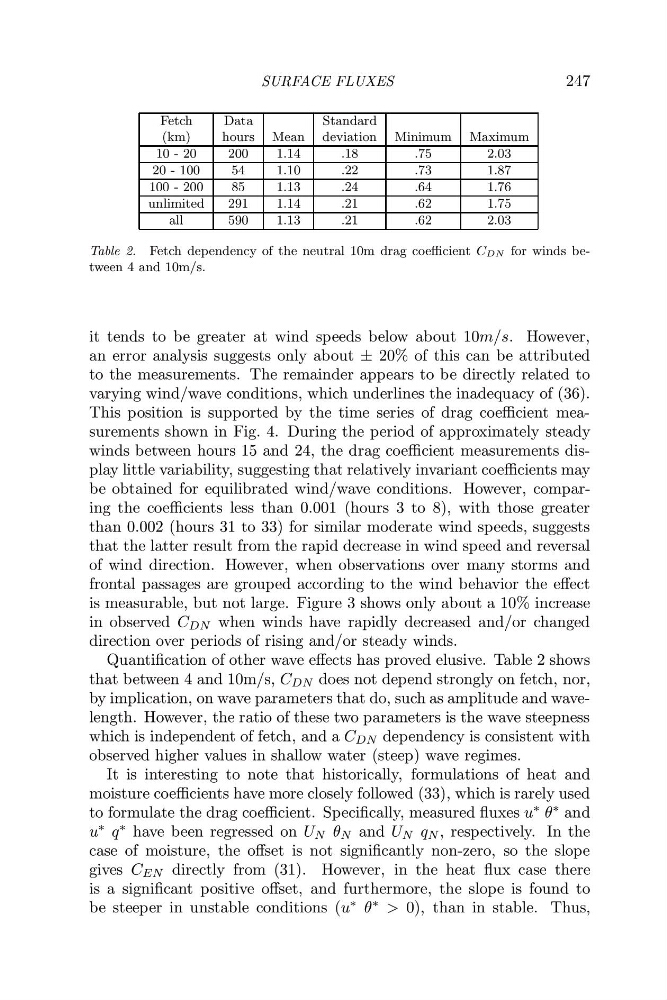
Table 2. Fetch dependency of the neutral 10m drag coefficient CDN for winds between 4 and 10m/s.
it tends to be greater at wind speeds below about 10m/s. However,
an error analysis suggests only about ± 20% of this can be attributed
to the measurements. The remainder appears to be directly related to
varying wind/wave conditions, which underlines the inadequacy of (36).
This position is supported by the time series of drag coefficient measurements shown in Fig. 4. During the period of approximately steady
winds between hours 15 and 24, the drag coefficient measurements display little variability, suggesting that relatively invariant coefficients may
be obtained for equilibrated wind/wave conditions. However, comparing the coefficients less than 0.001 (hours 3 to 8), with those greater
than 0.002 (hours 31 to 33) for similar moderate wind speeds, suggests
that the latter result from the rapid decrease in wind speed and reversal
of wind direction. However, when observations over many storms and
frontal passages are grouped according to the wind behavior the effect
is measurable, but not large. Figure 3 shows only about a 10% increase
in observed C DN when winds have rapidly decreased and/or changed
direction over periods of rising and/or steady winds.
Quantification of other wave effects has proved elusive. Table 2 shows
that between 4 and 10m/s, C DN does not depend strongly on fetch, nor,
by implication, on wave parameters that do, such as amplitude and wavelength. However, the ratio of these two parameters is the wave steepness
which is independent of fetch, and a C DN dependency is consistent with
observed higher values in shallow water (steep) wave regimes.
It is interesting to note that historically, formulations of heat and
moisture coefficients have more closely followed (33), which is rarely used
to formulate the drag coefficient. Specifically, measured fluxes u ∗ θ ∗ and
u ∗ q ∗ have been regressed on U N θ N and U N q N , respectively. In the
case of moisture, the offset is not significantly non-zero, so the slope
gives C EN directly from (31). However, in the heat flux case there
is a significant positive offset, and furthermore, the slope is found to
be steeper in unstable conditions (u ∗ θ ∗ > 0), than in stable. Thus,
247
Fetch
Data
Standard
(km)
hours Mean deviation Minimum Maximum
10 - 20
200
1.14
.18
.75
2.03
20 - 100
54
1.10
.22
.73
1.87
100 - 200
85
1.13
.24
.64
1.76
unlimited
291
1.14
.21
.62
1.75
all
590
1.13
.21
.62
2.03
Table 2. Fetch dependency of the neutral 10m drag coefficient CDN for winds between 4 and 10m/s.
it tends to be greater at wind speeds below about 10m/s. However,
an error analysis suggests only about ± 20% of this can be attributed
to the measurements. The remainder appears to be directly related to
varying wind/wave conditions, which underlines the inadequacy of (36).
This position is supported by the time series of drag coefficient measurements shown in Fig. 4. During the period of approximately steady
winds between hours 15 and 24, the drag coefficient measurements display little variability, suggesting that relatively invariant coefficients may
be obtained for equilibrated wind/wave conditions. However, comparing the coefficients less than 0.001 (hours 3 to 8), with those greater
than 0.002 (hours 31 to 33) for similar moderate wind speeds, suggests
that the latter result from the rapid decrease in wind speed and reversal
of wind direction. However, when observations over many storms and
frontal passages are grouped according to the wind behavior the effect
is measurable, but not large. Figure 3 shows only about a 10% increase
in observed C DN when winds have rapidly decreased and/or changed
direction over periods of rising and/or steady winds.
Quantification of other wave effects has proved elusive. Table 2 shows
that between 4 and 10m/s, C DN does not depend strongly on fetch, nor,
by implication, on wave parameters that do, such as amplitude and wavelength. However, the ratio of these two parameters is the wave steepness
which is independent of fetch, and a C DN dependency is consistent with
observed higher values in shallow water (steep) wave regimes.
It is interesting to note that historically, formulations of heat and
moisture coefficients have more closely followed (33), which is rarely used
to formulate the drag coefficient. Specifically, measured fluxes u ∗ θ ∗ and
u ∗ q ∗ have been regressed on U N θ N and U N q N , respectively. In the
case of moisture, the offset is not significantly non-zero, so the slope
gives C EN directly from (31). However, in the heat flux case there
is a significant positive offset, and furthermore, the slope is found to
be steeper in unstable conditions (u ∗ θ ∗ > 0), than in stable. Thus,