

IN SITU OBSERVATIONS: SYSTEMS AND MANAGEMENT
215
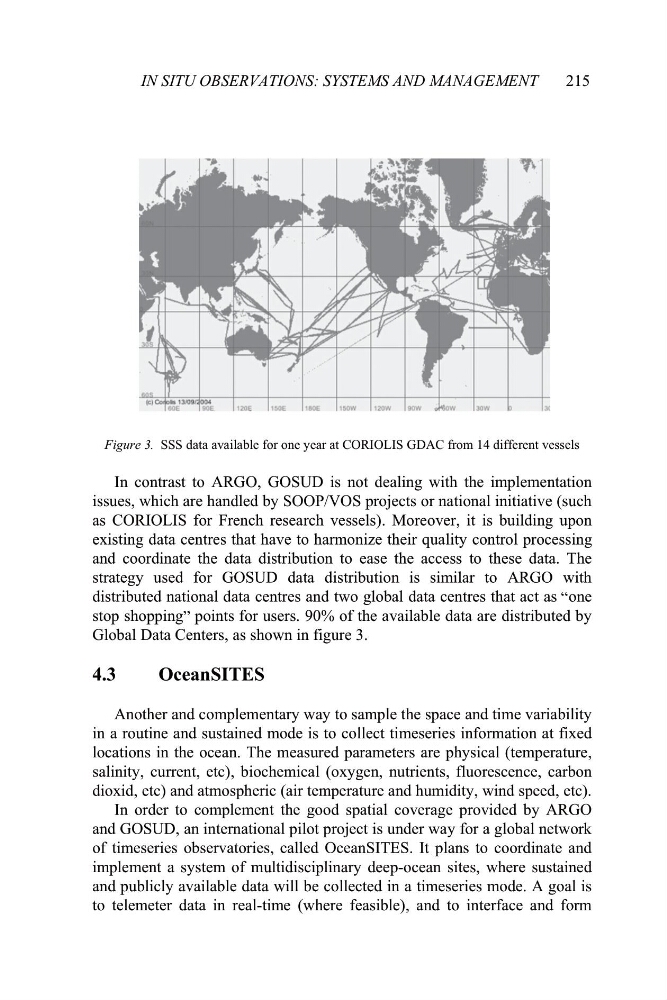
Figure 3. SSS data available for one year at CORIOLIS GDAC from 14 different vessels
In contrast to ARGO, GOSUD is not dealing with the implementation
issues, which are handled by SOOP/VOS projects or national initiative (such
as CORIOLIS for French research vessels). Moreover, it is building upon
existing data centres that have to harmonize their quality control processing
and coordinate the data distribution to ease the access to these data. The
strategy used for GOSUD data distribution is similar to ARGO with
distributed national data centres and two global data centres that act as one
stop shopping points for users. 90% of the available data are distributed by
Global Data Centers, as shown in figure 3.
4.3
OceanSITES
Another and complementary way to sample the space and time variability
in a routine and sustained mode is to collect timeseries information at fixed
locations in the ocean. The measured parameters are physical (temperature,
salinity, current, etc), biochemical (oxygen, nutrients, fluorescence, carbon
dioxid, etc) and atmospheric (air temperature and humidity, wind speed, etc).
In order to complement the good spatial coverage provided by ARGO
and GOSUD, an international pilot project is under way for a global network
of timeseries observatories, called OceanSITES. It plans to coordinate and
implement a system of multidisciplinary deep-ocean sites, where sustained
and publicly available data will be collected in a timeseries mode. A goal is
to telemeter data in real-time (where feasible), and to interface and form
“
”
215
Figure 3. SSS data available for one year at CORIOLIS GDAC from 14 different vessels
In contrast to ARGO, GOSUD is not dealing with the implementation
issues, which are handled by SOOP/VOS projects or national initiative (such
as CORIOLIS for French research vessels). Moreover, it is building upon
existing data centres that have to harmonize their quality control processing
and coordinate the data distribution to ease the access to these data. The
strategy used for GOSUD data distribution is similar to ARGO with
distributed national data centres and two global data centres that act as one
stop shopping points for users. 90% of the available data are distributed by
Global Data Centers, as shown in figure 3.
4.3
OceanSITES
Another and complementary way to sample the space and time variability
in a routine and sustained mode is to collect timeseries information at fixed
locations in the ocean. The measured parameters are physical (temperature,
salinity, current, etc), biochemical (oxygen, nutrients, fluorescence, carbon
dioxid, etc) and atmospheric (air temperature and humidity, wind speed, etc).
In order to complement the good spatial coverage provided by ARGO
and GOSUD, an international pilot project is under way for a global network
of timeseries observatories, called OceanSITES. It plans to coordinate and
implement a system of multidisciplinary deep-ocean sites, where sustained
and publicly available data will be collected in a timeseries mode. A goal is
to telemeter data in real-time (where feasible), and to interface and form
“
”