

SATELLITE MEASUREMENTS
169
3.3.2
Satellite infrared sensors
An infrared sensor records the radiance detected at the top of the
atmosphere in specific wavebands, O n . The individual measurements in each
channel, n, can be expressed as an equivalent black body brightness
temperature, T bn , that is the temperature required for a black body with 100%
emissivity to emit the measured radiance. At a particular wavelength, black
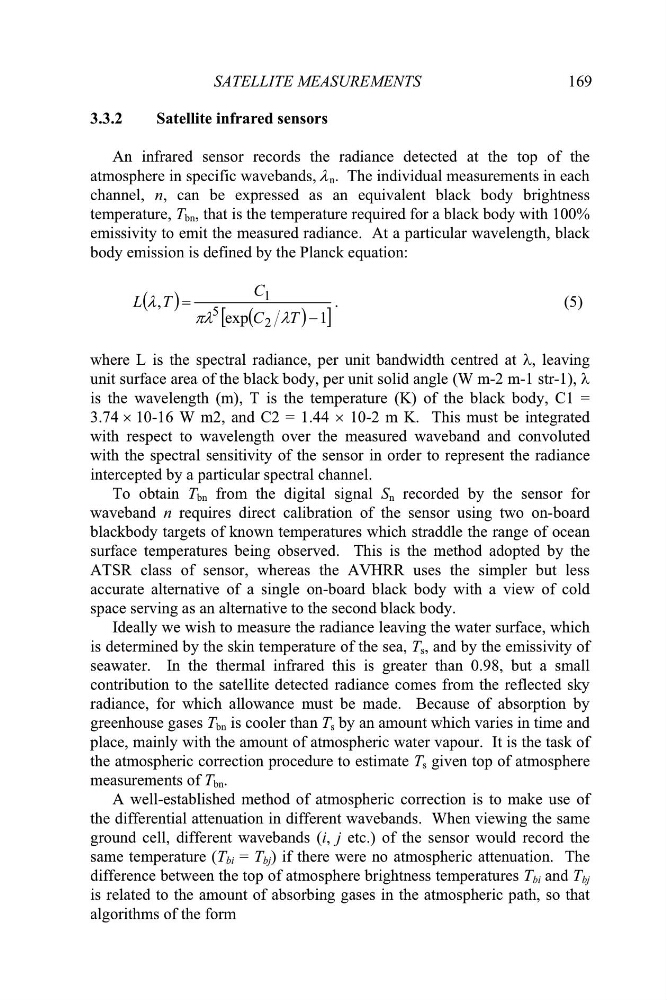
body emission is defined by the Planck equation:
>
@
1
exp
,
2
5
1
T
C
C
T
L
O
SO
O
.
(5)
where L is the spectral radiance, per unit bandwidth centred at O, leaving
unit surface area of the black body, per unit solid angle (W m-2 m-1 str-1), O
is the wavelength (m), T is the temperature (K) of the black body, C1 =
3.74 u 10-16 W m2, and C2 = 1.44 u 10-2 m K. This must be integrated
with respect to wavelength over the measured waveband and convoluted
with the spectral sensitivity of the sensor in order to represent the radiance
intercepted by a particular spectral channel.
To obtain T bn from the digital signal S n recorded by the sensor for
waveband n requires direct calibration of the sensor using two on-board
blackbody targets of known temperatures which straddle the range of ocean
surface temperatures being observed. This is the method adopted by the
ATSR class of sensor, whereas the AVHRR uses the simpler but less
accurate alternative of a single on-board black body with a view of cold
space serving as an alternative to the second black body.
Ideally we wish to measure the radiance leaving the water surface, which
is determined by the skin temperature of the sea, T s , and by the emissivity of
seawater. In the thermal infrared this is greater than 0.98, but a small
contribution to the satellite detected radiance comes from the reflected sky
radiance, for which allowance must be made. Because of absorption by
greenhouse gases T bn is cooler than T s by an amount which varies in time and
place, mainly with the amount of atmospheric water vapour. It is the task of
the atmospheric correction procedure to estimate T s given top of atmosphere
measurements of T bn .
A well-established method of atmospheric correction is to make use of
the differential attenuation in different wavebands. When viewing the same
ground cell, different wavebands (i, j etc.) of the sensor would record the
same temperature (T bi = T bj ) if there were no atmospheric attenuation. The
difference between the top of atmosphere brightness temperatures T bi and T bj
is related to the amount of absorbing gases in the atmospheric path, so that
algorithms of the form
169
3.3.2
Satellite infrared sensors
An infrared sensor records the radiance detected at the top of the
atmosphere in specific wavebands, O n . The individual measurements in each
channel, n, can be expressed as an equivalent black body brightness
temperature, T bn , that is the temperature required for a black body with 100%
emissivity to emit the measured radiance. At a particular wavelength, black
body emission is defined by the Planck equation:
>
@
1
exp
,
2
5
1
T
C
C
T
L
O
SO
O
.
(5)
where L is the spectral radiance, per unit bandwidth centred at O, leaving
unit surface area of the black body, per unit solid angle (W m-2 m-1 str-1), O
is the wavelength (m), T is the temperature (K) of the black body, C1 =
3.74 u 10-16 W m2, and C2 = 1.44 u 10-2 m K. This must be integrated
with respect to wavelength over the measured waveband and convoluted
with the spectral sensitivity of the sensor in order to represent the radiance
intercepted by a particular spectral channel.
To obtain T bn from the digital signal S n recorded by the sensor for
waveband n requires direct calibration of the sensor using two on-board
blackbody targets of known temperatures which straddle the range of ocean
surface temperatures being observed. This is the method adopted by the
ATSR class of sensor, whereas the AVHRR uses the simpler but less
accurate alternative of a single on-board black body with a view of cold
space serving as an alternative to the second black body.
Ideally we wish to measure the radiance leaving the water surface, which
is determined by the skin temperature of the sea, T s , and by the emissivity of
seawater. In the thermal infrared this is greater than 0.98, but a small
contribution to the satellite detected radiance comes from the reflected sky
radiance, for which allowance must be made. Because of absorption by
greenhouse gases T bn is cooler than T s by an amount which varies in time and
place, mainly with the amount of atmospheric water vapour. It is the task of
the atmospheric correction procedure to estimate T s given top of atmosphere
measurements of T bn .
A well-established method of atmospheric correction is to make use of
the differential attenuation in different wavebands. When viewing the same
ground cell, different wavebands (i, j etc.) of the sensor would record the
same temperature (T bi = T bj ) if there were no atmospheric attenuation. The
difference between the top of atmosphere brightness temperatures T bi and T bj
is related to the amount of absorbing gases in the atmospheric path, so that
algorithms of the form