

164
IAN ROBINSON
green. Therefore, as the chlorophyll concentration increases, more blue light
is absorbed while the green light continues to be scattered and so from above
the sea water looks greener. This is the basis for many of the quantitative
estimates of sea water content derived from satellite ocean colour data. The
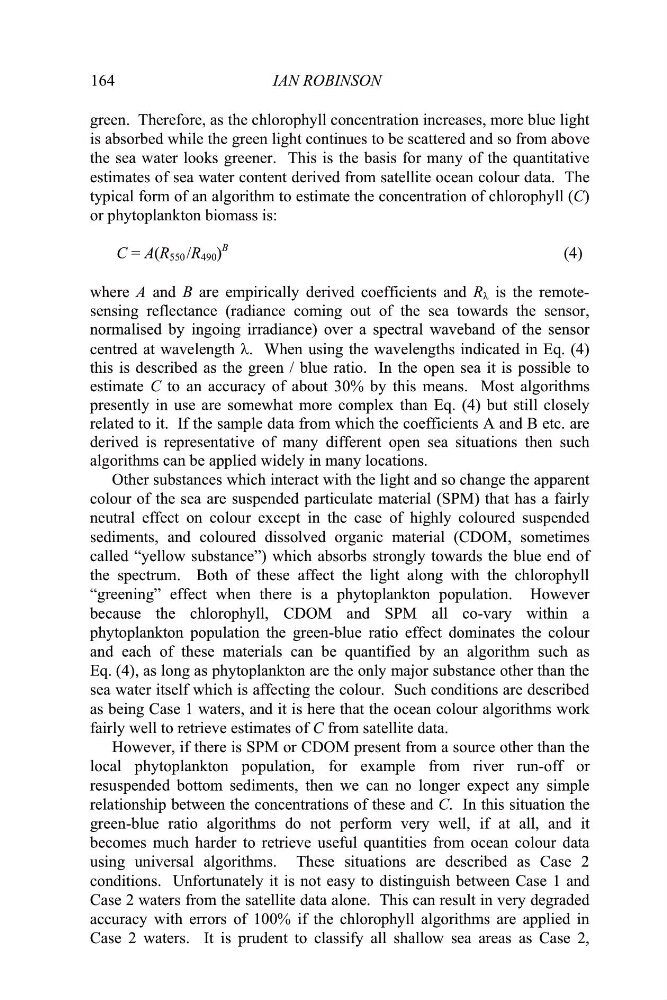
typical form of an algorithm to estimate the concentration of chlorophyll (C)
or phytoplankton biomass is:
C = A(R 550 /R 490 )
B
(4)
where A and B are empirically derived coefficients and R O is the remotesensing reflectance (radiance coming out of the sea towards the sensor,
normalised by ingoing irradiance) over a spectral waveband of the sensor
centred at wavelength O. When using the wavelengths indicated in Eq. (4)
this is described as the green / blue ratio. In the open sea it is possible to
estimate C to an accuracy of about 30% by this means. Most algorithms
presently in use are somewhat more complex than Eq. (4) but still closely
related to it. If the sample data from which the coefficients A and B etc. are
derived is representative of many different open sea situations then such
algorithms can be applied widely in many locations.
Other substances which interact with the light and so change the apparent
colour of the sea are suspended particulate material (SPM) that has a fairly
neutral effect on colour except in the case of highly coloured suspended
sediments, and coloured dissolved organic material (CDOM, sometimes
called “yellow substance”) which absorbs strongly towards the blue end of
the spectrum. Both of these affect the light along with the chlorophyll
“greening” effect when there is a phytoplankton population. However
because the chlorophyll, CDOM and SPM all co-vary within a
phytoplankton population the green-blue ratio effect dominates the colour
and each of these materials can be quantified by an algorithm such as
Eq. (4), as long as phytoplankton are the only major substance other than the
sea water itself which is affecting the colour. Such conditions are described
as being Case 1 waters, and it is here that the ocean colour algorithms work
fairly well to retrieve estimates of C from satellite data.
However, if there is SPM or CDOM present from a source other than the
local phytoplankton population, for example from river run-off or
resuspended bottom sediments, then we can no longer expect any simple
relationship between the concentrations of these and C. In this situation the
green-blue ratio algorithms do not perform very well, if at all, and it
becomes much harder to retrieve useful quantities from ocean colour data
using universal algorithms. These situations are described as Case 2
conditions. Unfortunately it is not easy to distinguish between Case 1 and
Case 2 waters from the satellite data alone. This can result in very degraded
accuracy with errors of 100% if the chlorophyll algorithms are applied in
Case 2 waters. It is prudent to classify all shallow sea areas as Case 2,
IAN ROBINSON
green. Therefore, as the chlorophyll concentration increases, more blue light
is absorbed while the green light continues to be scattered and so from above
the sea water looks greener. This is the basis for many of the quantitative
estimates of sea water content derived from satellite ocean colour data. The
typical form of an algorithm to estimate the concentration of chlorophyll (C)
or phytoplankton biomass is:
C = A(R 550 /R 490 )
B
(4)
where A and B are empirically derived coefficients and R O is the remotesensing reflectance (radiance coming out of the sea towards the sensor,
normalised by ingoing irradiance) over a spectral waveband of the sensor
centred at wavelength O. When using the wavelengths indicated in Eq. (4)
this is described as the green / blue ratio. In the open sea it is possible to
estimate C to an accuracy of about 30% by this means. Most algorithms
presently in use are somewhat more complex than Eq. (4) but still closely
related to it. If the sample data from which the coefficients A and B etc. are
derived is representative of many different open sea situations then such
algorithms can be applied widely in many locations.
Other substances which interact with the light and so change the apparent
colour of the sea are suspended particulate material (SPM) that has a fairly
neutral effect on colour except in the case of highly coloured suspended
sediments, and coloured dissolved organic material (CDOM, sometimes
called “yellow substance”) which absorbs strongly towards the blue end of
the spectrum. Both of these affect the light along with the chlorophyll
“greening” effect when there is a phytoplankton population. However
because the chlorophyll, CDOM and SPM all co-vary within a
phytoplankton population the green-blue ratio effect dominates the colour
and each of these materials can be quantified by an algorithm such as
Eq. (4), as long as phytoplankton are the only major substance other than the
sea water itself which is affecting the colour. Such conditions are described
as being Case 1 waters, and it is here that the ocean colour algorithms work
fairly well to retrieve estimates of C from satellite data.
However, if there is SPM or CDOM present from a source other than the
local phytoplankton population, for example from river run-off or
resuspended bottom sediments, then we can no longer expect any simple
relationship between the concentrations of these and C. In this situation the
green-blue ratio algorithms do not perform very well, if at all, and it
becomes much harder to retrieve useful quantities from ocean colour data
using universal algorithms. These situations are described as Case 2
conditions. Unfortunately it is not easy to distinguish between Case 1 and
Case 2 waters from the satellite data alone. This can result in very degraded
accuracy with errors of 100% if the chlorophyll algorithms are applied in
Case 2 waters. It is prudent to classify all shallow sea areas as Case 2,