

NESTING OCEAN MODELS
137
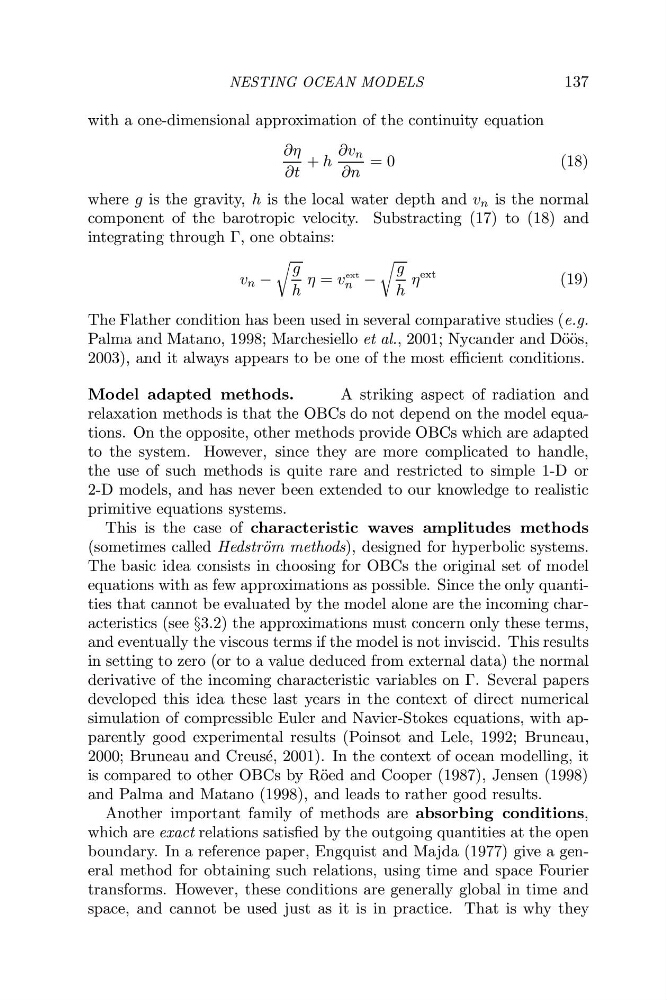
with a one-dimensional approximation of the continuity equation
∂η
∂t
+ h
∂v n
∂n
= 0
(18)
where g is the gravity, h is the local water depth and v n is the normal
component of the barotropic velocity. Substracting (17) to (18) and
integrating through Γ, one obtains:
v n −
g
h
η = v
ext
n −
g
h
η
ext
(19)
The Flather condition has been used in several comparative studies (e.g.
Palma and Matano, 1998; Marchesiello et al., 2001; Nycander and D¨ o¨ os,
2003), and it always appears to be one of the most efficient conditions.
Model adapted methods.
A striking aspect of radiation and
relaxation methods is that the OBCs do not depend on the model equations. On the opposite, other methods provide OBCs which are adapted
to the system. However, since they are more complicated to handle,
the use of such methods is quite rare and restricted to simple 1-D or
2-D models, and has never been extended to our knowledge to realistic
primitive equations systems.
This is the case of characteristic waves amplitudes methods
(sometimes called Hedstr¨ om methods), designed for hyperbolic systems.
The basic idea consists in choosing for OBCs the original set of model
equations with as few approximations as possible. Since the only quantities that cannot be evaluated by the model alone are the incoming characteristics (see §3.2) the approximations must concern only these terms,
and eventually the viscous terms if the model is not inviscid. This results
in setting to zero (or to a value deduced from external data) the normal
derivative of the incoming characteristic variables on Γ. Several papers
developed this idea these last years in the context of direct numerical
simulation of compressible Euler and Navier-Stokes equations, with apparently good experimental results (Poinsot and Lele, 1992; Bruneau,
2000; Bruneau and Creus´ e, 2001). In the context of ocean modelling, it
is compared to other OBCs by R¨ oed and Cooper (1987), Jensen (1998)
and Palma and Matano (1998), and leads to rather good results.
Another important family of methods are absorbing conditions,
which are exact relations satisfied by the outgoing quantities at the open
boundary. In a reference paper, Engquist and Majda (1977) give a general method for obtaining such relations, using time and space Fourier
transforms. However, these conditions are generally global in time and
space, and cannot be used just as it is in practice. That is why they
137
with a one-dimensional approximation of the continuity equation
∂η
∂t
+ h
∂v n
∂n
= 0
(18)
where g is the gravity, h is the local water depth and v n is the normal
component of the barotropic velocity. Substracting (17) to (18) and
integrating through Γ, one obtains:
v n −
g
h
η = v
ext
n −
g
h
η
ext
(19)
The Flather condition has been used in several comparative studies (e.g.
Palma and Matano, 1998; Marchesiello et al., 2001; Nycander and D¨ o¨ os,
2003), and it always appears to be one of the most efficient conditions.
Model adapted methods.
A striking aspect of radiation and
relaxation methods is that the OBCs do not depend on the model equations. On the opposite, other methods provide OBCs which are adapted
to the system. However, since they are more complicated to handle,
the use of such methods is quite rare and restricted to simple 1-D or
2-D models, and has never been extended to our knowledge to realistic
primitive equations systems.
This is the case of characteristic waves amplitudes methods
(sometimes called Hedstr¨ om methods), designed for hyperbolic systems.
The basic idea consists in choosing for OBCs the original set of model
equations with as few approximations as possible. Since the only quantities that cannot be evaluated by the model alone are the incoming characteristics (see §3.2) the approximations must concern only these terms,
and eventually the viscous terms if the model is not inviscid. This results
in setting to zero (or to a value deduced from external data) the normal
derivative of the incoming characteristic variables on Γ. Several papers
developed this idea these last years in the context of direct numerical
simulation of compressible Euler and Navier-Stokes equations, with apparently good experimental results (Poinsot and Lele, 1992; Bruneau,
2000; Bruneau and Creus´ e, 2001). In the context of ocean modelling, it
is compared to other OBCs by R¨ oed and Cooper (1987), Jensen (1998)
and Palma and Matano (1998), and leads to rather good results.
Another important family of methods are absorbing conditions,
which are exact relations satisfied by the outgoing quantities at the open
boundary. In a reference paper, Engquist and Majda (1977) give a general method for obtaining such relations, using time and space Fourier
transforms. However, these conditions are generally global in time and
space, and cannot be used just as it is in practice. That is why they