

136
ERIC BLAYO AND LAURENT DEBREU
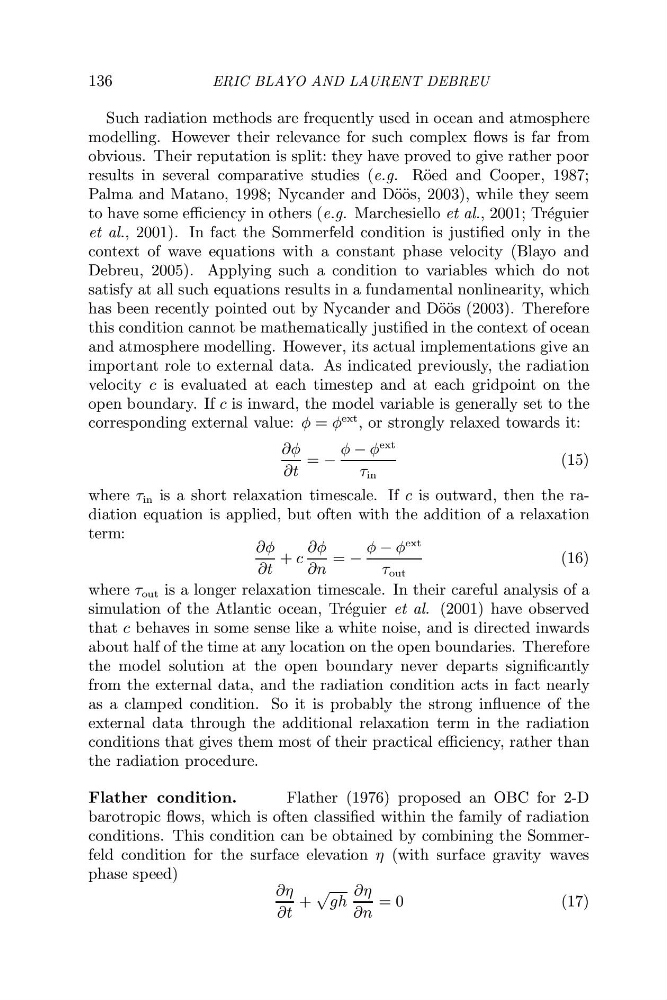
Such radiation methods are frequently used in ocean and atmosphere
modelling. However their relevance for such complex flows is far from
obvious. Their reputation is split: they have proved to give rather poor
results in several comparative studies (e.g. R¨ oed and Cooper, 1987;
Palma and Matano, 1998; Nycander and D¨ o¨ os, 2003), while they seem
to have some efficiency in others (e.g. Marchesiello et al., 2001; Tr´ eguier
et al., 2001). In fact the Sommerfeld condition is justified only in the
context of wave equations with a constant phase velocity (Blayo and
Debreu, 2005). Applying such a condition to variables which do not
satisfy at all such equations results in a fundamental nonlinearity, which
has been recently pointed out by Nycander and D¨ o¨ os (2003). Therefore
this condition cannot be mathematically justified in the context of ocean
and atmosphere modelling. However, its actual implementations give an
important role to external data. As indicated previously, the radiation
velocity c is evaluated at each timestep and at each gridpoint on the
open boundary. If c is inward, the model variable is generally set to the
corresponding external value: φ = φ
ext , or strongly relaxed towards it:
∂φ
∂t
= −
φ − φ
ext
τ in
(15)
where τ in is a short relaxation timescale. If c is outward, then the radiation equation is applied, but often with the addition of a relaxation
term:
∂φ
∂t
+ c
∂φ
∂n
= −
φ − φ
ext
τ out
(16)
where τ out is a longer relaxation timescale. In their careful analysis of a
simulation of the Atlantic ocean, Tr´ eguier et al. (2001) have observed
that c behaves in some sense like a white noise, and is directed inwards
about half of the time at any location on the open boundaries. Therefore
the model solution at the open boundary never departs significantly
from the external data, and the radiation condition acts in fact nearly
as a clamped condition. So it is probably the strong influence of the
external data through the additional relaxation term in the radiation
conditions that gives them most of their practical efficiency, rather than
the radiation procedure.
Flather condition.
Flather (1976) proposed an OBC for 2-D
barotropic flows, which is often classified within the family of radiation
conditions. This condition can be obtained by combining the Sommerfeld condition for the surface elevation η (with surface gravity waves
phase speed)
∂η
∂t
+
gh
∂η
∂n
= 0
(17)
ERIC BLAYO AND LAURENT DEBREU
Such radiation methods are frequently used in ocean and atmosphere
modelling. However their relevance for such complex flows is far from
obvious. Their reputation is split: they have proved to give rather poor
results in several comparative studies (e.g. R¨ oed and Cooper, 1987;
Palma and Matano, 1998; Nycander and D¨ o¨ os, 2003), while they seem
to have some efficiency in others (e.g. Marchesiello et al., 2001; Tr´ eguier
et al., 2001). In fact the Sommerfeld condition is justified only in the
context of wave equations with a constant phase velocity (Blayo and
Debreu, 2005). Applying such a condition to variables which do not
satisfy at all such equations results in a fundamental nonlinearity, which
has been recently pointed out by Nycander and D¨ o¨ os (2003). Therefore
this condition cannot be mathematically justified in the context of ocean
and atmosphere modelling. However, its actual implementations give an
important role to external data. As indicated previously, the radiation
velocity c is evaluated at each timestep and at each gridpoint on the
open boundary. If c is inward, the model variable is generally set to the
corresponding external value: φ = φ
ext , or strongly relaxed towards it:
∂φ
∂t
= −
φ − φ
ext
τ in
(15)
where τ in is a short relaxation timescale. If c is outward, then the radiation equation is applied, but often with the addition of a relaxation
term:
∂φ
∂t
+ c
∂φ
∂n
= −
φ − φ
ext
τ out
(16)
where τ out is a longer relaxation timescale. In their careful analysis of a
simulation of the Atlantic ocean, Tr´ eguier et al. (2001) have observed
that c behaves in some sense like a white noise, and is directed inwards
about half of the time at any location on the open boundaries. Therefore
the model solution at the open boundary never departs significantly
from the external data, and the radiation condition acts in fact nearly
as a clamped condition. So it is probably the strong influence of the
external data through the additional relaxation term in the radiation
conditions that gives them most of their practical efficiency, rather than
the radiation procedure.
Flather condition.
Flather (1976) proposed an OBC for 2-D
barotropic flows, which is often classified within the family of radiation
conditions. This condition can be obtained by combining the Sommerfeld condition for the surface elevation η (with surface gravity waves
phase speed)
∂η
∂t
+
gh
∂η
∂n
= 0
(17)