

HYBRID VERTICAL COORDINATES
119
It is for this reason that experiments continue in which T, S are
replaced as prognostic variables in HYCOM by pairs of thermodynamic
tracers which are more likely to maintain the coherence of T, S fronts
during advection. In MICOM’s isopycnic interior, this is presently achieved by advecting only one variable, S or T , and diagnosing the other
one knowing ρ. The most straightforward generalization of this concept
to the HYCOM case is to advect, as is done in MICOM’s slab mixed
layer, either the pair ρ, S or the pair ρ, T . An alternative approach,
which addresses the pitfalls of diagnosing either T from S or S from T ,
is discussed below.
3.1
Spiciness
Because the density of near-freezing sea water is mainly a function
of salinity, diagnosing T from ρ and S is an ill-posed problem in polar
oceans – in the sense that small changes in S or ρ can bring about
large changes in the diagnosed value of T . If advecting ρ in HYCOM is
deemed important for maintaining the spatial coherence of T, S fronts,
then the ideal second variable to be advected should be one whose isolines
are everywhere orthogonal to isopycnals in T, S space. Such a variable
exists and has become known as spiciness (Flament, 2002).
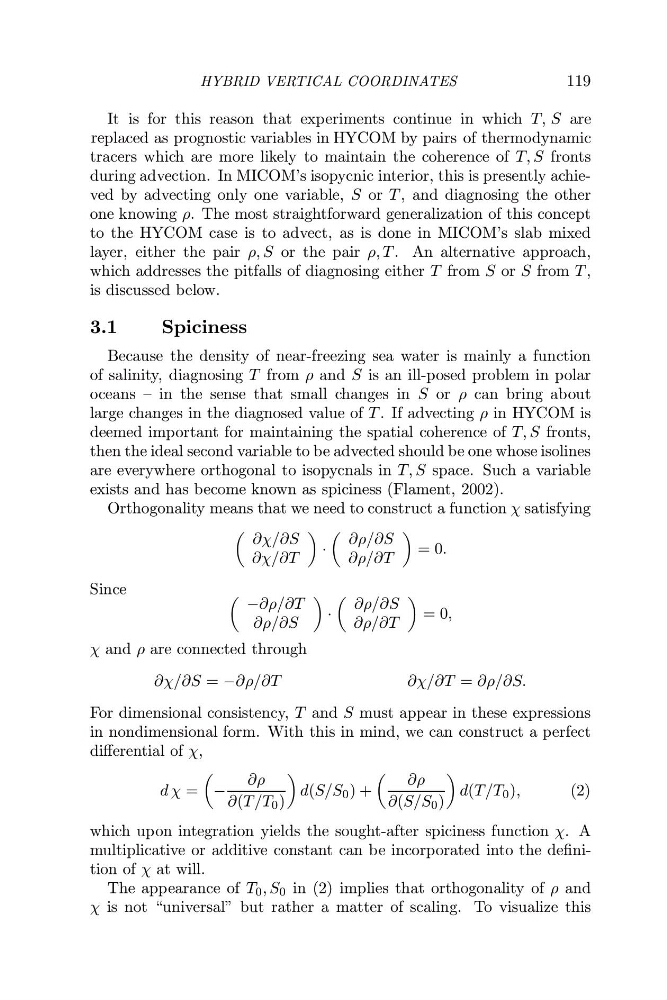
Orthogonality means that we need to construct a function χ satisfying
∂χ/∂S
∂χ/∂T
·
∂ρ/∂S
∂ρ/∂T
= 0.
Since
−∂ρ/∂T
∂ρ/∂S
·
∂ρ/∂S
∂ρ/∂T
= 0,
χ and ρ are connected through
∂χ/∂S = −∂ρ/∂T
∂χ/∂T = ∂ρ/∂S.
For dimensional consistency, T and S must appear in these expressions
in nondimensional form. With this in mind, we can construct a perfect
differential of χ,
d χ =
−
∂ρ
∂(T/T 0 )
d(S/S 0 ) +
∂ρ
∂(S/S 0 )
d(T/T 0 ),
(2)
which upon integration yields the sought-after spiciness function χ. A
multiplicative or additive constant can be incorporated into the definition of χ at will.
The appearance of T 0 , S 0 in (2) implies that orthogonality of ρ and
χ is not “universal” but rather a matter of scaling. To visualize this
119
It is for this reason that experiments continue in which T, S are
replaced as prognostic variables in HYCOM by pairs of thermodynamic
tracers which are more likely to maintain the coherence of T, S fronts
during advection. In MICOM’s isopycnic interior, this is presently achieved by advecting only one variable, S or T , and diagnosing the other
one knowing ρ. The most straightforward generalization of this concept
to the HYCOM case is to advect, as is done in MICOM’s slab mixed
layer, either the pair ρ, S or the pair ρ, T . An alternative approach,
which addresses the pitfalls of diagnosing either T from S or S from T ,
is discussed below.
3.1
Spiciness
Because the density of near-freezing sea water is mainly a function
of salinity, diagnosing T from ρ and S is an ill-posed problem in polar
oceans – in the sense that small changes in S or ρ can bring about
large changes in the diagnosed value of T . If advecting ρ in HYCOM is
deemed important for maintaining the spatial coherence of T, S fronts,
then the ideal second variable to be advected should be one whose isolines
are everywhere orthogonal to isopycnals in T, S space. Such a variable
exists and has become known as spiciness (Flament, 2002).
Orthogonality means that we need to construct a function χ satisfying
∂χ/∂S
∂χ/∂T
·
∂ρ/∂S
∂ρ/∂T
= 0.
Since
−∂ρ/∂T
∂ρ/∂S
·
∂ρ/∂S
∂ρ/∂T
= 0,
χ and ρ are connected through
∂χ/∂S = −∂ρ/∂T
∂χ/∂T = ∂ρ/∂S.
For dimensional consistency, T and S must appear in these expressions
in nondimensional form. With this in mind, we can construct a perfect
differential of χ,
d χ =
−
∂ρ
∂(T/T 0 )
d(S/S 0 ) +
∂ρ
∂(S/S 0 )
d(T/T 0 ),
(2)
which upon integration yields the sought-after spiciness function χ. A
multiplicative or additive constant can be incorporated into the definition of χ at will.
The appearance of T 0 , S 0 in (2) implies that orthogonality of ρ and
χ is not “universal” but rather a matter of scaling. To visualize this