

3.20 Exercise 12: Double-Diffusive Layering
77
three-dimensional nature. The result of the double-diffusive instability is a slightly
stratified water column characterised by a stability frequency of N = 4×10
−3 s
−1 .
This weak residual density stratification is caused by the initial outburst of convective plumes moving density anomalies away from the initial density interface.
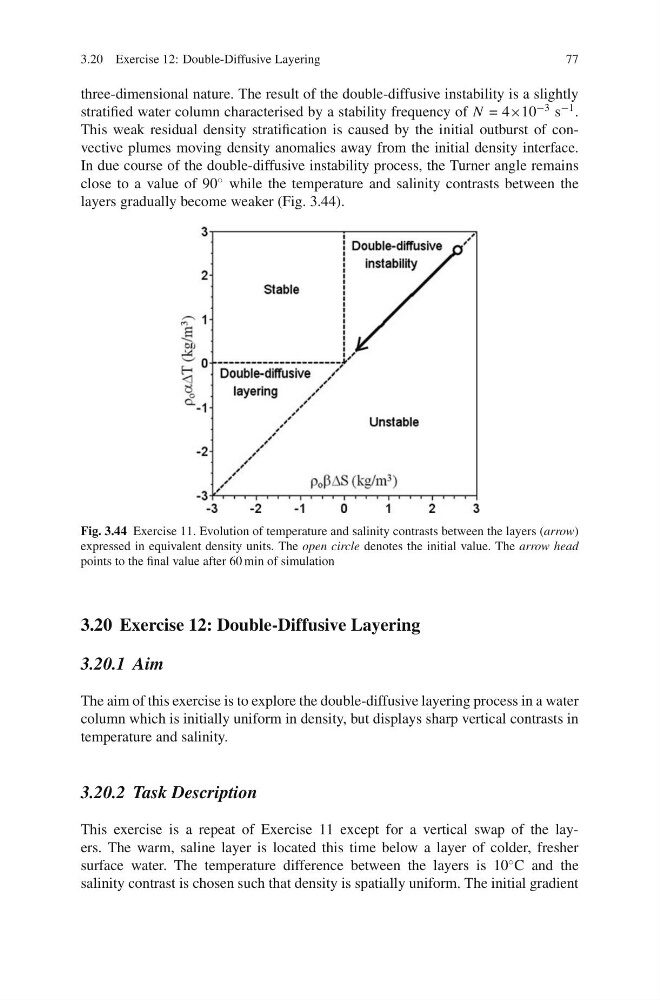
In due course of the double-diffusive instability process, the Turner angle remains
close to a value of 90
◦ while the temperature and salinity contrasts between the
layers gradually become weaker (Fig. 3.44).
Fig. 3.44 Exercise 11. Evolution of temperature and salinity contrasts between the layers (arrow)
expressed in equivalent density units. The open circle denotes the initial value. The arrow head
points to the final value after 60 min of simulation
3.20 Exercise 12: Double-Diffusive Layering
3.20.1 Aim
The aim of this exercise is to explore the double-diffusive layering process in a water
column which is initially uniform in density, but displays sharp vertical contrasts in
temperature and salinity.
3.20.2 Task Description
This exercise is a repeat of Exercise 11 except for a vertical swap of the layers. The warm, saline layer is located this time below a layer of colder, fresher
surface water. The temperature difference between the layers is 10
◦ C and the
salinity contrast is chosen such that density is spatially uniform. The initial gradient
77
three-dimensional nature. The result of the double-diffusive instability is a slightly
stratified water column characterised by a stability frequency of N = 4×10
−3 s
−1 .
This weak residual density stratification is caused by the initial outburst of convective plumes moving density anomalies away from the initial density interface.
In due course of the double-diffusive instability process, the Turner angle remains
close to a value of 90
◦ while the temperature and salinity contrasts between the
layers gradually become weaker (Fig. 3.44).
Fig. 3.44 Exercise 11. Evolution of temperature and salinity contrasts between the layers (arrow)
expressed in equivalent density units. The open circle denotes the initial value. The arrow head
points to the final value after 60 min of simulation
3.20 Exercise 12: Double-Diffusive Layering
3.20.1 Aim
The aim of this exercise is to explore the double-diffusive layering process in a water
column which is initially uniform in density, but displays sharp vertical contrasts in
temperature and salinity.
3.20.2 Task Description
This exercise is a repeat of Exercise 11 except for a vertical swap of the layers. The warm, saline layer is located this time below a layer of colder, fresher
surface water. The temperature difference between the layers is 10
◦ C and the
salinity contrast is chosen such that density is spatially uniform. The initial gradient