

72
3 Basics of Nonhydrostatic Modelling
is also encouraged to add the Lagrangian float prediction scheme to the model code
as another means to track movement of the density-driven plume.
3.18 Double Diffusion
3.18.1 Background
Molecules perform random motions, called Brownian motion (Brown, 1866), in the
absence of turbulence. The result of this motion is a slow but continuous molecular
diffusion which operates to smooth curvature in spatial distributions of a property.
The rate of molecular diffusion of heat is about 100 times that for salt. Hence, molecular diffusion in a water column uniform in density but gradients in temperature and
salinity gives rise to local density variations that can trigger the onset of convection
in the interior of the water column (Turner, 1973). The type of instability that develops depends on the specific shapes of vertical profiles of temperature and salinity
that make up the density stratification.
3.18.2 Double-Diffusive Instability
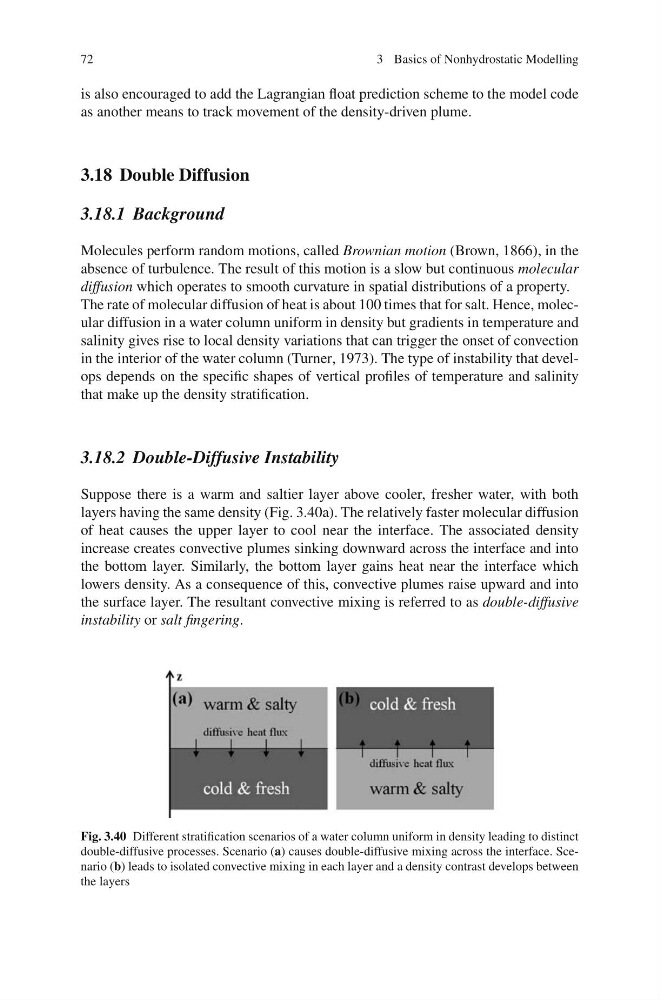
Suppose there is a warm and saltier layer above cooler, fresher water, with both
layers having the same density (Fig. 3.40a). The relatively faster molecular diffusion
of heat causes the upper layer to cool near the interface. The associated density
increase creates convective plumes sinking downward across the interface and into
the bottom layer. Similarly, the bottom layer gains heat near the interface which
lowers density. As a consequence of this, convective plumes raise upward and into
the surface layer. The resultant convective mixing is referred to as double-diffusive
instability or salt fingering.
Fig. 3.40 Different stratification scenarios of a water column uniform in density leading to distinct
double-diffusive processes. Scenario (a) causes double-diffusive mixing across the interface. Scenario (b) leads to isolated convective mixing in each layer and a density contrast develops between
the layers
3 Basics of Nonhydrostatic Modelling
is also encouraged to add the Lagrangian float prediction scheme to the model code
as another means to track movement of the density-driven plume.
3.18 Double Diffusion
3.18.1 Background
Molecules perform random motions, called Brownian motion (Brown, 1866), in the
absence of turbulence. The result of this motion is a slow but continuous molecular
diffusion which operates to smooth curvature in spatial distributions of a property.
The rate of molecular diffusion of heat is about 100 times that for salt. Hence, molecular diffusion in a water column uniform in density but gradients in temperature and
salinity gives rise to local density variations that can trigger the onset of convection
in the interior of the water column (Turner, 1973). The type of instability that develops depends on the specific shapes of vertical profiles of temperature and salinity
that make up the density stratification.
3.18.2 Double-Diffusive Instability
Suppose there is a warm and saltier layer above cooler, fresher water, with both
layers having the same density (Fig. 3.40a). The relatively faster molecular diffusion
of heat causes the upper layer to cool near the interface. The associated density
increase creates convective plumes sinking downward across the interface and into
the bottom layer. Similarly, the bottom layer gains heat near the interface which
lowers density. As a consequence of this, convective plumes raise upward and into
the surface layer. The resultant convective mixing is referred to as double-diffusive
instability or salt fingering.
Fig. 3.40 Different stratification scenarios of a water column uniform in density leading to distinct
double-diffusive processes. Scenario (a) causes double-diffusive mixing across the interface. Scenario (b) leads to isolated convective mixing in each layer and a density contrast develops between
the layers