

3.17 Exercise 10: Slope Convection near the Shore
71
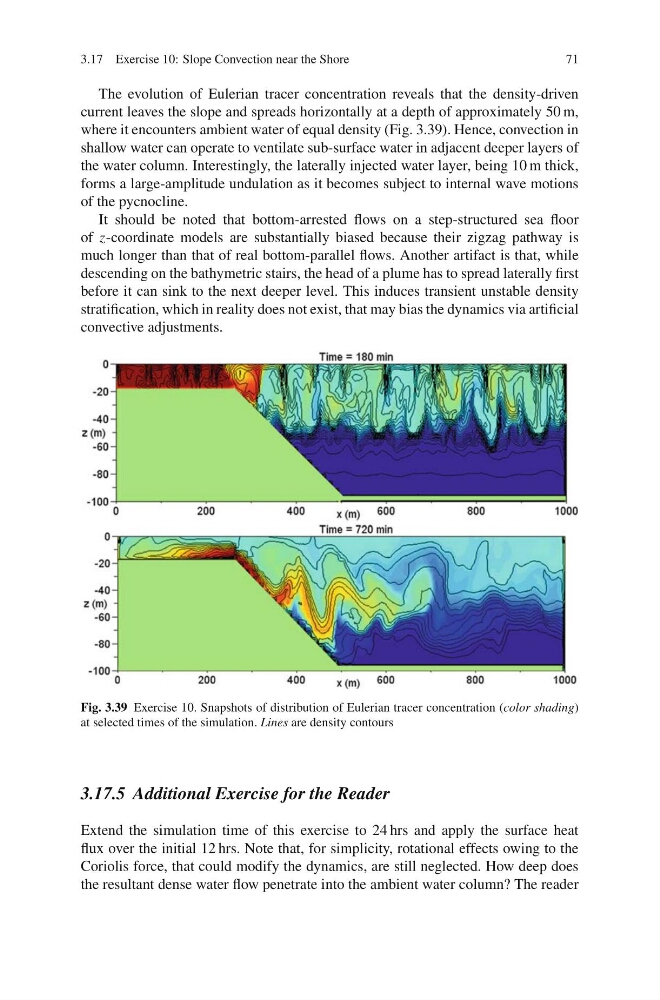
The evolution of Eulerian tracer concentration reveals that the density-driven
current leaves the slope and spreads horizontally at a depth of approximately 50 m,
where it encounters ambient water of equal density (Fig. 3.39). Hence, convection in
shallow water can operate to ventilate sub-surface water in adjacent deeper layers of
the water column. Interestingly, the laterally injected water layer, being 10 m thick,
forms a large-amplitude undulation as it becomes subject to internal wave motions
of the pycnocline.
It should be noted that bottom-arrested flows on a step-structured sea floor
of z-coordinate models are substantially biased because their zigzag pathway is
much longer than that of real bottom-parallel flows. Another artifact is that, while
descending on the bathymetric stairs, the head of a plume has to spread laterally first
before it can sink to the next deeper level. This induces transient unstable density
stratification, which in reality does not exist, that may bias the dynamics via artificial
convective adjustments.
Fig. 3.39 Exercise 10. Snapshots of distribution of Eulerian tracer concentration (color shading)
at selected times of the simulation. Lines are density contours
3.17.5 Additional Exercise for the Reader
Extend the simulation time of this exercise to 24 hrs and apply the surface heat
flux over the initial 12 hrs. Note that, for simplicity, rotational effects owing to the
Coriolis force, that could modify the dynamics, are still neglected. How deep does
the resultant dense water flow penetrate into the ambient water column? The reader
71
The evolution of Eulerian tracer concentration reveals that the density-driven
current leaves the slope and spreads horizontally at a depth of approximately 50 m,
where it encounters ambient water of equal density (Fig. 3.39). Hence, convection in
shallow water can operate to ventilate sub-surface water in adjacent deeper layers of
the water column. Interestingly, the laterally injected water layer, being 10 m thick,
forms a large-amplitude undulation as it becomes subject to internal wave motions
of the pycnocline.
It should be noted that bottom-arrested flows on a step-structured sea floor
of z-coordinate models are substantially biased because their zigzag pathway is
much longer than that of real bottom-parallel flows. Another artifact is that, while
descending on the bathymetric stairs, the head of a plume has to spread laterally first
before it can sink to the next deeper level. This induces transient unstable density
stratification, which in reality does not exist, that may bias the dynamics via artificial
convective adjustments.
Fig. 3.39 Exercise 10. Snapshots of distribution of Eulerian tracer concentration (color shading)
at selected times of the simulation. Lines are density contours
3.17.5 Additional Exercise for the Reader
Extend the simulation time of this exercise to 24 hrs and apply the surface heat
flux over the initial 12 hrs. Note that, for simplicity, rotational effects owing to the
Coriolis force, that could modify the dynamics, are still neglected. How deep does
the resultant dense water flow penetrate into the ambient water column? The reader