

5.11 The El-Ni˜ no Southern Oscillation
161
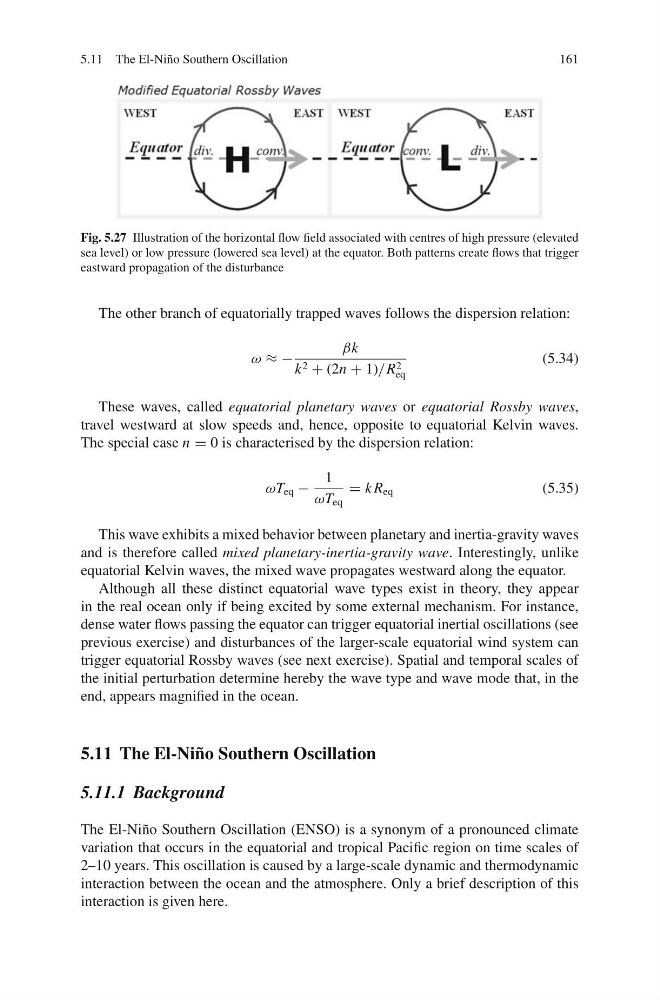
Fig. 5.27 Illustration of the horizontal flow field associated with centres of high pressure (elevated
sea level) or low pressure (lowered sea level) at the equator. Both patterns create flows that trigger
eastward propagation of the disturbance
The other branch of equatorially trapped waves follows the dispersion relation:
ω ≈ −
βk
k 2 + (2n + 1)/R 2
eq
(5.34)
These waves, called equatorial planetary waves or equatorial Rossby waves,
travel westward at slow speeds and, hence, opposite to equatorial Kelvin waves.
The special case n = 0 is characterised by the dispersion relation:
ωT eq −
1
ωT eq
= k R eq
(5.35)
This wave exhibits a mixed behavior between planetary and inertia-gravity waves
and is therefore called mixed planetary-inertia-gravity wave. Interestingly, unlike
equatorial Kelvin waves, the mixed wave propagates westward along the equator.
Although all these distinct equatorial wave types exist in theory, they appear
in the real ocean only if being excited by some external mechanism. For instance,
dense water flows passing the equator can trigger equatorial inertial oscillations (see
previous exercise) and disturbances of the larger-scale equatorial wind system can
trigger equatorial Rossby waves (see next exercise). Spatial and temporal scales of
the initial perturbation determine hereby the wave type and wave mode that, in the
end, appears magnified in the ocean.
5.11 The El-Ni ˜
no Southern Oscillation
5.11.1 Background
The El-Ni˜ no Southern Oscillation (ENSO) is a synonym of a pronounced climate
variation that occurs in the equatorial and tropical Pacific region on time scales of
2–10 years. This oscillation is caused by a large-scale dynamic and thermodynamic
interaction between the ocean and the atmosphere. Only a brief description of this
interaction is given here.
161
Fig. 5.27 Illustration of the horizontal flow field associated with centres of high pressure (elevated
sea level) or low pressure (lowered sea level) at the equator. Both patterns create flows that trigger
eastward propagation of the disturbance
The other branch of equatorially trapped waves follows the dispersion relation:
ω ≈ −
βk
k 2 + (2n + 1)/R 2
eq
(5.34)
These waves, called equatorial planetary waves or equatorial Rossby waves,
travel westward at slow speeds and, hence, opposite to equatorial Kelvin waves.
The special case n = 0 is characterised by the dispersion relation:
ωT eq −
1
ωT eq
= k R eq
(5.35)
This wave exhibits a mixed behavior between planetary and inertia-gravity waves
and is therefore called mixed planetary-inertia-gravity wave. Interestingly, unlike
equatorial Kelvin waves, the mixed wave propagates westward along the equator.
Although all these distinct equatorial wave types exist in theory, they appear
in the real ocean only if being excited by some external mechanism. For instance,
dense water flows passing the equator can trigger equatorial inertial oscillations (see
previous exercise) and disturbances of the larger-scale equatorial wind system can
trigger equatorial Rossby waves (see next exercise). Spatial and temporal scales of
the initial perturbation determine hereby the wave type and wave mode that, in the
end, appears magnified in the ocean.
5.11 The El-Ni ˜
no Southern Oscillation
5.11.1 Background
The El-Ni˜ no Southern Oscillation (ENSO) is a synonym of a pronounced climate
variation that occurs in the equatorial and tropical Pacific region on time scales of
2–10 years. This oscillation is caused by a large-scale dynamic and thermodynamic
interaction between the ocean and the atmosphere. Only a brief description of this
interaction is given here.