

5.5 Exercise 22: Exchange Flow Through a Strait
139
water and to an inflow of surface water from the ambient ocean (Fig. 5.10b). The
Eurafrican Mediterranean Sea, the Red Sea and the Persian Gulf are examples of
concentration basins. The Baltic Sea and the Arctic Ocean are examples of dilution
basins.
The Coriolis force comes into play in this exchange circulation when the width of
the entrance to a mediterranean sea exceeds the internal Rossby radius of deformation. In this situation, geostrophic adjustment triggers a predominantly horizontal
exchange circulation. In additional to this, geostrophic frontal flows often lead to
dynamic instabilities and shedding of eddies, which makes the exchange circulation complex and difficult to predict. On the other hand, relatively narrow entrances
constrain the circulation to a purely vertical overturning circulation.
5.5.3 Task Description
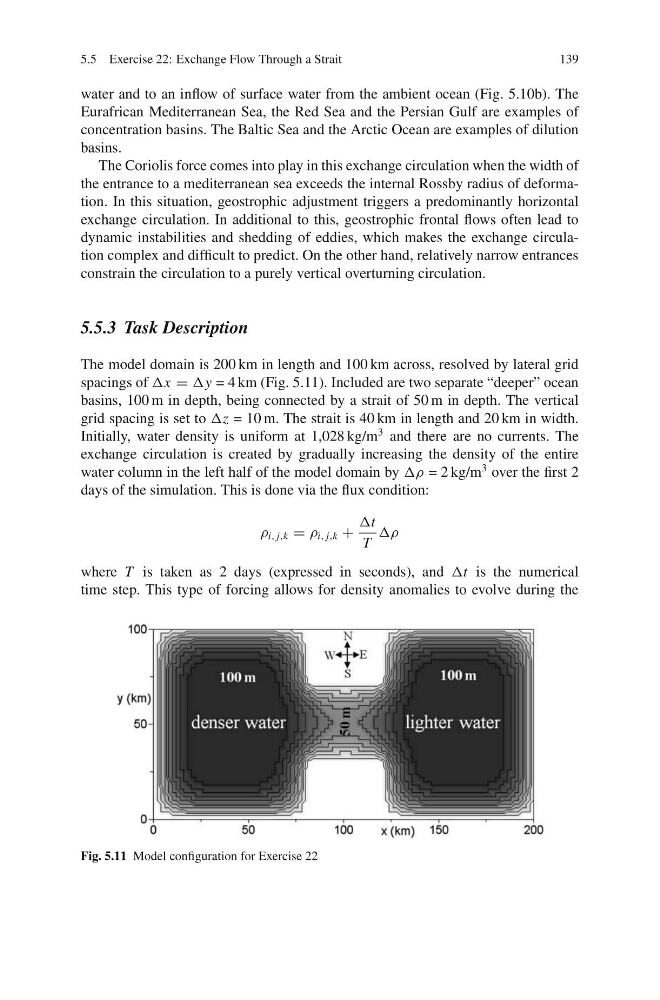
The model domain is 200 km in length and 100 km across, resolved by lateral grid
spacings of Δx = Δy = 4 km (Fig. 5.11). Included are two separate “deeper” ocean
basins, 100 m in depth, being connected by a strait of 50 m in depth. The vertical
grid spacing is set to Δz = 10 m. The strait is 40 km in length and 20 km in width.
Initially, water density is uniform at 1,028 kg/m
3 and there are no currents. The
exchange circulation is created by gradually increasing the density of the entire
water column in the left half of the model domain by Δρ = 2 kg/m
3 over the first 2
days of the simulation. This is done via the flux condition:
ρ i, j,k = ρ i, j,k +
Δt
T
Δρ
where T is taken as 2 days (expressed in seconds), and Δt is the numerical
time step. This type of forcing allows for density anomalies to evolve during the
Fig. 5.11 Model configuration for Exercise 22
139
water and to an inflow of surface water from the ambient ocean (Fig. 5.10b). The
Eurafrican Mediterranean Sea, the Red Sea and the Persian Gulf are examples of
concentration basins. The Baltic Sea and the Arctic Ocean are examples of dilution
basins.
The Coriolis force comes into play in this exchange circulation when the width of
the entrance to a mediterranean sea exceeds the internal Rossby radius of deformation. In this situation, geostrophic adjustment triggers a predominantly horizontal
exchange circulation. In additional to this, geostrophic frontal flows often lead to
dynamic instabilities and shedding of eddies, which makes the exchange circulation complex and difficult to predict. On the other hand, relatively narrow entrances
constrain the circulation to a purely vertical overturning circulation.
5.5.3 Task Description
The model domain is 200 km in length and 100 km across, resolved by lateral grid
spacings of Δx = Δy = 4 km (Fig. 5.11). Included are two separate “deeper” ocean
basins, 100 m in depth, being connected by a strait of 50 m in depth. The vertical
grid spacing is set to Δz = 10 m. The strait is 40 km in length and 20 km in width.
Initially, water density is uniform at 1,028 kg/m
3 and there are no currents. The
exchange circulation is created by gradually increasing the density of the entire
water column in the left half of the model domain by Δρ = 2 kg/m
3 over the first 2
days of the simulation. This is done via the flux condition:
ρ i, j,k = ρ i, j,k +
Δt
T
Δρ
where T is taken as 2 days (expressed in seconds), and Δt is the numerical
time step. This type of forcing allows for density anomalies to evolve during the
Fig. 5.11 Model configuration for Exercise 22