

138
5 3D Level Modelling
5.5.2 Mediterranean Seas
Mediterranean seas are semi-enclosed bodies of water that have a limited exchange
of deep water with the ambient ocean and where the water circulation is dominated
by salinity and temperature differences rather than wind forcing. The exchange with
the adjacent ocean is constrained by a narrow strait often in conjunction with shallower water depth associated with a sill.
Mediterranean seas of the Atlantic Ocean are the Eurafrican Mediterranean Sea
including various sub-seas such as the Adriatic Sea and the Black Sea, the Arctic
Ocean, the American Mediterranean Sea that includes the Gulf of Mexico and the
Carrabian Sea, and the Baltic Sea. Mediterranean seas of the Indian Ocean are the
Persian Gulf and the Red Sea, and the Australasian Mediterranean Sea, including
the Banda, Sulu, Sulawesi and Java Seas, being connected with the Pacific Ocean.
See (Tomczak and Godfrey, 2003) for more details.
Mediterranean seas share characteristics of estuaries, but the latter are generally
much shallower and narrower including gulfs and seaward portions of rivers. Some
scientists including the author prefer to classify the Baltic Sea and the Persian Gulf
as estuaries.
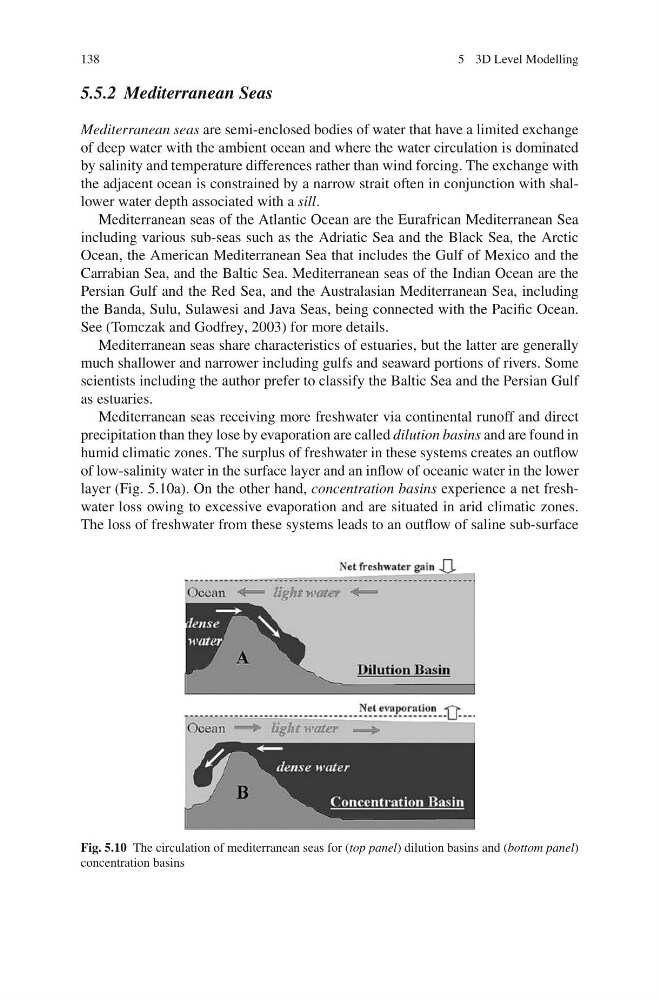
Mediterranean seas receiving more freshwater via continental runoff and direct
precipitation than they lose by evaporation are called dilution basins and are found in
humid climatic zones. The surplus of freshwater in these systems creates an outflow
of low-salinity water in the surface layer and an inflow of oceanic water in the lower
layer (Fig. 5.10a). On the other hand, concentration basins experience a net freshwater loss owing to excessive evaporation and are situated in arid climatic zones.
The loss of freshwater from these systems leads to an outflow of saline sub-surface
Fig. 5.10 The circulation of mediterranean seas for (top panel) dilution basins and (bottom panel)
concentration basins
5 3D Level Modelling
5.5.2 Mediterranean Seas
Mediterranean seas are semi-enclosed bodies of water that have a limited exchange
of deep water with the ambient ocean and where the water circulation is dominated
by salinity and temperature differences rather than wind forcing. The exchange with
the adjacent ocean is constrained by a narrow strait often in conjunction with shallower water depth associated with a sill.
Mediterranean seas of the Atlantic Ocean are the Eurafrican Mediterranean Sea
including various sub-seas such as the Adriatic Sea and the Black Sea, the Arctic
Ocean, the American Mediterranean Sea that includes the Gulf of Mexico and the
Carrabian Sea, and the Baltic Sea. Mediterranean seas of the Indian Ocean are the
Persian Gulf and the Red Sea, and the Australasian Mediterranean Sea, including
the Banda, Sulu, Sulawesi and Java Seas, being connected with the Pacific Ocean.
See (Tomczak and Godfrey, 2003) for more details.
Mediterranean seas share characteristics of estuaries, but the latter are generally
much shallower and narrower including gulfs and seaward portions of rivers. Some
scientists including the author prefer to classify the Baltic Sea and the Persian Gulf
as estuaries.
Mediterranean seas receiving more freshwater via continental runoff and direct
precipitation than they lose by evaporation are called dilution basins and are found in
humid climatic zones. The surplus of freshwater in these systems creates an outflow
of low-salinity water in the surface layer and an inflow of oceanic water in the lower
layer (Fig. 5.10a). On the other hand, concentration basins experience a net freshwater loss owing to excessive evaporation and are situated in arid climatic zones.
The loss of freshwater from these systems leads to an outflow of saline sub-surface
Fig. 5.10 The circulation of mediterranean seas for (top panel) dilution basins and (bottom panel)
concentration basins