

122
4 2.5D Vertical Slice Modelling
wind-stress forcing imposed creates low-amplitude internal waves at the pycnocline.
Baroclinic compensation is evident from the weakening of geostrophic flows below
the pycnocline.
In the real situation and away from the western boundaries of ocean basins, the
divergence of transports in the surface Ekman layer is compensated by a convergence of geostrophic flow owing to meridional variation of the Coriolis parameter;
that is, the so-called β effect. The configuration of this exercise does not reproduce
this balance, known as the Sverdrup balance. Nevertheless, the principal mechanism
inherent with the baroclinic compensation process is the same.
4.6.5 Results: Scenario 2
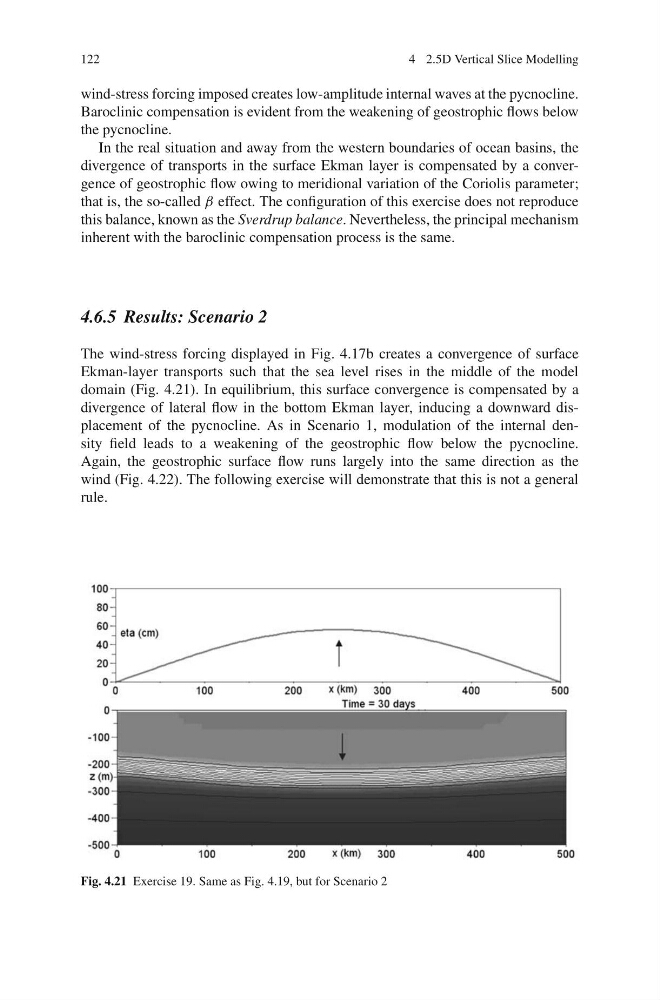
The wind-stress forcing displayed in Fig. 4.17b creates a convergence of surface
Ekman-layer transports such that the sea level rises in the middle of the model
domain (Fig. 4.21). In equilibrium, this surface convergence is compensated by a
divergence of lateral flow in the bottom Ekman layer, inducing a downward displacement of the pycnocline. As in Scenario 1, modulation of the internal density field leads to a weakening of the geostrophic flow below the pycnocline.
Again, the geostrophic surface flow runs largely into the same direction as the
wind (Fig. 4.22). The following exercise will demonstrate that this is not a general
rule.
Fig. 4.21 Exercise 19. Same as Fig. 4.19, but for Scenario 2
4 2.5D Vertical Slice Modelling
wind-stress forcing imposed creates low-amplitude internal waves at the pycnocline.
Baroclinic compensation is evident from the weakening of geostrophic flows below
the pycnocline.
In the real situation and away from the western boundaries of ocean basins, the
divergence of transports in the surface Ekman layer is compensated by a convergence of geostrophic flow owing to meridional variation of the Coriolis parameter;
that is, the so-called β effect. The configuration of this exercise does not reproduce
this balance, known as the Sverdrup balance. Nevertheless, the principal mechanism
inherent with the baroclinic compensation process is the same.
4.6.5 Results: Scenario 2
The wind-stress forcing displayed in Fig. 4.17b creates a convergence of surface
Ekman-layer transports such that the sea level rises in the middle of the model
domain (Fig. 4.21). In equilibrium, this surface convergence is compensated by a
divergence of lateral flow in the bottom Ekman layer, inducing a downward displacement of the pycnocline. As in Scenario 1, modulation of the internal density field leads to a weakening of the geostrophic flow below the pycnocline.
Again, the geostrophic surface flow runs largely into the same direction as the
wind (Fig. 4.22). The following exercise will demonstrate that this is not a general
rule.
Fig. 4.21 Exercise 19. Same as Fig. 4.19, but for Scenario 2