

118
4 2.5D Vertical Slice Modelling
4.6 Exercise 19: Ekman Pumping
4.6.1 Theoretical Background
It is obvious that an equilibrium distribution of sea-level elevation is only possible if
wind-induced flow divergence (convergence) in the surface Ekman layer is balanced
by a flow convergence (divergence) in the ocean underneath. As a consequence of
this, density surfaces in the ocean interior tend to be an amplified mirror image of
the shape of the sea surface. The physical mechanism that converts flow divergence
in the surface Ekman layer to vertical displacements of isopycnals is called Ekman
pumping. Coastal upwelling and downwelling of density interfaces (see previous
exercise) are the signatures of Ekman pumping.
4.6.2 Aim
Divergence of wind-driven flow in the surface Ekman layer is the principle agent to
creating deep-reaching geostrophic flows in the ocean. In a stratified fluid, however,
dynamical adjustment of isopycnals in the ocean interior operates to reduce lateral
pressure gradients such that large-scale geostrophic flows tend to become negligibly
weak below depths of 1,500–2,500 m. The aim of this exercise is to illustrate this
principle of baroclinic compensation using the wind-forced 2.5d vertical ocean-slice
model.
4.6.3 Task Description
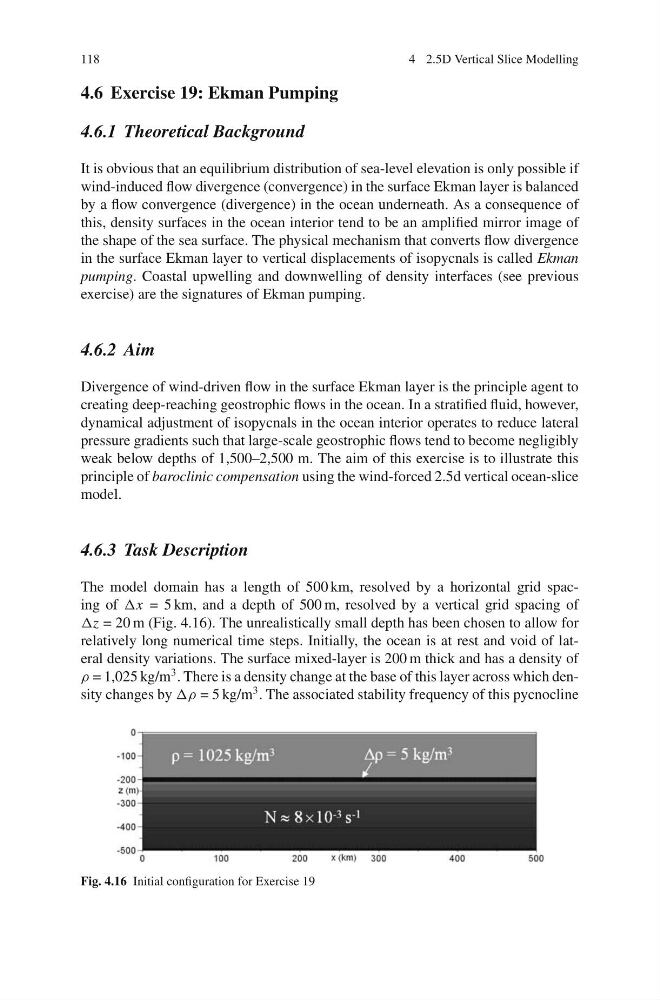
The model domain has a length of 500 km, resolved by a horizontal grid spacing of Δx = 5 km, and a depth of 500 m, resolved by a vertical grid spacing of
Δz = 20 m (Fig. 4.16). The unrealistically small depth has been chosen to allow for
relatively long numerical time steps. Initially, the ocean is at rest and void of lateral density variations. The surface mixed-layer is 200 m thick and has a density of
ρ = 1,025 kg/m
3 . There is a density change at the base of this layer across which density changes by Δρ = 5 kg/m
3 . The associated stability frequency of this pycnocline
Fig. 4.16 Initial configuration for Exercise 19
4 2.5D Vertical Slice Modelling
4.6 Exercise 19: Ekman Pumping
4.6.1 Theoretical Background
It is obvious that an equilibrium distribution of sea-level elevation is only possible if
wind-induced flow divergence (convergence) in the surface Ekman layer is balanced
by a flow convergence (divergence) in the ocean underneath. As a consequence of
this, density surfaces in the ocean interior tend to be an amplified mirror image of
the shape of the sea surface. The physical mechanism that converts flow divergence
in the surface Ekman layer to vertical displacements of isopycnals is called Ekman
pumping. Coastal upwelling and downwelling of density interfaces (see previous
exercise) are the signatures of Ekman pumping.
4.6.2 Aim
Divergence of wind-driven flow in the surface Ekman layer is the principle agent to
creating deep-reaching geostrophic flows in the ocean. In a stratified fluid, however,
dynamical adjustment of isopycnals in the ocean interior operates to reduce lateral
pressure gradients such that large-scale geostrophic flows tend to become negligibly
weak below depths of 1,500–2,500 m. The aim of this exercise is to illustrate this
principle of baroclinic compensation using the wind-forced 2.5d vertical ocean-slice
model.
4.6.3 Task Description
The model domain has a length of 500 km, resolved by a horizontal grid spacing of Δx = 5 km, and a depth of 500 m, resolved by a vertical grid spacing of
Δz = 20 m (Fig. 4.16). The unrealistically small depth has been chosen to allow for
relatively long numerical time steps. Initially, the ocean is at rest and void of lateral density variations. The surface mixed-layer is 200 m thick and has a density of
ρ = 1,025 kg/m
3 . There is a density change at the base of this layer across which density changes by Δρ = 5 kg/m
3 . The associated stability frequency of this pycnocline
Fig. 4.16 Initial configuration for Exercise 19