

4.5 Exercise 18: Coastal Upwelling and Downwelling
115
where c 2 is a free parameter, Δz is vertical grid spacing, and A z,min is a small
background value. The author uses c 2 = 0.15. Additional treatment is required if the
grid spacing chosen does not resolve convective plumes created by unstable density
stratification (N
2
< 0). A conventional approach is to increase turbulence levels to
a certain large value A z,max in such situations. Explicit finite-difference formulation
of the diffusion terms is associated the stability condition:
Δt ≤
(Δz)
2
max(A z )
4.5.4 Results: Upwelling Scenario
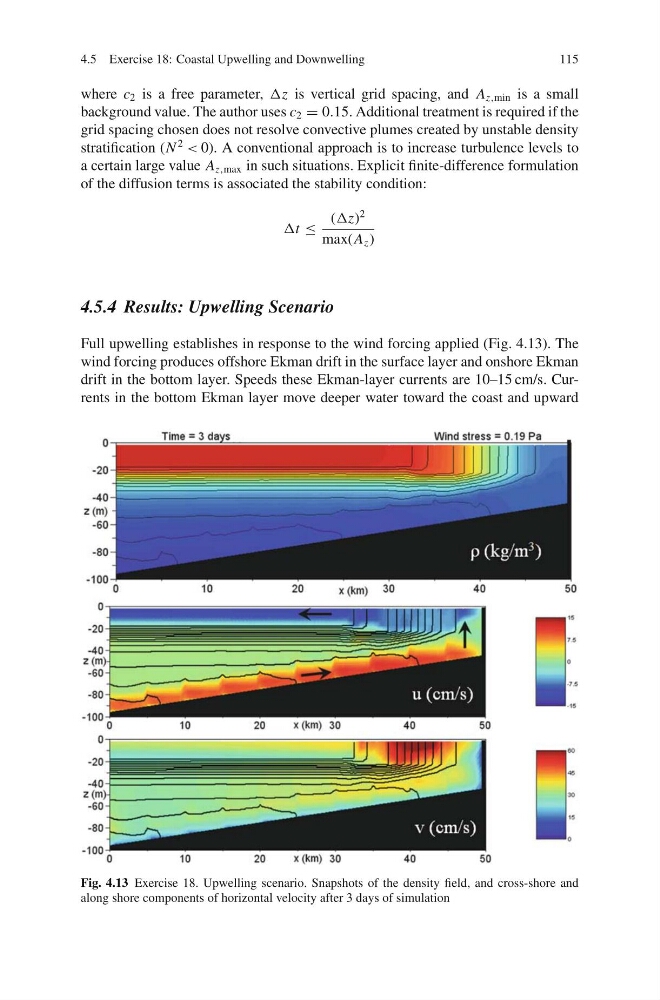
Full upwelling establishes in response to the wind forcing applied (Fig. 4.13). The
wind forcing produces offshore Ekman drift in the surface layer and onshore Ekman
drift in the bottom layer. Speeds these Ekman-layer currents are 10–15 cm/s. Currents in the bottom Ekman layer move deeper water toward the coast and upward
Fig. 4.13 Exercise 18. Upwelling scenario. Snapshots of the density field, and cross-shore and
along shore components of horizontal velocity after 3 days of simulation
115
where c 2 is a free parameter, Δz is vertical grid spacing, and A z,min is a small
background value. The author uses c 2 = 0.15. Additional treatment is required if the
grid spacing chosen does not resolve convective plumes created by unstable density
stratification (N
2
< 0). A conventional approach is to increase turbulence levels to
a certain large value A z,max in such situations. Explicit finite-difference formulation
of the diffusion terms is associated the stability condition:
Δt ≤
(Δz)
2
max(A z )
4.5.4 Results: Upwelling Scenario
Full upwelling establishes in response to the wind forcing applied (Fig. 4.13). The
wind forcing produces offshore Ekman drift in the surface layer and onshore Ekman
drift in the bottom layer. Speeds these Ekman-layer currents are 10–15 cm/s. Currents in the bottom Ekman layer move deeper water toward the coast and upward
Fig. 4.13 Exercise 18. Upwelling scenario. Snapshots of the density field, and cross-shore and
along shore components of horizontal velocity after 3 days of simulation