

112
4 2.5D Vertical Slice Modelling
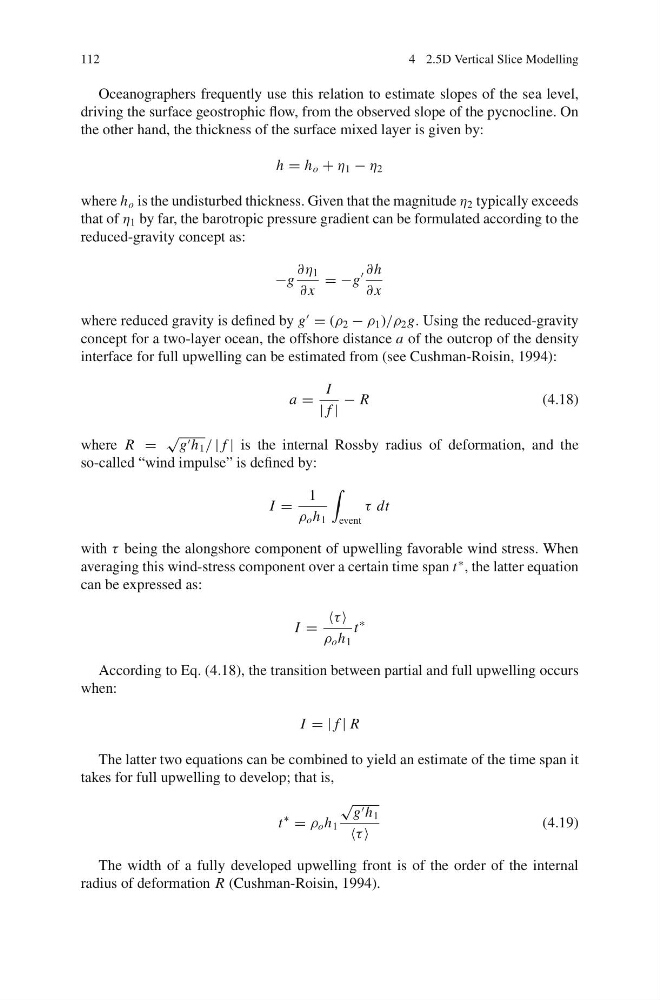
Oceanographers frequently use this relation to estimate slopes of the sea level,
driving the surface geostrophic flow, from the observed slope of the pycnocline. On
the other hand, the thickness of the surface mixed layer is given by:
h = h o + η 1 − η 2
where h o is the undisturbed thickness. Given that the magnitude η 2 typically exceeds
that of η 1 by far, the barotropic pressure gradient can be formulated according to the
reduced-gravity concept as:
−g
∂η 1
∂ x
= −g
∂h
∂ x
where reduced gravity is defined by g
= (ρ 2 − ρ 1 )/ρ 2 g. Using the reduced-gravity
concept for a two-layer ocean, the offshore distance a of the outcrop of the density
interface for full upwelling can be estimated from (see Cushman-Roisin, 1994):
a =
I
| f |
− R
(4.18)
where R =
√
g h 1 / | f | is the internal Rossby radius of deformation, and the
so-called “wind impulse” is defined by:
I =
1
ρ o h 1
event
τ dt
with τ being the alongshore component of upwelling favorable wind stress. When
averaging this wind-stress component over a certain time span t
∗ , the latter equation
can be expressed as:
I =
τ
ρ o h 1
t
∗
According to Eq. (4.18), the transition between partial and full upwelling occurs
when:
I = | f | R
The latter two equations can be combined to yield an estimate of the time span it
takes for full upwelling to develop; that is,
t
∗
= ρ o h 1
√
g h 1
τ
(4.19)
The width of a fully developed upwelling front is of the order of the internal
radius of deformation R (Cushman-Roisin, 1994).
4 2.5D Vertical Slice Modelling
Oceanographers frequently use this relation to estimate slopes of the sea level,
driving the surface geostrophic flow, from the observed slope of the pycnocline. On
the other hand, the thickness of the surface mixed layer is given by:
h = h o + η 1 − η 2
where h o is the undisturbed thickness. Given that the magnitude η 2 typically exceeds
that of η 1 by far, the barotropic pressure gradient can be formulated according to the
reduced-gravity concept as:
−g
∂η 1
∂ x
= −g
∂h
∂ x
where reduced gravity is defined by g
= (ρ 2 − ρ 1 )/ρ 2 g. Using the reduced-gravity
concept for a two-layer ocean, the offshore distance a of the outcrop of the density
interface for full upwelling can be estimated from (see Cushman-Roisin, 1994):
a =
I
| f |
− R
(4.18)
where R =
√
g h 1 / | f | is the internal Rossby radius of deformation, and the
so-called “wind impulse” is defined by:
I =
1
ρ o h 1
event
τ dt
with τ being the alongshore component of upwelling favorable wind stress. When
averaging this wind-stress component over a certain time span t
∗ , the latter equation
can be expressed as:
I =
τ
ρ o h 1
t
∗
According to Eq. (4.18), the transition between partial and full upwelling occurs
when:
I = | f | R
The latter two equations can be combined to yield an estimate of the time span it
takes for full upwelling to develop; that is,
t
∗
= ρ o h 1
√
g h 1
τ
(4.19)
The width of a fully developed upwelling front is of the order of the internal
radius of deformation R (Cushman-Roisin, 1994).