

4.4 Coastal Upwelling
111
4.4.2 How Does It Work?
Coastal upwelling is created by winds blowing along the coast such that the surface Ekman drift is directed offshore. This offshore movement lowers the coastal
sea level and produces a coastal geostrophic jet running into the same direction as
the wind. Friction of this flow with the seabed creates onshore flow in the bottom
Ekman layer and upward movement occurs in vicinity of the coast. The upward tilt
of density surfaces near the coast, however, reduces lateral pressure gradients in the
bottom layer. This partial compensation of the imposed surface pressure field in the
ocean interior, called baroclinic compensation and sometimes referred to as buoyancy shutdown (Chapman, 2002), weakens the geostrophic flow near the bottom and
thus the onshore flow in the bottom Ekman layer.
4.4.3 Partial and Full Upwelling
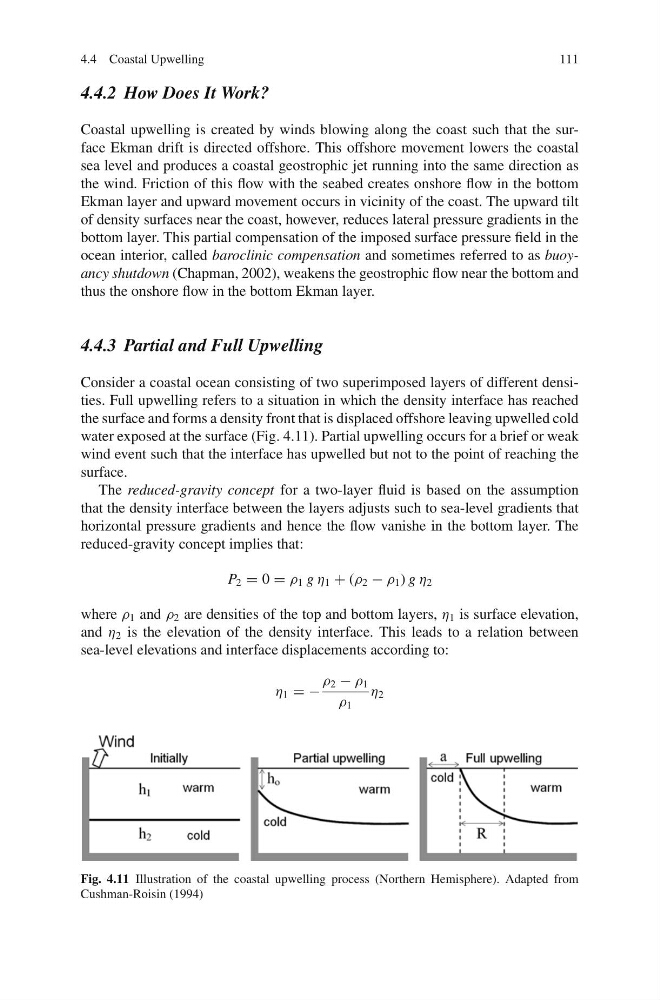
Consider a coastal ocean consisting of two superimposed layers of different densities. Full upwelling refers to a situation in which the density interface has reached
the surface and forms a density front that is displaced offshore leaving upwelled cold
water exposed at the surface (Fig. 4.11). Partial upwelling occurs for a brief or weak
wind event such that the interface has upwelled but not to the point of reaching the
surface.
The reduced-gravity concept for a two-layer fluid is based on the assumption
that the density interface between the layers adjusts such to sea-level gradients that
horizontal pressure gradients and hence the flow vanishe in the bottom layer. The
reduced-gravity concept implies that:
P 2 = 0 = ρ 1 g η 1 + (ρ 2 − ρ 1 ) g η 2
where ρ 1 and ρ 2 are densities of the top and bottom layers, η 1 is surface elevation,
and η 2 is the elevation of the density interface. This leads to a relation between
sea-level elevations and interface displacements according to:
η 1 = −
ρ 2 − ρ 1
ρ 1
η 2
Fig. 4.11 Illustration of the coastal upwelling process (Northern Hemisphere). Adapted from
Cushman-Roisin (1994)
111
4.4.2 How Does It Work?
Coastal upwelling is created by winds blowing along the coast such that the surface Ekman drift is directed offshore. This offshore movement lowers the coastal
sea level and produces a coastal geostrophic jet running into the same direction as
the wind. Friction of this flow with the seabed creates onshore flow in the bottom
Ekman layer and upward movement occurs in vicinity of the coast. The upward tilt
of density surfaces near the coast, however, reduces lateral pressure gradients in the
bottom layer. This partial compensation of the imposed surface pressure field in the
ocean interior, called baroclinic compensation and sometimes referred to as buoyancy shutdown (Chapman, 2002), weakens the geostrophic flow near the bottom and
thus the onshore flow in the bottom Ekman layer.
4.4.3 Partial and Full Upwelling
Consider a coastal ocean consisting of two superimposed layers of different densities. Full upwelling refers to a situation in which the density interface has reached
the surface and forms a density front that is displaced offshore leaving upwelled cold
water exposed at the surface (Fig. 4.11). Partial upwelling occurs for a brief or weak
wind event such that the interface has upwelled but not to the point of reaching the
surface.
The reduced-gravity concept for a two-layer fluid is based on the assumption
that the density interface between the layers adjusts such to sea-level gradients that
horizontal pressure gradients and hence the flow vanishe in the bottom layer. The
reduced-gravity concept implies that:
P 2 = 0 = ρ 1 g η 1 + (ρ 2 − ρ 1 ) g η 2
where ρ 1 and ρ 2 are densities of the top and bottom layers, η 1 is surface elevation,
and η 2 is the elevation of the density interface. This leads to a relation between
sea-level elevations and interface displacements according to:
η 1 = −
ρ 2 − ρ 1
ρ 1
η 2
Fig. 4.11 Illustration of the coastal upwelling process (Northern Hemisphere). Adapted from
Cushman-Roisin (1994)