

3.24 Exercise 14: Positive Estuaries
91
3.24.3 Implementation of Variable Channel Width
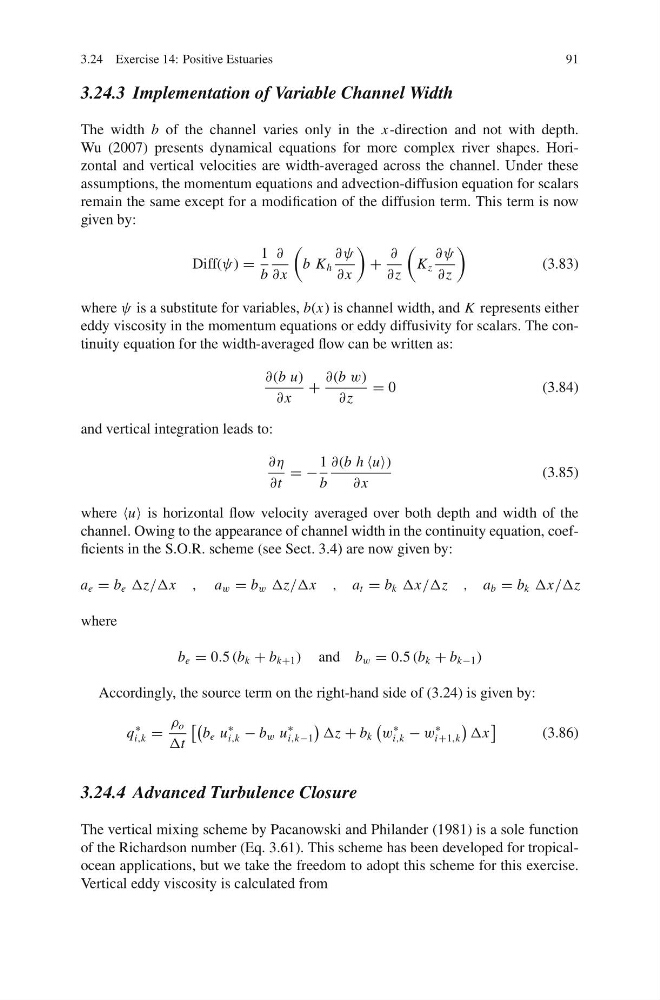
The width b of the channel varies only in the x-direction and not with depth.
Wu (2007) presents dynamical equations for more complex river shapes. Horizontal and vertical velocities are width-averaged across the channel. Under these
assumptions, the momentum equations and advection-diffusion equation for scalars
remain the same except for a modification of the diffusion term. This term is now
given by:
Diff(ψ) =
1
b
∂
∂ x
b K h
∂ψ
∂ x
+
∂
∂z
K z
∂ψ
∂z
(3.83)
where ψ is a substitute for variables, b(x) is channel width, and K represents either
eddy viscosity in the momentum equations or eddy diffusivity for scalars. The continuity equation for the width-averaged flow can be written as:
∂(b u)
∂ x
+
∂(b w)
∂z
= 0
(3.84)
and vertical integration leads to:
∂η
∂t
= −
1
b
∂(b h u)
∂ x
(3.85)
where u is horizontal flow velocity averaged over both depth and width of the
channel. Owing to the appearance of channel width in the continuity equation, coefficients in the S.O.R. scheme (see Sect. 3.4) are now given by:
a e = b e Δz/Δx , a w = b w Δz/Δx , a t = b k Δx/Δz , a b = b k Δx/Δz
where
b e = 0.5 (b k + b k+1 ) and b w = 0.5 (b k + b k−1 )
Accordingly, the source term on the right-hand side of (3.24) is given by:
q
∗
i,k =
ρ o
Δt
b e u
∗
i,k − b w u
∗
i,k−1
Δz + b k
w
∗
i,k − w
∗
i+1,k
Δx
(3.86)
3.24.4 Advanced Turbulence Closure
The vertical mixing scheme by Pacanowski and Philander (1981) is a sole function
of the Richardson number (Eq. 3.61). This scheme has been developed for tropicalocean applications, but we take the freedom to adopt this scheme for this exercise.
Vertical eddy viscosity is calculated from
91
3.24.3 Implementation of Variable Channel Width
The width b of the channel varies only in the x-direction and not with depth.
Wu (2007) presents dynamical equations for more complex river shapes. Horizontal and vertical velocities are width-averaged across the channel. Under these
assumptions, the momentum equations and advection-diffusion equation for scalars
remain the same except for a modification of the diffusion term. This term is now
given by:
Diff(ψ) =
1
b
∂
∂ x
b K h
∂ψ
∂ x
+
∂
∂z
K z
∂ψ
∂z
(3.83)
where ψ is a substitute for variables, b(x) is channel width, and K represents either
eddy viscosity in the momentum equations or eddy diffusivity for scalars. The continuity equation for the width-averaged flow can be written as:
∂(b u)
∂ x
+
∂(b w)
∂z
= 0
(3.84)
and vertical integration leads to:
∂η
∂t
= −
1
b
∂(b h u)
∂ x
(3.85)
where u is horizontal flow velocity averaged over both depth and width of the
channel. Owing to the appearance of channel width in the continuity equation, coefficients in the S.O.R. scheme (see Sect. 3.4) are now given by:
a e = b e Δz/Δx , a w = b w Δz/Δx , a t = b k Δx/Δz , a b = b k Δx/Δz
where
b e = 0.5 (b k + b k+1 ) and b w = 0.5 (b k + b k−1 )
Accordingly, the source term on the right-hand side of (3.24) is given by:
q
∗
i,k =
ρ o
Δt
b e u
∗
i,k − b w u
∗
i,k−1
Δz + b k
w
∗
i,k − w
∗
i+1,k
Δx
(3.86)
3.24.4 Advanced Turbulence Closure
The vertical mixing scheme by Pacanowski and Philander (1981) is a sole function
of the Richardson number (Eq. 3.61). This scheme has been developed for tropicalocean applications, but we take the freedom to adopt this scheme for this exercise.
Vertical eddy viscosity is calculated from