

6.17 Exercise 22: Reduced-Gravity Plumes
165
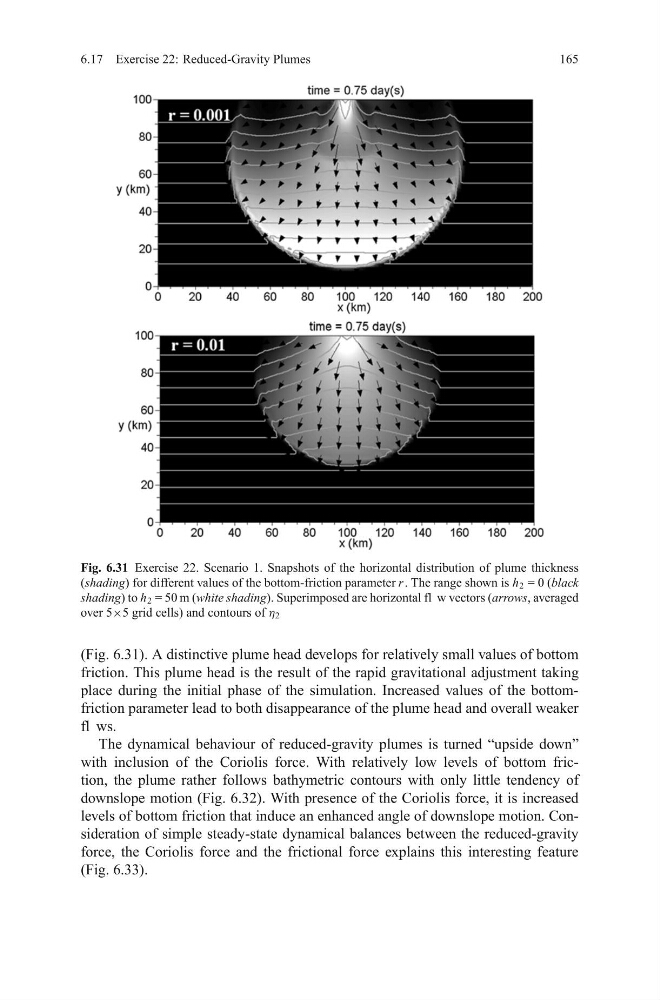
Fig. 6.31 Exercise 22. Scenario 1. Snapshots of the horizontal distribution of plume thickness
(shading) for different values of the bottom-friction parameter r . The range shown is h 2 = 0 (black
shading) to h 2 = 50 m (white shading). Superimposed are horizontal fl w vectors (arrows, averaged
over 5×5 grid cells) and contours of η 2
(Fig. 6.31). A distinctive plume head develops for relatively small values of bottom
friction. This plume head is the result of the rapid gravitational adjustment taking
place during the initial phase of the simulation. Increased values of the bottomfriction parameter lead to both disappearance of the plume head and overall weaker
fl ws.
The dynamical behaviour of reduced-gravity plumes is turned “upside down”
with inclusion of the Coriolis force. With relatively low levels of bottom friction, the plume rather follows bathymetric contours with only little tendency of
downslope motion (Fig. 6.32). With presence of the Coriolis force, it is increased
levels of bottom friction that induce an enhanced angle of downslope motion. Consideration of simple steady-state dynamical balances between the reduced-gravity
force, the Coriolis force and the frictional force explains this interesting feature
(Fig. 6.33).
165
Fig. 6.31 Exercise 22. Scenario 1. Snapshots of the horizontal distribution of plume thickness
(shading) for different values of the bottom-friction parameter r . The range shown is h 2 = 0 (black
shading) to h 2 = 50 m (white shading). Superimposed are horizontal fl w vectors (arrows, averaged
over 5×5 grid cells) and contours of η 2
(Fig. 6.31). A distinctive plume head develops for relatively small values of bottom
friction. This plume head is the result of the rapid gravitational adjustment taking
place during the initial phase of the simulation. Increased values of the bottomfriction parameter lead to both disappearance of the plume head and overall weaker
fl ws.
The dynamical behaviour of reduced-gravity plumes is turned “upside down”
with inclusion of the Coriolis force. With relatively low levels of bottom friction, the plume rather follows bathymetric contours with only little tendency of
downslope motion (Fig. 6.32). With presence of the Coriolis force, it is increased
levels of bottom friction that induce an enhanced angle of downslope motion. Consideration of simple steady-state dynamical balances between the reduced-gravity
force, the Coriolis force and the frictional force explains this interesting feature
(Fig. 6.33).