

156
6 Rotational Effects
and a radius of 15 km (see Fig. 6.20). The ambient ocean has a density of 1028 km
m
−3
. The Coriolis parameter is set to f = 1×10
−4
s
−1
. The task is to employ the
two-layer shallow-water model to simulate the geostrophic adjustment process over
5 days with horizontal grid spacings of Δx = Δy = 1 km. The time step is set to
Δt = 2 s. After (6.68), the expected width of the frontal zone can be estimated at
about 10 km. The horizontal grid spacing chosen just resolves this scale.
This exercise ignores wind-stress-forcing, the nonlinear terms, and horizontal
and vertical friction. All lateral boundaries are kept open using zero-gradient conditions for all variables. To avoid the appearance of unwanted gravity waves and inertial oscillations, the density anomaly in the surface layer is slowly linearly adjusted
from zero to its fina value over the firs 2 days of the simulation. Non-buoyant
Lagrangian float are included to visualise the resultant fl w paths.
6.13.3 Results
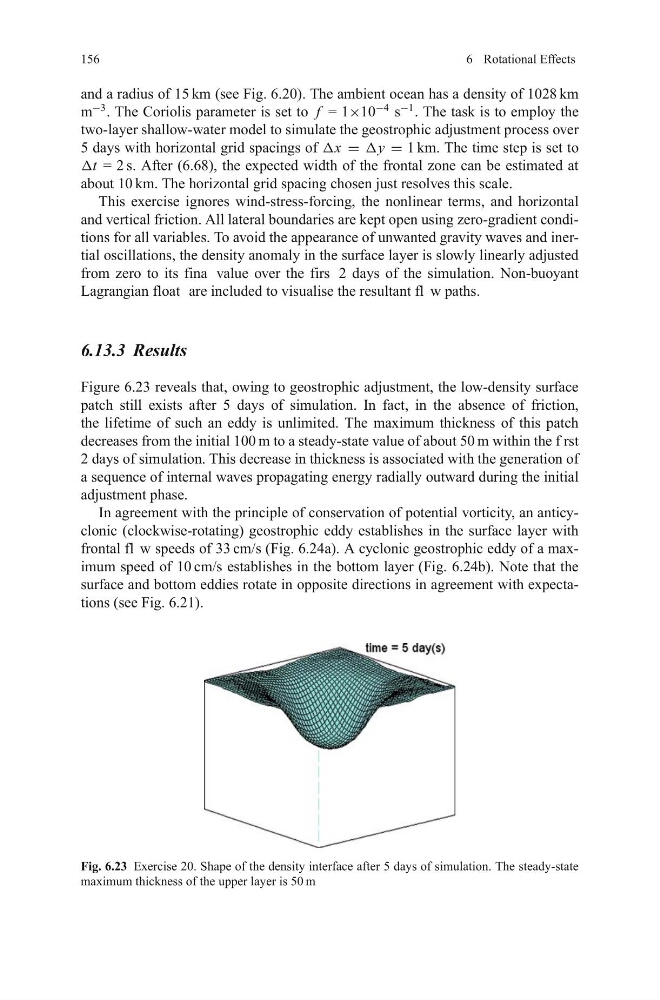
Figure 6.23 reveals that, owing to geostrophic adjustment, the low-density surface
patch still exists after 5 days of simulation. In fact, in the absence of friction,
the lifetime of such an eddy is unlimited. The maximum thickness of this patch
decreases from the initial 100 m to a steady-state value of about 50 m within the f rst
2 days of simulation. This decrease in thickness is associated with the generation of
a sequence of internal waves propagating energy radially outward during the initial
adjustment phase.
In agreement with the principle of conservation of potential vorticity, an anticyclonic (clockwise-rotating) geostrophic eddy establishes in the surface layer with
frontal fl w speeds of 33 cm/s (Fig. 6.24a). A cyclonic geostrophic eddy of a maximum speed of 10 cm/s establishes in the bottom layer (Fig. 6.24b). Note that the
surface and bottom eddies rotate in opposite directions in agreement with expectations (see Fig. 6.21).
Fig. 6.23 Exercise 20. Shape of the density interface after 5 days of simulation. The steady-state
maximum thickness of the upper layer is 50 m
6 Rotational Effects
and a radius of 15 km (see Fig. 6.20). The ambient ocean has a density of 1028 km
m
−3
. The Coriolis parameter is set to f = 1×10
−4
s
−1
. The task is to employ the
two-layer shallow-water model to simulate the geostrophic adjustment process over
5 days with horizontal grid spacings of Δx = Δy = 1 km. The time step is set to
Δt = 2 s. After (6.68), the expected width of the frontal zone can be estimated at
about 10 km. The horizontal grid spacing chosen just resolves this scale.
This exercise ignores wind-stress-forcing, the nonlinear terms, and horizontal
and vertical friction. All lateral boundaries are kept open using zero-gradient conditions for all variables. To avoid the appearance of unwanted gravity waves and inertial oscillations, the density anomaly in the surface layer is slowly linearly adjusted
from zero to its fina value over the firs 2 days of the simulation. Non-buoyant
Lagrangian float are included to visualise the resultant fl w paths.
6.13.3 Results
Figure 6.23 reveals that, owing to geostrophic adjustment, the low-density surface
patch still exists after 5 days of simulation. In fact, in the absence of friction,
the lifetime of such an eddy is unlimited. The maximum thickness of this patch
decreases from the initial 100 m to a steady-state value of about 50 m within the f rst
2 days of simulation. This decrease in thickness is associated with the generation of
a sequence of internal waves propagating energy radially outward during the initial
adjustment phase.
In agreement with the principle of conservation of potential vorticity, an anticyclonic (clockwise-rotating) geostrophic eddy establishes in the surface layer with
frontal fl w speeds of 33 cm/s (Fig. 6.24a). A cyclonic geostrophic eddy of a maximum speed of 10 cm/s establishes in the bottom layer (Fig. 6.24b). Note that the
surface and bottom eddies rotate in opposite directions in agreement with expectations (see Fig. 6.21).
Fig. 6.23 Exercise 20. Shape of the density interface after 5 days of simulation. The steady-state
maximum thickness of the upper layer is 50 m