

6.12 Geostrophic Adjustment of a Density Front
153
6.12.3 Theory
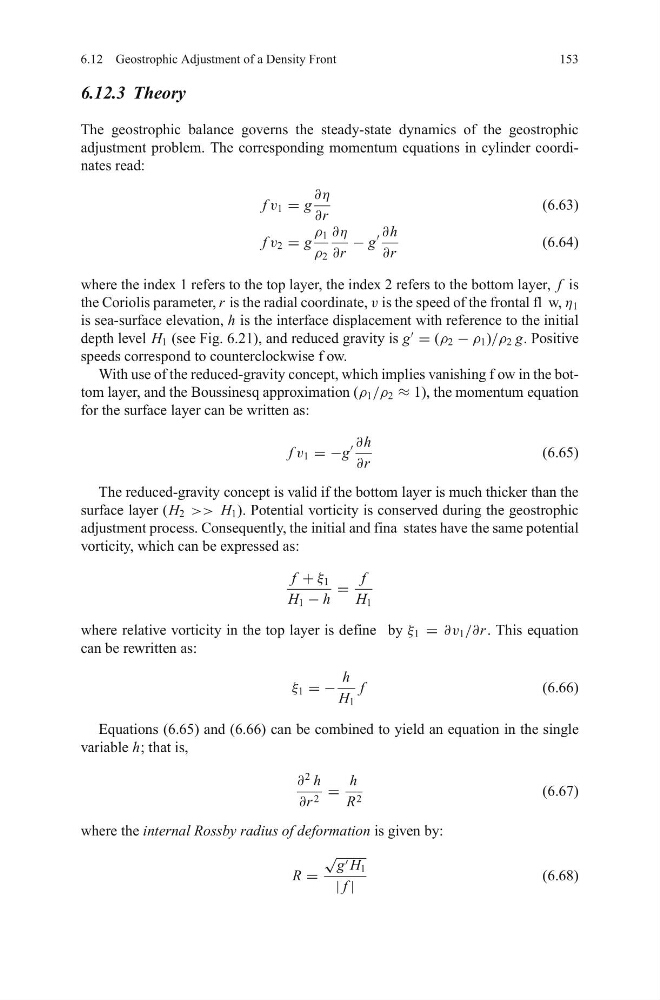
The geostrophic balance governs the steady-state dynamics of the geostrophic
adjustment problem. The corresponding momentum equations in cylinder coordinates read:
f v 1 = g
∂η
∂r
(6.63)
f v 2 = g
ρ 1
ρ 2
∂η
∂r
− g
∂h
∂r
(6.64)
where the index 1 refers to the top layer, the index 2 refers to the bottom layer, f is
the Coriolis parameter, r is the radial coordinate, v is the speed of the frontal fl w, η 1
is sea-surface elevation, h is the interface displacement with reference to the initial
depth level H 1 (see Fig. 6.21), and reduced gravity is g
= (ρ 2 − ρ 1 )/ρ 2 g. Positive
speeds correspond to counterclockwise f ow.
With use of the reduced-gravity concept, which implies vanishing f ow in the bottom layer, and the Boussinesq approximation (ρ 1 /ρ 2 ≈ 1), the momentum equation
for the surface layer can be written as:
f v 1 = −g
∂h
∂r
(6.65)
The reduced-gravity concept is valid if the bottom layer is much thicker than the
surface layer (H 2 >> H 1 ). Potential vorticity is conserved during the geostrophic
adjustment process. Consequently, the initial and fina states have the same potential
vorticity, which can be expressed as:
f + ξ 1
H 1 − h
=
f
H 1
where relative vorticity in the top layer is define by ξ 1 = ∂v 1 /∂r . This equation
can be rewritten as:
ξ 1 = −
h
H 1
f
(6.66)
Equations (6.65) and (6.66) can be combined to yield an equation in the single
variable h; that is,
∂
2
h
∂r 2 =
h
R 2
(6.67)
where the internal Rossby radius of deformation is given by:
R =
√ g H 1
| f |
(6.68)
153
6.12.3 Theory
The geostrophic balance governs the steady-state dynamics of the geostrophic
adjustment problem. The corresponding momentum equations in cylinder coordinates read:
f v 1 = g
∂η
∂r
(6.63)
f v 2 = g
ρ 1
ρ 2
∂η
∂r
− g
∂h
∂r
(6.64)
where the index 1 refers to the top layer, the index 2 refers to the bottom layer, f is
the Coriolis parameter, r is the radial coordinate, v is the speed of the frontal fl w, η 1
is sea-surface elevation, h is the interface displacement with reference to the initial
depth level H 1 (see Fig. 6.21), and reduced gravity is g
= (ρ 2 − ρ 1 )/ρ 2 g. Positive
speeds correspond to counterclockwise f ow.
With use of the reduced-gravity concept, which implies vanishing f ow in the bottom layer, and the Boussinesq approximation (ρ 1 /ρ 2 ≈ 1), the momentum equation
for the surface layer can be written as:
f v 1 = −g
∂h
∂r
(6.65)
The reduced-gravity concept is valid if the bottom layer is much thicker than the
surface layer (H 2 >> H 1 ). Potential vorticity is conserved during the geostrophic
adjustment process. Consequently, the initial and fina states have the same potential
vorticity, which can be expressed as:
f + ξ 1
H 1 − h
=
f
H 1
where relative vorticity in the top layer is define by ξ 1 = ∂v 1 /∂r . This equation
can be rewritten as:
ξ 1 = −
h
H 1
f
(6.66)
Equations (6.65) and (6.66) can be combined to yield an equation in the single
variable h; that is,
∂
2
h
∂r 2 =
h
R 2
(6.67)
where the internal Rossby radius of deformation is given by:
R =
√ g H 1
| f |
(6.68)