

6.11 The Reduced-Gravity Concept
149
6.10.4 Results
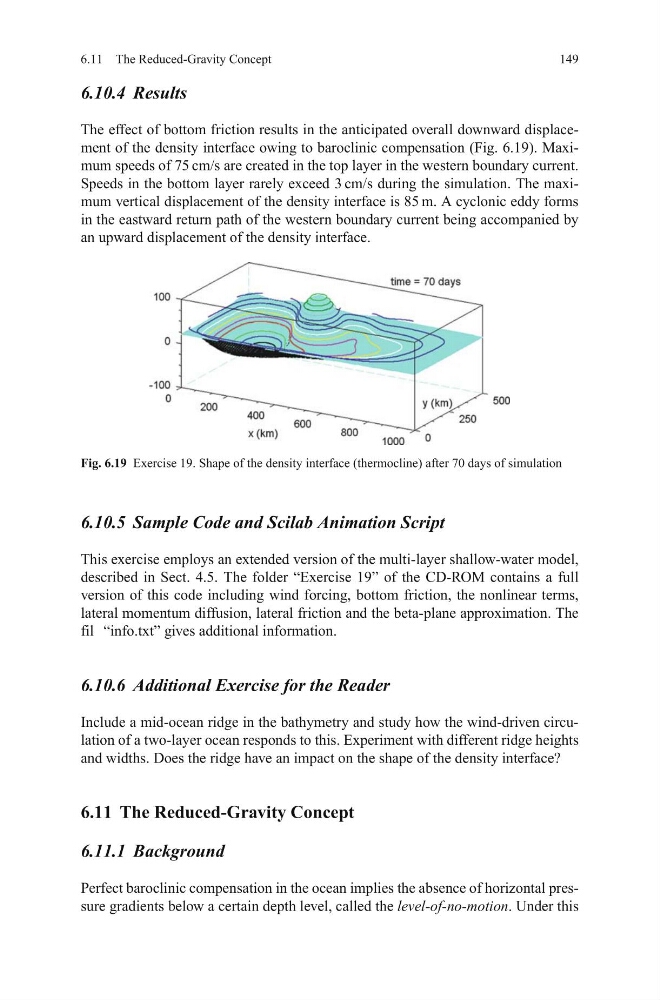
The effect of bottom friction results in the anticipated overall downward displacement of the density interface owing to baroclinic compensation (Fig. 6.19). Maximum speeds of 75 cm/s are created in the top layer in the western boundary current.
Speeds in the bottom layer rarely exceed 3 cm/s during the simulation. The maximum vertical displacement of the density interface is 85 m. A cyclonic eddy forms
in the eastward return path of the western boundary current being accompanied by
an upward displacement of the density interface.
Fig. 6.19 Exercise 19. Shape of the density interface (thermocline) after 70 days of simulation
6.10.5 Sample Code and Scilab Animation Script
This exercise employs an extended version of the multi-layer shallow-water model,
described in Sect. 4.5. The folder “Exercise 19” of the CD-ROM contains a full
version of this code including wind forcing, bottom friction, the nonlinear terms,
lateral momentum diffusion, lateral friction and the beta-plane approximation. The
fil “info.txt” gives additional information.
6.10.6 Additional Exercise for the Reader
Include a mid-ocean ridge in the bathymetry and study how the wind-driven circulation of a two-layer ocean responds to this. Experiment with different ridge heights
and widths. Does the ridge have an impact on the shape of the density interface?
6.11 The Reduced-Gravity Concept
6.11.1 Background
Perfect baroclinic compensation in the ocean implies the absence of horizontal pressure gradients below a certain depth level, called the level-of-no-motion. Under this
149
6.10.4 Results
The effect of bottom friction results in the anticipated overall downward displacement of the density interface owing to baroclinic compensation (Fig. 6.19). Maximum speeds of 75 cm/s are created in the top layer in the western boundary current.
Speeds in the bottom layer rarely exceed 3 cm/s during the simulation. The maximum vertical displacement of the density interface is 85 m. A cyclonic eddy forms
in the eastward return path of the western boundary current being accompanied by
an upward displacement of the density interface.
Fig. 6.19 Exercise 19. Shape of the density interface (thermocline) after 70 days of simulation
6.10.5 Sample Code and Scilab Animation Script
This exercise employs an extended version of the multi-layer shallow-water model,
described in Sect. 4.5. The folder “Exercise 19” of the CD-ROM contains a full
version of this code including wind forcing, bottom friction, the nonlinear terms,
lateral momentum diffusion, lateral friction and the beta-plane approximation. The
fil “info.txt” gives additional information.
6.10.6 Additional Exercise for the Reader
Include a mid-ocean ridge in the bathymetry and study how the wind-driven circulation of a two-layer ocean responds to this. Experiment with different ridge heights
and widths. Does the ridge have an impact on the shape of the density interface?
6.11 The Reduced-Gravity Concept
6.11.1 Background
Perfect baroclinic compensation in the ocean implies the absence of horizontal pressure gradients below a certain depth level, called the level-of-no-motion. Under this